
Well, after a year of Gov. Wes Moore cajoling lawmakers, a special legislation session and a state Supreme Court decision, Maryland is poised to redraw its congressional maps to hand Democrats an 8-0 advantage.
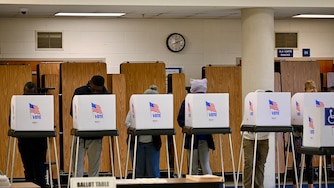
Voters on Tuesday overwhelmingly passed Question 3, a ballot question that amends the state constitution to permit more forms of partisan gerrymandering. Democrats already enjoy a 7-1 advantage, but what’s one more among a uni-party state that enjoys a supermajority in the legislature?
What happens now?
Nothing. At least not yet. Question 3 does not automatically mean Maryland will have new congressional districts. It means the legislature can pass a new map. And that still might be contentious.
Why would it be contentious?
Great question. In this year’s legislative session, the House of Delegates overwhelmingly approved a new map likely to give Democrats an 8-0 advantage.
But the districts were wonky, and would’ve caused some issues with Maryland’s current congressional Democrats. For example, Rep. Sarah Elfreth, currently in the 3rd District entirely on the western side of the Chesapeake Bay, would have been in the 1st District under that map. That would put her in a race against Rep. Andy Harris, Maryland’s lone Republican, who represents the entirety of the Eastern Shore.
And Baltimore, mostly contained in Rep. Kweisi Mfume’s 7th District now, would have been sliced into three districts. Under that map, the 7th District would have 54% of its voters from Baltimore compared to its current 72%. Urban neighborhoods would share a district with rural counties.
None of these issues ever reared its head because the House’s proposal, despite its robust support in that chamber and Moore’s backing, didn’t get a vote in the Senate.
The Senate wouldn’t vote?
Some in the state Senate, most notably Senate President Bill Ferguson, worried that without a constitutional change, more gerrymandered districts would get struck down by the courts.
The last time Maryland redistricted, the courts rejected the General Assembly’s map, which caused a big stink. Eager not to repeat that mistake, Ferguson came out three months before the legislative session started to effectively say, ‘This isn’t happening,’ beating Moore to the punch.
And it didn’t matter that Rep. Hakeem Jeffries, who is now likely to become Speaker of the House, came to Annapolis to tell Ferguson otherwise. Or that Moore was going on TV all the time to pressure him. Or that Moore was calling senators to try to force a vote.
Ferguson wasn’t going to budge. Until he did.
Why’d he budge?
It’s kind of a long story, but it all changed when the Supreme Court struck down a key provision of the Voting Rights Act. That, in Ferguson’s words, changed everything. All of a sudden, changing the state constitution was on the table.
One thing led to another, and, by August, there was a special session, and Question 3 was on the ballot.
So, about that new map — would my representative change?
Maybe? It’s hard to say and is entirely dependent on where you live. If you live in Montgomery County and are repped by Jamie Raskin, probably not. If Johnny Olszewski Jr. is your representative, a change would be more likely.
Again, and this can’t be stressed enough, it’s entirely up to the legislature how the lines will be drawn. They will have to draw a new map and approve it, and that process usually involves soliciting public input, even if it doesn’t require listening to that input.
It’s also entirely possible that, depending on how the potential districts are drawn, some current members of Maryland’s congressional delegation could decide not to run again.
How soon could a new map get passed?
Potentially as soon as January, when the General Assembly gavels back into session. But as mentioned above, any new map could be contentious. And the next round of elections isn’t until 2028, so lawmakers have until that year to approve one.



Comments
Welcome to The Banner's subscriber-only commenting community. Please review our community guidelines.