
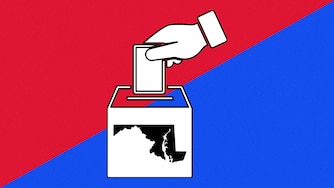
Voters across the Old Line State are headed to the polls today to determine whether the General Assembly should be given more latitude in drawing Maryland’s congressional maps in favor of Democrats.
The proposal, known as Question 3, is a Democratic-backed ballot initiative that would change the state constitution, eroding some protections against partisan gerrymandering. Maryland’s map already hands Democrats a 7-1 advantage, but should Question 3 pass, it would lay the groundwork to create an 8-0 map ahead of the 2028 election. National Democrats have pushed for partisan redistricting to combat similar efforts in Republican-led states as both parties vie for long-term control of Congress.
In Maryland, Republicans like gubernatorial nominee Dan Cox, former Gov. Larry Hogan and Rep. Andy Harris, Maryland’s lone GOPer at the federal level, have all vehemently opposed Question 3.
Cox argued the measure would hurt unaffiliated voters as much as it would hurt Republicans, given that only registered party members can vote in primary elections. Of the roughly 4.3 million registered voters in Maryland, nearly a quarter are unaffiliated.
“It is wrong to take away the voices of the people,” Cox said at a news conference last month.
Key Democrats, like Gov. Wes Moore, have said Question 3 is necessary to fight Republican overreach, specifically that of President Donald Trump.
“Question 3 is our way of pushing back,” Moore said. “Question 3 is our way of saying that Donald Trump does not get to control elections, the people of Maryland do.”
Moore, widely seen as having 2028 presidential ambitions, has sought to turn Maryland’s election map into an 8-0 sweep for Democrats. The highs and lows of this effort have tested Moore’s relationship with state legislators and his ability as a party leader, featuring a last-ditch effort to sway public opinion by getting former President Barack Obama to cut a TV ad.
Getting one’s state to join the fight served as an early litmus test for Democrats eyeing a presidential run, such as California Gov. Gavin Newsom, who led his party’s effort there.
But Moore has met roadblocks at several key junctures. In an October 2025 letter, state Senate President Bill Ferguson, a Baltimore Democrat, outlined his opposition to the proposal and declared that the Senate would not support it. Midcycle redistricting would likely be struck down by the courts, Ferguson and others argued, and Maryland already had a fairly gerrymandered map.
Ferguson held strong through early this year, even after the House of Delegates overwhelmingly approved Moore’s proposal. Moore staffers, perhaps in an act of political gamesmanship, were among the first donors to Ferguson’s primary challenger’s campaign. At one point, U.S. Rep. Hakeem Jeffries, the Democratic leader in the House, came to Annapolis to try to sway Ferguson.
The stalemate became so bitter that Moore rescinded a planned endorsement of Ferguson ahead of the June primary.

But when the U.S. Supreme Court in May gutted most of the Voting Rights Act, something flipped.
Suddenly, Ferguson and other Democratic opponents were ready to consider the proposal. In August, the legislature met in a special session to place Question 3, which would amend Maryland’s constitution and hopefully insulate future redistricting from legal challenges, on the ballot.
Even with all the high-profile support, the success of Question 3 has never been assured. Redistricting is not a priority for most Democratic voters, polls have shown, and some are flat-out opposed to further partisan mapmaking. In a late September poll, a majority of respondents said they would vote against the ballot measure.
Both sides have fought hard to cement their status, sometimes through sleight of hand. A Republican strategist engineered a TV ad that told voters to vote “yes for Wes” but “against Question 3.”
Moore’s campaign, facing token opposition from Republican nominee Dan Cox, shifted its media budget of more than $1.2 million in the final days of the campaign cycle to boost Question 3. That advertising buy included the Obama commercial.
Banner reporter Pamela Wood contributed to this story.


Comments
Welcome to The Banner's subscriber-only commenting community. Please review our community guidelines.