
With thousands of ballots left to count, Maryland appears on track to match some of its strongest voter turnout numbers of the last three election cycles, preliminary state data shows.
Early results tallied from Maryland’s race for governor, which incumbent Gov. Wes Moore won handily on Tuesday, show that the state has already counted more than 1.86 million ballots, with provisional and mail-in votes still left to tally, according to the Maryland State Board of Elections. That could put the governor in a position to post numbers similar to what he earned when he first ran four years ago, when he took home more than 1.2 million votes.
Initial returns show that Maryland voters, even with a relatively safe incumbent at the top of the ticket this year, remained engaged amid broader national pushback against President Donald Trump and the Republican-controlled U.S. Congress.
The so-called “blue tsunami,” in which Democrats won majorities in the U.S. House of Representatives and the U.S. Senate, could change the trajectory of Trump’s next two years as he confronts more resistance to his agenda, cabinet nominees and judicial appointments.
Trump told reporters Tuesday night that he looked forward to working with the Democrats.
State elections data shows that early-voting totals in Tuesday’s race exceed those from 2022 by almost 60%, or about 220,000 votes — which could reflect a shift in how voters prefer to cast ballots following the COVID-19 pandemic. Yet those totals so far lag behind Trump’s last midterm in 2018, which experts say is a more useful, though still imperfect, comparison. Early-voting levels may never return to prepandemic volumes now that voters have more options for casting ballots by mail.
In-person Election Day numbers, meanwhile, also show higher turnout in the governor’s race than four years ago but, so far, less than in 2018. That year, incumbent Gov. Larry Hogan, a Republican, defeated Democratic challenger Ben Jealous in what was hailed at the time as a “purple wave.”
Experts who study elections said that while it’s too soon to draw conclusions, Maryland’s results demonstrate strong voter enthusiasm.
“The numbers are going to continue going up by 10 days, and provisional ballots have barely been touched yet,” said Alysoun McLaughlin, director of the Election Resilience Lab at the University of Maryland’s Center for Democracy and Civic Engagement.
Provisional ballots in past years have comprised as much as 5% of the total vote, she said. Those votes, as well as other mail-in ballots, are likely to lean Democratic.
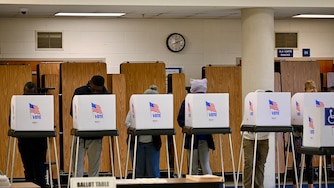
In some parts of the state, Election Day voters encountered long lines and delays, suggesting that some local officials may not have been prepared to meet the demand.
A last-minute complaint filed by the NAACP and the League of Women Voters Maryland alleged that the Prince George’s County Board of Elections failed to deliver ballots to one polling location in Laurel on time and that voting equipment there didn’t work. A judge rejected the complaint.

McLaughlin said those problems might also indicate a need for Maryland elections officials to invest more in technology or staffing at specific voting locations.
Once challenges in high-turnout elections start happening, she said, “it’s hard to recover.”
On Tuesday, voters across Maryland said they were motivated to send a message of repudiation to Washington, D.C., and to restore a sense of balance to a national government led by one party since Trump’s successful reelection bid in 2024.
Outside polling locations across the state, they spoke of affordability challenges at home, wariness about conflicts abroad, and fatigue with a style of leadership in the White House that several said had distracted from kitchen-table issues.
Many voters also said they wanted to participate in local contests, including the statewide ballot question that effectively asked for voters’ approval to redraw congressional districts. The measure, known as Question 3, passed overwhelmingly.

That could make for a future leadership shake-up on Maryland’s Eastern Shore, where the state’s lone Republican member of Congress, Rep. Andy Harris, defeated challenger Dan Schwartz for a ninth term. Early-voting figures posted from that race show increased participation from 2022, though slightly less than in 2018.
Early-voting numbers also increased in Maryland’s 5th Congressional District, where newcomer Adrian Boafo, a longtime staffer to U.S. Rep. Steny Hoyer, succeeded his former boss in the first wide-open contest since Hoyer took office in 1981. That race, along with the District 3 contest that sent Democratic Rep. Sarah Elfreth back to Congress for a second term, posted higher early-voting totals than in the last two gubernatorial contests.



Comments
Welcome to The Banner's subscriber-only commenting community. Please review our community guidelines.