
At first, Denise Day told her grandnephew to think of running and hiding from the cops like a game.
After they lost their house in a fire last year, they treated homelessness like an extended summer vacation. Weeks later, when Tristan King leaped from a caseworker’s car the day he was set to enter foster care, police declared him missing. Evading them became part of the fun.
But summer vacations don’t last forever and 9-year-olds aren’t meant to live like fugitives. The fun had run out long before police found the pair in Curtis Bay on March 13.
A Banner investigation into Tristan’s case outraged the public, revealing how he’d been failed by the school system that unenrolled him, the child welfare agency that lost him, and the police officers who mistakenly closed his case. Gov. Wes Moore and Baltimore Mayor Brandon Scott pledged to hold those agencies accountable.
Months later, Day is the only adult who has publicly faced consequences for what happened to Tristan. Police arrested Day, 60, on abduction charges. She spent a month in jail only for the case to be dropped. Baltimore’s top prosecutor said the pair’s love for one another influenced his thinking — a conviction would have made reunification unlikely.
In a series of interviews with reporters, Day revealed how a would-be third grader and a woman with a drug addiction managed to scrape by for as long as they did. Staying one step ahead of authorities was thrilling for the street-smart boy. But as fall turned to winter and the pressure to find Tristan ratcheted up, Day said his mental health unraveled. Toward the end of their time on the lam, she remembered him crying at night because he feared being separated.
Read More
Day said she worried about him and knew he was unwell. She could “see it in his eyes.” So she soothed him as best she could, with false promises of a future together, one with a home and a yard, a full fridge and a PlayStation, and even friends who would come over.
Still, she balked at the idea that she should have turned Tristan over to the Maryland Department of Human Services, the same agency whose employee didn’t stop him from running into six lanes of traffic.
“I had him for eight years, you had him for a day and lost him,” Day said she once told Tristan’s social worker. “Who can take better care of him, me or you?”
Day longs to be with Tristan again. She called him her child and said they’d shared a bedroom for as long as she could remember.
The state placed Tristan in a therapeutic foster home in Prince George’s County in March. Child privacy laws prevent officials from sharing information about him, but a picture posted on Facebook in September by his mother, absent for most of his life, shows the now-10-year-old healthy and smiling. She wrote that she was working toward reunification.
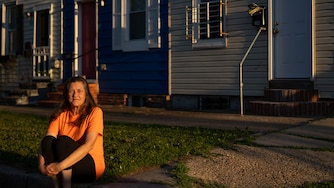
After getting out of jail, Day went back to the same blocks where she and Tristan hid. She stayed for several weeks in an abandoned house, one without lights or running water. She had no phone and got by on charity. Yet when it came to her and Tristan, she said she wouldn’t have done anything differently.
“I’d do it again,” she said.

‘I knew it was him’
For much of his life, Tristan lived in a rowhome south of the Hanover Street Bridge in Baltimore’s Brooklyn neighborhood with Day and his grandmother, Donna White. He called White his Nana and Day his Nene (pronounced “knee-knee”).
That house on Horton Avenue burned down in July 2025, but their lives became tumultuous long before.
Child Protective Services visited the home the year before to check on Tristan, and the family struggled to make ends meet. In May 2025, White, Day’s sister and Tristan’s legal guardian, had a stroke that landed her in a nursing home.
After the fire, Day and Tristan slept in a tent in the alley behind their home. Several weeks later, Day connected with Department of Human Services workers who helped them check into the Americas Best Value Inn on the city’s eastern edge. The state paid for the room. They had a roof, clean clothes and a moment to breathe. The respite lasted just 11 days.
Day experienced opioid withdrawal symptoms so severe she felt she could no longer care for Tristan. She turned him over to the Department of Human Services on Sept. 23.
“I was deathly sick,” Day said.
She took a bus back to Brooklyn, and a caseworker whisked Tristan away. Day hoped she’d see him again soon.
She got her wish. The next morning, on the way to a hearing that likely would have landed him in foster care, Tristan ran home, yelling out as he went. She heard him before she saw him.
“I knew it was him,” Day said. She resolved not to give Tristan up again. Police declared him missing that day.

By October, they’d gone back to living behind the Horton Avenue home, and it wasn’t long before social workers, police and at least one relative tried to collect Tristan. But the pair had a routine for these incursions. Day would tell Tristan to run, and he would weave through Brooklyn’s alleys, disappear, and then reappear at their meeting place: a tagless red Ford Escape parked behind a house a few blocks away. When things got tougher, they would sometimes sleep in it.
They also found refuge on neighbors’ couches or in their basements. A few times, they spent the night in an abandoned house.
Day hadn’t always led a life this unstable.
In her 30s, she was married to a firefighter and owned a bar called The French Quarter. She had two sons, and her friends saw her as both a caring mother and a smart, no-nonsense business owner. Then Day began using heroin — she told a court official after her arrest that she had a two-decade-long opioid addiction and suffered from depression and anxiety.
However, she maintains her drug use didn’t affect her ability to care for Tristan.
“I’m not some piece-of-s--t junkie,” she said. “I know how to take care of a child.”

To maintain a sense of normalcy while hiding out, Tristan went to the park or rode bikes, and Day rented DVDs from the neighborhood library branch. They watched “Deadpool” and “Star Trek” together; Day watched “The Wire” but wouldn’t show Tristan. She said she was heartbroken when Bodie and Poot shot and killed Wallace at the end of the first season.
Day wasn’t caring for Tristan by herself that fall. A man named Anthony “Tony” Scardina was helping her. He dated Tristan’s grandmother, and after her stroke, he started seeing Day. Tristan called him PawPaw, and the three of them often stayed together. They relied on food stamps to eat. Scardina, like Day, had a drug addiction. He acknowledged Tristan’s situation was not ideal, but said he and Day had done their best to care for him.
“I’m no angel. But I’m no bad guy, either,” Scardina said.
Tristan, previously diagnosed with oppositional defiant disorder and other behavioral conditions, had stopped taking his prescribed medications. Day said she weaned him off them without consulting a doctor because she thought they made him tired and loopy. To calm his outbursts, the boy instead smoked weed, a habit Day said she allowed but didn’t encourage.

He had not been in school for months. Baltimore City Public Schools unenrolled Tristan after he didn’t show up to the second grade for two consecutive weeks. Even before police declared Tristan missing, neither Day nor Scardina made an effort to send him back to class.
School staff offered to help reenroll him, but Day declined. Though staff says they told her otherwise, she would later say she thought she needed proof of residence.
“I couldn’t put him in school until I had an address,” Day said.
‘It’s not gonna end good, Ma’
Once December arrived, the authorities’ search for Tristan had become so passive that Day thought her running and hiding had paid off.
Day remembered that officers who saw her in the neighborhood would ask how her nephew was doing, and she would usually reply with a smile and a thumbs-up. The missing-persons detectives assigned to Tristan’s case mistook a court order and closed his case for almost a month before they noticed their error.
At the same time, the child welfare workers assigned to Tristan were showing up in the neighborhood less often, interviews and records show.
Scott, Baltimore’s mayor, would later say everyone could’ve done their jobs better. His office said in a statement that police had reviewed Tristan’s case and identified opportunities for improvement.
The Department of Human Services made several changes to its internal policies in August in response to Tristan’s case. The department established a statewide youth services coordinator responsible for overseeing cases when children go missing from under its supervision, and officials said they strengthened communication with local law enforcement agencies, among other changes.
Even Derek Hadaway, Day’s adult son who sometimes stayed with her and Tristan, understood the pair couldn’t run forever. He said in an interview earlier this year that he had told her as much.
“It’s not gonna end good, Ma,” Hadaway, who died in September, recalled warning his mother. “It’s not gonna end good.”
People who knew that Tristan was listed as missing had started noticing him wandering Brooklyn during school hours, often by himself in oversized clothes and no coat. Some of them would call police to report sightings, only for Tristan to slip away before the cops showed up. Others pleaded with authorities to do something, worried he could freeze to death during one of the city’s coldest winters on record.
By January, after months of inaction, authorities were suddenly everywhere. The Banner had started asking questions about Tristan’s case. Detectives were knocking on the doors of houses where Tristan and Day used to sleep some nights.
At the end of that month, Day and Tristan moved into a Maude Avenue house where people came and went at all hours. Scardina, who was in and out of the picture at this time, said the home was filthy and that Tristan struggled there. He loved being clean and often wanted to shower multiple times a day.
Not long after, United States Marshals showed up in the neighborhood at the request of Baltimore Police and began asking about Tristan’s whereabouts.
Desperate to buy more time, Day devised a plan for them to leave Brooklyn. It would keep him out of foster care a little longer, but it would also rip him away from the only neighborhood he’d known. She executed her plan on Feb. 5, having arranged for a car to pick her and Tristan up at the end of an iced-over alley. Day wouldn’t identify the driver, but she joked they had a plan to hide the 90-pound boy in a black garbage bag and pretend to take him out like trash.
“I just got a feeling,” she said of the decision to leave that night. “I got him out of there.”
Her hunch was prescient. The next morning, at the break of dawn, marshals kicked in the door of the house where they’d been staying.
‘Stay with me’
The place they landed was, as Day described it, a “glorified bando,” slang for an abandoned house.
The second-floor apartment in Curtis Bay, an industrial neighborhood at Baltimore’s southern tip, had no working fridge, stove or oven. The kitchen faucet was the only working tap, and it only ran cold. Day would microwave water so Tristan could bathe. There was no furniture. They slept in sleeping bags.

Tristan was really suffering now, Day said. He had become paranoid and isolated. This new place made it worse. He was only allowed outside after dark, when it was less likely someone could recognize him from the missing-person posters being put up in convenience stores — posters she and Tristan tore down on sight.
Day said Tristan would act tough when they were around other people. But he would cry when they were alone. She would rub his back and tell him to imagine a real home. Maybe it could be somewhere like Locust Point, where she grew up, or across the county line in leafy Brooklyn Park.
“I never knew how to get to that spot,” Day said of the stability she wished she could give him. Instead, she tried to put a hopeful spin on their desperate situation. “I didn’t want to tell him that this was like the hardest thing ever.”
They left that apartment not long after arriving, when the landlord, a man Day and Scardina had done odd jobs for, demanded rent. Day said he wanted $750, which she would not, and could not, pay.
So they went to a house on nearby Filbert Street, across from a church. A guy Day knew let her and Tristan stay in the tiny back bedroom of the second-floor apartment. Day said she cleaned the home, which was full of drug paraphernalia, in exchange for the room.

In the few days Day and Tristan were on Filbert, authorities had begun zeroing in on Curtis Bay, driven by tips.
The Banner published the first news story about Tristan’s case on March 11. White, his grandmother, gave a reporter a message to be read on the evening news, pleading for Tristan to stop running. Police told the public a relative was hiding him.
On March 12, a team of at least seven marshals, heavily armed and carrying a battering ram, went to a house a few blocks down from Tristan and Day’s hiding spot, according to security footage reviewed by The Banner.
“He’s a missing kid,” a marshal told a neighbor next door, who came out to see what was going on. The marshal showed her a picture of Tristan. She didn’t know him.
“We got some information stating that they may be staying in this house,” another marshal said.
That was impossible. That house had been empty for a year, the woman said.

Hours later, city police got an anonymous tip on Tristan’s whereabouts. Court records, interviews and body camera footage reviewed by The Banner piece together what happened next.
Police cars, marked and unmarked, gathered just before 9 a.m. in the parking lot of 7 Star Food Market, three blocks away. The officers drove to a house, where the door had been left unlocked. They filed up the stairs and into the cramped bedroom. There was Tristan, asleep in bed, next to Day. Morning light streamed through the window as the pair woke up.
“Tristan, you’re not in trouble,” the police told him.
The 9-year-old pulled the blanket over his head, trying to hide himself.
“I want you to stay with me,” he told his Nene. She told him to be brave.
The police took Tristan to a hospital to be examined. Others stayed behind to question Day. Detectives had two that were critical:
Did she know Tristan was considered missing?
“Yes,” she said.
And did she know police were looking for him?
She did. “For a long time.”




Comments
Welcome to The Banner's subscriber-only commenting community. Please review our community guidelines.