
Join the huddle. Sign up here for Ravens updates in your inbox.
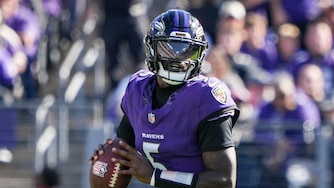
One week ago, reporters were watching Lamar Jackson’s ankle during practice, wondering if the two-time MVP would be healthy enough to take back the reins from veteran backup Tyler Huntley and salvage the season.
On Tuesday, the Ravens practiced with two quarterbacks they’ve signed since Monday — Austin Reed and Kedon Slovis — and announced that undrafted rookie Joe Fagnano’s ankle is just healthy enough for him to make his first career start.
It’s ugly in Baltimore.
With Jackson out for at least a month and Huntley reportedly out for the year with turf toe, the Ravens don’t appear to have a credible solution to guide them through the rest of the year — especially if Jackson’s injury is season-ending.
The questions facing this franchise are, frankly, a bit overwhelming.
Read More
Columnist Kyle Goon and NFL reporter Giana Han take a look at the biggest ones: what the Ravens should do at quarterback, how they should manage their roster, and if tanking is a viable option for a historically competitive franchise.
Kyle Goon: Giana, you’ve seen how this team plays without Lamar in two- or three-week stretches over the last two seasons, but this latest injury could be longer. If the Ravens are looking for a quarterback to trade for or sign off the free agent market, what kind of traits does he need to have?
Giana Han: If you make a trade, you’re going to want someone that can hold things together enough that Jackson has a chance to work a miracle at the end of the season. One of the beauties of Huntley is that he has a similar playing style to Jackson’s. Declan Doyle can scheme around different types of quarterbacks, but it would make the transition smoother if the quarterback could make plays with his legs.
With the way the offensive line has been struggling, the Ravens’ quarterback needs to get the ball out quickly for his own preservation. NFL game experience would be nice, too, with the ability to throw on time and target. He doesn’t have to do anything fancy, just operate the offense.
Can you think of anyone who fits this list — or at least enough of it?
KG: Very few guys floating out there meet these criteria. Our colleague Jonas Shaffer put together a thorough breakdown of guys who might be available. The most desirable is probably Tyson Bagent of the Chicago Bears, who has previous experience with Doyle. But he’s not particularly mobile, and he has three times as many career interceptions (9) as touchdowns.
I get fearful thinking about getting 38-year-old Case Keenum in a trade, because if he pulls a hamstring or some comparable old man injury, the Ravens are back in the same spot (yes, I include Bengals QB Joe Flacco in that group, too).
The most intriguing backups to me — caretaker types who have experience — are pretty entrenched behind injury-prone quarterbacks. Think Marcus Mariota in Washington, Carson Wentz in Minnesota, or Andy Dalton in Atlanta. Those teams would be reluctant to part with these guys because they need them for insurance. And as far as free agents go, the Ravens already know Cooper Rush ain’t it.
If the Ravens keep rolling with Fagnano or one of these less-inspiring interim options, are they trying to win? Or is this now an opportunity to tank for a better draft pick in the spring?
GH: What I think they should do and what they will do are very different. I don’t know if it’s in the Ravens’ DNA to tank General manager Eric DeCosta’s job security and whether owner Steve Bisciotti is pressuring him to win now will help determine his approach.
But I don’t think you’re going to get very far with any of the quarterbacks you could reasonably get without giving up serious draft capital. DeCosta doesn’t typically like to part ways with picks, and I don’t think he should in this scenario. I think the Ravens should keep their picks and have the opportunity to pick higher in the 2027 Draft.
It’s also the better way to prepare for the uncertainty surrounding the Ravens’ future with Jackson going into the final year of his contract. That way, if Jackson isn’t here next season, you can start building the future. And if he is, you can invest in more help for him.
That seems the most logical to me, but what do you see as the downside to tanking?
KG: You got to the heart of it. Is it in Baltimore’s DNA to tank?
The most visible difference in atmosphere this Thursday will probably be people punting on their tickets, preferring not to watch the Ravens get stomped in a game that stretches past 11 p.m. on a school night. Secondary market tickets are already hitting rock bottom. The fan base is irate — they were hoping for a Super Bowl this year, but the playoffs are already looking out of reach.
Some fans will have the perspective to see that tanking is the Ravens’ best option given their injuries, but plenty of others will tune out or stay away from M&T Bank Stadium. Tanking just doesn’t happen much here. The last time the team picked in the top 10 of the draft was 2016 (Ronnie Stanley) and it was preceded by a painful 5-11 season.
The locker room is another concern. The Ravens have players like Derrick Henry, Calais Campbell, Mark Andrews, Trey Hendrickson and Stanley who are in the later stages of their careers — their time to chase a title is running short. Do they have time or patience to tank? That decision could fracture the veteran leadership of this team, which has already been shaky through the 4-4 start.
Let’s say the Ravens decide they can’t tank for their fans, their vets or rookie head coach Jesse Minter. What are the biggest fixes they have to make in the next month while Jackson is on the injured reserve to stay competitive?
GH: First and foremost, the offensive line needs to get its act together. In addition to keeping the quarterback healthy, it needs to buy him time to go through his reads. And if the offense uses the run game as a crutch, the line needs to do a better job of clearing space for the running backs. Getting Vega Ioane back should help this group find some stability (he practiced in full Tuesday.)
Both defense and special teams need to be more consistent. The defense can help by forcing more turnovers (it has only had eight; only seven teams have had fewer). Special teams can help with field position, and kicker Jake Moody has to show if he can salvage his career by stepping in place of Tyler Loop.
All three phases need to be more disciplined and cut down on the penalties — which they can do, regardless of the quarterback.
If you do decide to sell, though, do you see any potential trade candidates, considering the struggles across all three phases?
KG: I’ve been up and down the roster and see only one: Derrick Henry. Even at 32, Henry is still an effective running back on pace for a 1000-yard season. He’s among the NFL leaders in average time behind the line of scrimmage, largely because the offensive line isn’t creating great lanes for him to break the plane. Teams like Minnesota or Green Bay could use him to bolster their ground games.
Everyone else is either a foundational piece at the start of a big deal (Kyle Hamilton, Zay Flowers) or an aging vet who is probably too expensive (Roquan Smith, Marlon Humphrey, Mark Andrews) to move. Maybe linebacker Trenton Simpson’s improved fourth season could generate a bit of interest.
But even for Henry, we’re talking probably a Day 2 pick at the absolute best. As Childs Walker astutely observed, if the Ravens trade Henry, they’ll be searching for a new lead back next year if Jackson returns.
This might be the group that the Ravens are stuck with when the trade deadline hits next Tuesday. That’s the one constant I’ve felt this week while examining Baltimore’s dire situation: Everywhere you look, it feels like the walls are closing in.


Comments
Welcome to The Banner's subscriber-only commenting community. Please review our community guidelines.