
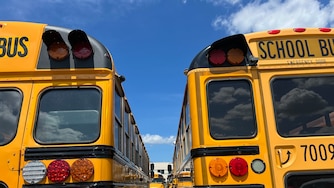
Four years after Prince George’s County Public Schools pledged to transition to an all-electric school bus fleet by 2040, a school board work group is recommending that the district push back its deadline.
The Electric School Bus and Bus Lot Modernization Focus Work Group, established earlier this year and co-chaired by school board members Pamela Boozer-Strother and Aimee Olivo, is recommending that the district stop purchasing or leasing diesel and propane buses after 2035 and complete the transition to electric buses by 2047.
The district has acquired 21 electric buses out of the 1,267 it planned to purchase.
As justification for the proposed delay, the work group cited funding shortages, infrastructure challenges and the difficulty of replacing the nation’s sixth-largest school bus fleet.
The group’s seven recommendations, released Oct. 14 and presented Thursday to the Prince George’s County Board of Education, outline a phased approach to electrifying a fleet that transports approximately 87,000 students along more than 1,000 daily routes. They also call for hiring a permanent transportation director, modernizing bus lots and securing additional funding.
The work group attributed the district’s slow progress partly to rising costs and the loss of federal funding, which it said complicated plans to build a major electric bus charging facility at the Mullikin School Bus Lot in Bowie.
Read More
The facility was originally designed to accommodate 90 electric buses, but financial setbacks prompted the district to pursue charging infrastructure at multiple locations, including its Greenbelt and Crossland bus lots.
The Oct. 14 report also highlighted deteriorating conditions at the district’s 12 bus lots, where mechanics frequently perform repairs outdoors and staff work in aging trailers with inadequate facilities.
The proposed 2047 deadline would allow the district to replace older buses gradually as they reach Maryland’s 12-year service limit, the work group wrote.
Neighboring Montgomery County Public Schools has faced its own setbacks in electrifying its fleet. A 2024 inspector general report found millions of dollars in wasteful spending tied to the district’s $168 million electric bus contract, including buses delivered late or unable to operate. Montgomery County ended the remaining portion of its contract with Highland Electric Fleets in February 2025.
The contract remains tied up in a yearslong legal dispute. Last November, the Maryland State Board of Education overturned the award after finding that two former district transportation officials, who were later convicted of financial misconduct, had tainted the bidding process.
On Wednesday, a Montgomery County Circuit Court judge ruled that Highland should have been allowed to participate in proceedings before the Maryland State Board of Education, sending the case back to the state board.
Still, students and parents who testified before the Prince George’s County school board Thursday emphasized the urgency of reducing diesel pollution, particularly for children with respiratory conditions.
Josue Canales, a 13-year-old student at James Madison Middle School, told board members that he and his siblings have asthma and rely on school buses to get to school.
“For my family, asthma is not just a medical condition,” Canales said. “It can also affect our ability to participate fully in school and enjoy our everyday lives.”
Angeline Diaz, a senior at Bladensburg High School, described how her younger brother’s asthma forced him to give up playing soccer. She said diesel buses regularly travel through her Riverdale Park neighborhood.
“Every student deserves clean air and a healthy environment, regardless of where they live or go to school,” she said. “We should not have to worry about the air we breathe on our way to class or while participating in activities we love.”
Joseph Jakuta, a Mount Rainier council member speaking on behalf of Climate Parents of Prince George’s County, urged the district to adopt the recommendations, appoint a permanent transportation director and publicly report its progress annually.
After hearing from 15 speakers, many of whom addressed climate and transportation concerns, board Chair Brandon Jackson said the electric school bus proposal would return to the board’s agenda in November.


Comments
Welcome to The Banner's subscriber-only commenting community. Please review our community guidelines.