
When Crossland High School student Jordin Worley arrived at a construction site last school year, she faced a big assignment: installing the rafters that would support a house’s roof.
She was the only student to show up that day.
With guidance from her instructors, Worley — then a junior in the school’s carpentry program — calculated angles, cut lumber and installed most of the rafters herself, according to Matthew Davis, a construction coordinator who helped oversee the project.
“She was doing the lion’s share of the work, and we were pushing her a bit,” Davis recalled. “She was always one of the first to jump in and throw in her bags and get to work.”
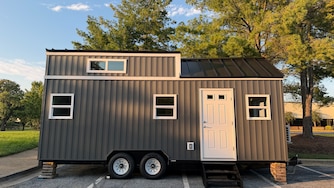
Worley, now a senior, was among roughly 150 Prince George’s County Public Schools students who helped transform an empty trailer into a fully functioning tiny home.
On Sunday, their work will go up for auction.
Read More
The 280-square-foot home, dubbed Homestead 24, has a full kitchen and bathroom, washer and dryer, heating and air conditioning and a sleeping loft. It’s the first tiny home built through the school system’s student-built housing program and the 49th house that students have completed since the program began in 1981.
Bidding starts at $55,000 during a live auction at 2 p.m. Sunday in Upper Marlboro. All proceeds will help finance the program’s next house and support students after graduation.
Learning by building
For students, the experience went beyond building something that could be sold. Their work had to meet construction standards and pass regular inspections.
“This isn’t just for a grade. This isn’t to pass a test,” Davis said. “This is something that someone is going to purchase and live in.”
Students primarily from Crossland and Bladensburg high schools worked in carpentry, electrical, plumbing, heating and air conditioning. They framed walls, installed wiring and plumbing, and finished the interior with cabinets, tile and wood paneling.
They performed about 90% of the construction themselves, Davis said, with contractors handling specialized work, including the metal roof, spray-foam insulation and exterior siding.

That level of hands-on involvement was a departure from the program’s traditional houses, which were often about 3,000 square feet and required more outside professional expertise to finish within a school year. Still, working in tight quarters presented its own set of challenges.
“When you downsize something, it becomes exponentially harder to do because there’s a greater exposure to error,” Davis said.
Construction stretched from November to April, with students making 70 visits to the site around their school schedules. Davis estimated their combined time on the project amounted to about a month and a half of eight-hour workdays.
Even excruciating temperatures didn’t stop them. Davis recalled plumbing students crawling beneath the trailer on cardboard, tarps and blankets to install drainage lines in 20-degree weather.

“The primary goal is to give students real world experience,” said Raynah Adams, who works in the school system’s career and technical education department. “Also, to find a niche for students who may not have found their love in education.”
Nearly 13,100 high schoolers are registered in Career and Technical Education programs across Prince George’s County.
New model, new challenges
The shift to tiny homes wasn’t originally part of the program’s plan, organizers told The Banner.
For decades, students built traditional single-family houses that were sold on the real estate market for hundreds of thousands of dollars. But rising land costs and difficulty finding suitable building lots forced organizers to rethink the model.
“There’s land, and then there’s buildable land,” said Patricia Long, a longtime board member of the Foundation of Applied Construction Technology for Students, or FACTS, the nonprofit that finances the projects.
Long is also the broker-owner of Keller Williams Preferred Properties, the real estate company facilitating Sunday’s auction.
Homestead 24 cost about $62,000 to construct, Adams told The Banner. FACTS purchases construction materials, pays contractors when needed and provides tools and scholarships ranging from $500 to $1,000 to students entering the trades.
Building on wheels allowed the program to continue, but it also introduced a new hurdle: finding a buyer who can legally place the home somewhere.
Under current Prince George’s County zoning rules, tiny homes on wheels cannot be used as permanent primary residences. That means the students’ first tiny home will likely leave the county.
Long hopes the program can eventually return to building homes on permanent foundations, potentially developing a community of 10 to 15 compact houses on surplus county-owned land. She said organizers discussed the possibility with county officials Thursday but have received no commitment.

Long also acknowledged that building tiny homes on wheels isn’t financially sustainable indefinitely. “As cute as this is,” she said, “We have to be able to have real property.”
For now, students are preparing to build the program’s 50th house, another tiny home expected to get underway this month.
Worley will be among those returning to the construction site as one of four student leaders, bringing experience from the house she already helped build.
“I wouldn’t be surprised if this build goes much faster and smoother than last year’s build with an even better end product,” Davis said, “because the learning curve has already been accomplished and gone through.”
Sunday’s event runs from noon to 3 p.m. in Upper Marlboro, with house tours, food trucks, a DJ and a silent auction. The live auction begins at 2 p.m. Bidders can register on-site, and the winner must pay a 5% deposit, with the balance due Oct. 21.



Comments
Welcome to The Banner's subscriber-only commenting community. Please review our community guidelines.