
Baltimore voters seem willing to make a trade when it comes to congressional redistricting: giving Democrats a better chance at control of the House of Representatives in 2028 and beyond, potentially at the cost of some of the city’s influence.
By a seemingly vast margin, Baltimore voters approved Question 3, a ballot measure that lays the groundwork for lawmakers to create new congressional districts that give Democrats a shot at sweeping all eight House seats.
Statewide, about 60% of votes tallied by Wednesday morning supported the measure. More than three-quarters of expected votes in the race were counted across the state by the end of election night, according to estimates from The Associated Press, and about 63% of the city’s votes were tallied.
The approval comes with a catch: Ousting the state’s only Republican in Congress, U.S. Rep. Andy Harris, would mean reallocating voters across the state. And that likely means Baltimore, now largely contained in one district, could be split among several, diluting the power of city voters.
Baltimoreans’ approval of the constitutional amendment reflects their support for Maryland joining the handful of Democratic-led states pursuing midcycle redistricting, said Sam Novey, chief strategist for the University of Maryland’s Center for Democracy and Civic Engagement.
“The extent to which one party or another party is going to control Congress has enormous consequences for federal spending. That has a huge impact on Baltimore,” Novey said.
There’s no guarantee that lawmakers will draw new districts, or what those maps will look like.
But one plan introduced by lawmakers this spring proposed changing the boundaries of the Eastern Shore-based 1st District, represented by Harris. The new lines would have removed voters in Cecil and Harford counties from the district, while adding more Democratic voters in Anne Arundel and Howard counties.
Voters in Harris’ district were unenthusiastic about the proposed amendment. About 62% of votes tallied thus far in the 1st Congressional District opposed Question 3. Nearly a quarter of the votes against the measure came from Harris’ district.
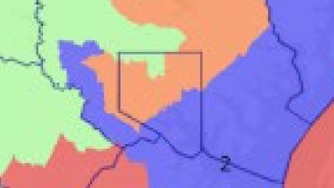
The map put forward earlier this year would split Baltimore voters, most of whom are in Rep. Kweisi Mfume’s 7th District. Some would remain in the 7th District, while a significant number would move into a heavily modified 2nd District that includes portions of Anne Arundel, Baltimore and Harford counties. Another northern slice of the city would move into a reshaped 3rd District stretching from Howard County to Cecil County.
Any gerrymandering resulting from the referendum’s passage could have “enormous implications” for the city, Novey said.
The Question 3 vote marks the end of a bitter year of infighting among Maryland Democrats.
States typically redraw congressional lines once every 10 years to conform with the U.S. census. But Maryland officials began facing pressure from national Democrats last year to redraw the map in the middle of a cycle, after Republican-led states began redistricting at the urging of President Donald Trump to boost their party’s chances during the 2026 midterms.
Two of the state’s three top Democratic leaders — Gov. Wes Moore and then-House Speaker Adrienne A. Jones — quickly supported a gerrymandering effort.
Bill Ferguson, the state Senate president, did not. He represents the 46th District, encompassing communities along the city’s harbor and South Baltimore.

Ferguson’s stand against his own party was driven by a desire to manage risk, according to a letter he wrote to his fellow Senate Democrats last October. The last time Maryland Democrats tried to draw a map more in their favor, a judge ruled they had violated the state constitution — and Ferguson said he didn’t want to risk invalidating Maryland’s current map, under which Democrats hold seven of the state’s eight U.S. House seats.
His stance, however, had softened by the summer of 2026.
And in August, Ferguson and newly minted House Speaker Joseline Peña-Melnyk introduced the constitutional amendment that appeared on Marylanders’ ballots Tuesday.
Voters in Ferguson’s district don’t seem swayed by his initial hesitance: As of Wednesday morning, support for the measure led by roughly 46 points across the precincts he represents.
The resounding statewide backing for the amendment came after several polls prior to Election Day showed it did not have majority support. Political action committees on both sides of the issue spent money to convince voters. One group aired ads urging voters to vote “yes on Wes” — a reference to the governor — but “against Question 3.” A Carroll County man spent $20,000 of his own money to run radio ads against the measure.
“Voters are aware of the national context and willing to do something that they otherwise might not like,” Novey said, “because they feel like it doesn’t make sense for just a couple states to not do this.”




Comments
Welcome to The Banner's subscriber-only commenting community. Please review our community guidelines.