
The community meeting this summer in Baltimore’s Waverly neighborhood turned, as it often does, to the empty storefronts spreading like a plague.
Eric Oberlechner, a leader of the Waverly Improvement Association, grew impatient and grabbed the microphone. “Most of the vacant properties on Greenmount Avenue are owned by one person,” he said.
“His name is Matt Herman. And I feel like we’ve been tiptoeing around him.”
The crowd of about 100 residents and business owners erupted in supportive cheers for Oberlechner. People scanned the room for Herman — a man who chooses not to attend most meetings despite his influence over the community.
He told The Banner later, “They don’t really like me there.”
Read More
The struggles of the Waverly business district well predate Herman’s presence in the community, tracing back to the closure of nearby Memorial Stadium in the 1990s. That frustrates what the community’s boosters — including Herman — see as its untapped potential. Nearby are thriving residential neighborhoods such as Guilford and Charles Village, where the Johns Hopkins University is pumping hundreds of millions of dollars into development.
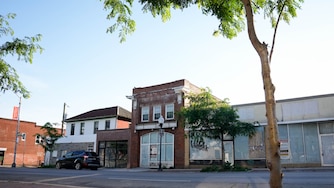
The Waverly Main Street Historic District, which spans Greenmount Avenue between 29th and 35th streets, encapsulates one of Baltimore’s greatest economic challenges: commercial areas beset by chronic empty storefronts and dilapidated buildings.
More than 1 in 4 buildings along this stretch appears to be completely empty, on-the-ground reviews by The Banner found. A single building may contain several storefronts, along with residential space on upper floors.
The city has a difficult time identifying commercial buildings that aren’t fit to occupy — the first step to holding owners accountable through citations and in some cases property seizure.
Code inspectors rely on what they see, such as boarded windows, sagging roofs, and trees and plants growing out through the interior, to make an assessment. But storefronts often have roll-top metal barriers, allowing owners to mask serious problems within, said Eric Booker, deputy commissioner for housing code enforcement and emergency operations.
Baltimore does not track long-term empty storefronts, whereas Washington, D.C., requires all unoccupied buildings to be reported to a citywide registry within 90 days. San Francisco and Portland, Maine, saw drops in commercial vacancy in the last year after implementing penalties for landlords who keep storefronts empty for six months or longer.

Mayor Brandon Scott vowed in 2023 that he would eliminate vacant houses within 15 years, an $8 billion endeavor that Gov. Wes Moore also backed. The effort has reduced the city’s count of uninhabitable vacant buildings 25%, to about 12,000.
About 3.5% of those buildings are commercial, according to Tammy Hawley, a spokesperson for the Baltimore Department of Housing and Community Development. In a review of commercial corridors last year, Baltimore Development Corp. analysts found community members consider far more properties vacant than the city does.
Baltimore’s difficulty in addressing the deterioration of Waverly’s business district has allowed some landlords to buy cheap properties and leave them languishing in neighborhoods starved for investment, community leaders said.
“The area has so much potential, and really there are people who want to come and be business owners here,” said Councilwoman Odette Ramos, who represents the district and convened the June 4 meeting. “And this is the thing that is holding back the neighborhood, no question about it.”

Greenmount life
On Saturdays, 32nd Street and Greenmount Avenue buzzes with life. Diners filter into Pete’s Grille, a community haunt since the 1980s. Cars squeeze onto side streets as people from across the city flood Waverly’s 46-year-old, year-round farmers market. The Baltimore Book Festival and other occasional events liven up the area.
But most days the crowds don’t stick around.
Vacancies make people feel unsafe, said Eduardo Magalhaes, a commercial broker. He said he’s found it easier to connect landlords with tenants downtown and in Federal Hill than in Waverly.
Shera Lynch, who owns Forget Me Not, a small business selling funeral gifts and services on Greenmount Avenue, said it feels as if the vacant stores are “swallowing” her shop. Her space is flanked by two empty buildings. One caught fire in March and the other — a landmark for its purple “Welcome to Waverly” mural — attracts the neighborhood rats, she said.
Yet some newcomers show the promise that Herman and others identified. Jinji’s Chocolate shop, which opened at 3100 Greenmount Ave. in October 2023, got a New York Times write-up just a few months later.

Owner Jinji Fraser said she often gets inquiries from other entrepreneurs wanting to move their businesses to the corridor, but even the shuttered buildings across the street from her store aren’t being leased.
“It’s kinda like that feeling when you walk into a restaurant and they’re like, ‘No, sorry, there’s an hour wait,’ but nobody’s at any of the tables,” she said.
The mythical Matt Herman
Herman’s Barrus Real Estate Group operates out of shared office space in a building one of his LLCs owns at 3028 Greenmount Ave. Herman says he is one of several investors in Greenmount Partners, which owns properties through LLCs, and that Barrus manages the properties.
Across the street is a vacant building that another of those LLCs owns. Herman says the suits he wears in the neighborhood make him stand out, but he also acknowledges he’s made himself scarce in recent years, as community leaders have grown more openly hostile toward him.
Herman’s LLCs own 11 properties on Greenmount Avenue, making him one of the most prolific landlords in the six-block business community, records show. Most of the storefronts at those properties are empty. The portfolio owes the city about $123,000 in unpaid water bills, about 80% of which come from properties the city has deemed uninhabitable.
Herman said his partnership’s properties span nine buildings and that four of them have tenants. He’s in talks to sell most of his portfolio, his spokesperson, Samantha Waranch, said in an email, though she declined to provide further information about those discussions.
The community considers his real estate portfolio an albatross. But Herman feels trapped by vacancies — his own and others, he said.

Herman’s LLCs began buying properties on Greenmount Avenue about a decade ago. He said he chose the area because it’s close to where he lives, near the Hopkins Homewood campus, and because he viewed it as up and coming. Properties there were cheaper than in adjoining neighborhoods, he said.
Waverly, he thought, could pattern itself after other commercial areas in the city that have revived in recent decades. “I really admire what Pigtown’s done,” he said of the commercial district in Southwest Baltimore.
What Waverly needs, he said, are fewer check-cashing counters and smoke shops and more cafés and distinctive retailers — vibrant businesses “worth getting off the bus for.”
“Once a thriving main street and national symbol of city life in America, Waverly is now a downtrodden retail strip full of month-to-month tenants, attracting an undesirable demographic,” Herman’s development group wrote in a 2019 brochure to investors. The group said its goal was to “mass purchase as much property within a five-block strip, and, once under control, shift the demographic through creative restoration of existing retail structures” and the addition of office and apartment space.
The brochure boasted that Johns Hopkins had purchased properties in support of the redevelopment but asked investors to “keep it under wraps.” The university denied that claim and demanded that Herman stop sharing the false material.
Turning the retail strip around has been much harder than Herman anticipated, though he and his investors spent more than $663,000 in 2024 and 2025 on building improvements, property taxes, insurance and repairs, according to his spokesperson.
“I agree with everyone. It should happen quicker,” he said. “It’s a lot of money to carry empty buildings.”
He blamed tripling insurance costs, the inability to secure capital funding and difficulty finding tenants who fulfill his mission to liven up the neighborhood. It often costs more to renovate a commercial space than the owner can make by selling or leasing it, the spokesperson said.
He also said his rocky relationships with former leaders of community groups such as Waverly Main Street and Central Baltimore Partnership have presented hurdles. They’ve stopped helping him find grants, he said.
Ashley Wallace, who leads the partnership, said its employees have spent lots of time helping Herman find resources to redevelop his properties, even though no specific project to do so has materialized.

‘It felt like a scam’
One of Herman’s companies owns 3326 Greenmount Ave., which for more than a decade housed the family-owned Mayflower Chinese Restaurant. It’s been empty for at least five years.
Donna Shi, who helped her parents run the eatery, said that, shortly after they asked for help with leaks in the roof around 2017, Herman pushed her family out. He decided not to renew the lease, the spokesperson said. He sued the restaurant for unpaid rent in Baltimore City Circuit Court and won in 2019.
Mayflower has reopened as a carryout-only business in a Greenmount Avenue building not associated with Herman.
Another former tenant, Jeanelle Spencer, said Herman “preyed on her” in trying to evict her gym, Zehbras Fitness Club, at 3313 Greenmount Ave., a space that now sits empty. She sued him for charging rent without setting up the building’s gas service, among other promised features. She won in Baltimore City Circuit Court in March. Herman appealed in April, and the case is ongoing.
Over time, Herman ran into trouble with some of his investors.
In 2019, investors from the Ethel H. Newcomb and Darrell S. Newcomb Living Trust sued Herman and his business partner for $4 million, accusing them of enriching themselves instead of using funds to redevelop the buildings.
The case was dismissed after two years in Maryland District Court, following the death of a broker who was recruiting investors for Herman’s redevelopment.
Herman declined to answer questions about any of the court cases.
He has tried getting creative in finding tenants for his empty storefronts.
In 2023, young businesses competed for a year of free rent at one of his spaces in a contest he sponsored with other local groups.
Evan Hall, founder of Divine Alignment Wellness Yoga, won. But, when she saw the space at 3030 Greenmount Ave., it wasn’t move-in ready. She said it was in disrepair and that Herman asked for maintenance fees to be paid up front.
“It felt like a scam,” she said.
She didn’t move in. The city has since issued that property a vacant building notice, declaring it unfit for habitation.
Herman said he has a tenant lined up for a nearby building at 3026 Greenmount Ave, which has a collapsing porch and tattered doorway.
He described it as a café in the making. The city slapped the property with a vacant building notice.
“The cost of rehabbing them is going to be insane,” said Jeff Jetton, who owns the buzzy ramen restaurant Toki Underground and other properties in Waverly and has tried to help Herman.
“Its easy to go to a community meeting and say nothing’s being done, but its a lot harder to actually raise the capital and take the risk.”
Red Emma’s versus Herman
Some weekends, Red Emma’s Coffeehouse at 3128 Greenmount Ave. turns into a dance floor. The 11,000-square-foot space is there for whatever the community needs, its managers said.
It’s considered one of the area’s most successful businesses — and it almost didn’t open.

Founded more than 20 years ago and named after 19th century anarchist and activist Emma Goldman, the worker-owned cooperative wanted a permanent home after moving around leased spaces.
It had its eye on one of Herman’s properties, buildings that had been empty for more than a decade. Red Emma’s employees remember crumbling walls and being able to see the sky through cracks in the second floor ceiling.
Herman initially wanted Red Emma’s to be a tenant in the space, potentially alongside other businesses, which was a nonstarter for the café, said Kate Khatib, one of the founders and managers.
“It doesn’t make sense for small businesses to pour a bunch of money into a building that’s building equity for someone else,” she said. “We should have a say in the asset that’s created as a result of our labor. Otherwise it’s an unsustainable power dynamic.”
Khatib said it took assistance from Central Baltimore Partnership and Waverly Main Street to strike a deal with Herman. She and her team paid $1.6 million to purchase and renovate the two buildings that make up the bookstore. Herman had paid just under $400,000 for them in 2016, records show.
Finances are tight, Khatib said. Red Emma’s is paying off loans and dealing with rising utility and supply costs. And it’s “constantly fighting” a perception of the business corridor as downtrodden because of the empty properties, Khatib said.
Although she has developed empathy for Herman as a property owner because “the deck is stacked against you,” Khatib said his strategy of acquiring numerous properties and not maintaining them “sets everybody in the community up for failure.”
“It would be really great to see all of his properties made available to small businesses like us so they can have the opportunities that we had,” she said. “That would be transformative.”


Comments
Welcome to The Banner's subscriber-only commenting community. Please review our community guidelines.