
Join the huddle. Sign up here for Ravens updates in your inbox.
Baltimore football fans don’t have much experience with lost seasons.
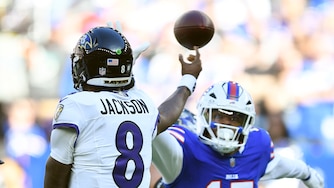
So we can understand why the discourse turned apocalyptic in the moments immediately after Jesse Minter announced Lamar Jackson would go on injured reserve. Hopes for the remainder of this Ravens season flatlined as soon as Jackson cracked his throwing thumb on Buffalo pass rusher Greg Rousseau. But this was a deeper shade of darkness. Technically, an IR trip just means a minimum four-week absence, but Minter acknowledged that Jackson might not return in 2026. Fans and analysts absorbed that bleak nugget and leaped immediately to wondering if the brilliant quarterback had played his last snap as a Raven.
The “Next Flight” morphed into a premature wake before our very eyes.
It’s not an out-of-bounds question given Jackson’s mounting injury history, his mammoth salary cap number for 2027 and his lack of interest to date in negotiating a long-term extension.
But the Ravens, and by extension those who care for the team, must resist this gloom. Instead of viewing Jackson’s freak injury as a portent of divorce, the team’s brain trust should see it as a challenge. Stop asking the most thrilling athlete in Ravens history to make miracles behind a line that can’t consistently protect him. That’s not a plan; it’s a perpetual doomsday clock.
Read More
If he follows his usual pattern, Ravens general manager Eric DeCosta will not take questions from reporters until after the season. If he did face interrogation this week, DeCosta might point out that the Ravens actually have invested heavily in their offensive line.
They used first- and fourth-round picks on linemen (Tyler Linderbaum and Daniel Faalele) in 2022, took Roger Rosengarten in the second round in 2024 and added Emery Jones Jr. in the third round in 2025. They made re-signing left tackle Ronnie Stanley their No. 1 priority in the 2025 offseason. They used their 2026 first-round pick on guard Vega Ioane after spending $30 million on John Simpson to bring veteran dependability to the other guard spot. And when the line was still an injury-ravaged mess a month into this season, DeCosta sacrificed a second-round pick to acquire former Pro Bowl center Cam Jurgens.
The problem is not the quantity of investment. It’s the quality.
• Neither of those 2022 draft picks is still on the team.
• Rosengarten has returned solid value as an established starting right tackle, but he gave up the pressure to Rousseau that led to Jackson’s injury, a reminder that he’s still several steps short of reliability.
• Jones was a healthy scratch Sunday, the latest signal that DeCosta wasted a Day 2 pick on a lineman the team doesn’t even trust as a reserve.
• Stanley is doing his best on a bad toe, but at age 32, he’s not the future at the most important position on the line.
• Simpson has gutted through a groin injury but remains mistake-prone in his seventh NFL season.
• Jurgens, whom Eagles fans were thrilled to discard, was part of the problem Sunday after a solid Ravens debut the weekend before.
• Ioane is the brightest spot but might still need another year or two to become a true anchor.
We’ve seen again and again that the downside for this group is more frightening than the upside is tantalizing. DeCosta bet on his scouting staff’s eyes for young talent when he moved on from veterans Kevin Zeitler and Morgan Moses after the 2023 season. But the fact is the Ravens have not successfully backfilled this unit with second- and third-day draft picks, and they’ll go into a third consecutive offseason needing to do serious repair work on the supposed bedrock of their offense. They could stand a pivot toward paying for more established talent but might be too cash-strapped for that approach. Another first-round pick — this front office rarely blows those — would be the quickest way to add a premium blocker.

When the Ravens are forced to play without Jackson, as they were again Sunday, television analysts invariably say the answer is to feed Derrick Henry. Those guys obviously have not been watching this offense regularly, because its run blocking is at least as broken as its pass protection. Henry is averaging four yards per carry, down from 5.2 last year and 5.9 in 2024, because he’s being hit by unblocked defenders before he can accelerate. The Ravens might like to refashion themselves as a sledgehammer team for the remaining nine games, but they don’t have the horses — including in a tight-end room devoid of an elite blocker — to pull it off.
Fans who were convinced that John Harbaugh was the man holding the Ravens back — a frigid take with the New York Giants, minus their starting quarterback at a division-leading 4-2-1 — are shifting their ire to DeCosta.
Is his chair getting toasty? Don’t bet on it. DeCosta was always more central than Harbaugh to owner Steve Bisciotti’s vision for the future of his franchise. Bisciotti paid dearly to keep DeCosta in place as Ozzie Newsome’s successor with the belief that DeCosta would remain chief football architect for as long as his mentor had. Bisciotti abhors chaos at the top, and he made it clear in January that he trusted DeCosta to be the bridge from one coach to the next.
“Eric is one of the best GMs in the league,” he said. “I’m very, very pleased with Eric. I know that Eric has been very, very introspective about his failures and how they contributed to our dear friend [Harbaugh] being shown the door, and so, nobody’s harder on himself than Eric.”
It’s going to take more than a season wrecked by a quarterback’s injuries to shatter that foundational confidence.
Which is not to say DeCosta is undeserving of the scrutiny he’s facing. Many of his big calls from recent years — signing a declining Mark Andrews to a $39 million extension, making Trey Hendrickson the highest-paid defensive free agent in team history, the aforementioned offensive line overhaul — are not paying off in 2026.
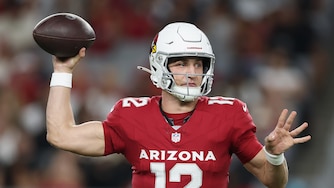
Now’s the time for his gaze to be fixed on the horizon instead of the ruins of this season. Yes, the Ravens face the immediate problem of needing another healthy body or two at the most important position in the sport. The speculation began Sunday evening. Would they make a push to trade for Chicago Bears backup Tyson Bagent, who’d bring some athletic juice and familiarity with offensive coordinator Declan Doyle? Though Bagent might be a fine solution in a vacuum, the Ravens should not be in the business of wasting meaningful future assets on a 2026 salvage job. They’ve had four games to convince us they might be a playoff team without Jackson and have demonstrated the opposite. The focus has to be on building a sturdier vehicle, perhaps enhanced by a high draft pick next April, for him to pilot into the future.
And make no mistake, Jackson, as he showed when healthy this season, remains the best reason to believe the Ravens might pull off a Super Bowl run this decade. Injuries have become a cruel, exasperating subplot to his story. But teams move mountains to draft and trade for quarterbacks who spell the difference between dregs of the league and championship contender. The Ravens never had such a player before Jackson, and there’s no telling when they might find another. No matter how awful this feels now, they cannot cast him aside lightly.
Asked Monday if he’d considered the possibility that Jackson had played his last game in a Ravens uniform, Minter answered with a simple “No.”
We were here in 2022, not as early in the season but certainly by the end of it, when Jackson and the Ravens seemed on different pages about his knee sprain and he was not under contract for the following season. After six tense months marked by a franchise tag and Jackson’s trade request, team and superstar reached a pact that fed directly into two of the best seasons in franchise history.
You wade through the worst times to continue working with the most gifted people.
With that rather massive item addressed, here are a few other observations on where the Ravens stand coming off their 36-10 loss to the Bills:
The defense still lacks an identity
Coming off a meltdown so troubling that former players and coaches called them out for disgracing the franchise’s legacy, the Ravens’ top defenders showed real fight in Buffalo. Linebacker Roquan Smith played perhaps his best game of the season, and All-Pro safety Kyle Hamilton did Kyle Hamilton things. They inevitably wore down, because the offense could not keep them off the field, but this was not humiliation redux, despite the final score.
That said, if you’re game planning to face the Baltimore defense, what really scares you other than Hamilton attacking from anywhere and everywhere? Minter’s schemes depend on generating pressure with four rushers, and that’s not happening consistently, despite Hendrickson’s presence. Cornerbacks Nate Wiggins and Marlon Humphrey don’t win their matchups against top receivers. The Ravens deliver some classic punishing hits but undermine them with subsequent tackling lapses. Their run defense has been fine but hardly smothering.
What does this defense do really well? Eight weeks in, we don’t have an answer.
Young edges continue to show signs
No Raven is on pace for double-digit sacks, a major disappointment considering the financial investment in Hendrickson and defensive tackle Nnamdi Madubuike’s return to the lineup. Tavius Robinson’s season-ending pectoral injury subtracted the team’s most rugged defensive end from the picture.
That said, Mike Green has taken genuine steps forward in his second season, not only tying for the team leads in sacks and quarterback hits but exceeding expectations when he sets the edge or drops into coverage. He’s looking more like an every-down player than a pure rush specialist. As for rookie second-round pick Zion Young, he took on greater responsibility with Robinson out and held up well in the Buffalo loss, flashing strength and tenacity against the run. He still needs much refinement as a pass rusher, but he’s trending toward becoming a viable replacement if the Ravens decide they can’t afford Robinson after this season.
Fans hoping the Ravens will sell at the trade deadline aren’t living in reality
We know the list of veterans fans want to purge from the roster: Humphrey, Andrews, to lesser degrees Stanley and Smith. The Ravens are paying tens of millions of dollars to these established names, all of whom are on the downside.
Common sense, however, tells us they’re unattractive trade targets for the very same reasons critics want them gone. There’s not a Jeffery Simmons or Quenton Nelson in the bunch. Henry might draw a midround pick, but that would be a less popular move and a de facto admission that this team might not be ready to contend in 2027 either. Might the Ravens make a move or two — Rashod Bateman comes to mind — for modest draft compensation? Sure. But any significant roster pruning will have to wait for the offseason.



Comments
Welcome to The Banner's subscriber-only commenting community. Please review our community guidelines.