
Gov. Wes Moore resoundingly convinced voters to give him another four years.
Whether he’ll use them all is another question.
A Democrat with a rising national profile and political and donor connections from his time as a nonprofit leader and surrogate for fellow Black Democratic candidates for governor, Moore is frequently discussed as a 2028 presidential contender.
The 48-year-old has built an enviable résumé for someone with political aspirations: Rhodes scholar, Army veteran in Afghanistan, bestselling author, entrepreneur and CEO of the poverty-fighting Robin Hood Foundation. From almost the moment he was elected governor in his first-ever political campaign in 2022, whispers began about how far his career would go.
He has repeatedly said he is focused on Maryland — but he also didn’t commit to serving a full second term when pressed during a debate this fall.
Over the past year, Moore said he was focused on winning reelection. With a decisive reelection behind him, that deflection strategy has run its course.
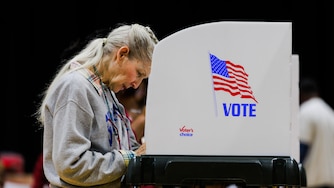
Dan Caton, a marketing professional who voted in Annapolis, said he agrees with “most, if not all” of the decisions Moore has made in office and believes he is fit for “a bigger office.”
“I’m all for it,” Caton said. “Country over state.”
Another Annapolis voter, retiree Carolyn Ring, said she’d like Moore to stick around as governor. “I think in the future he could make a great presidential candidate,” she said.
Moore said he is unbothered by speculation about 2028.
“I think people have been watching us from the first day we put our hand on the Bible, and it hasn’t moved me,” Moore said in an interview ahead of the election.
Moore said he believes the attention comes from results that he’s achieved in Maryland: lowering violent crime, investing in public schools, attracting new businesses.

“I think that we’re leading with a sense of focus, a sense of integrity and a sense of togetherness that I think, frankly, is uncommon,” Moore said.
Moore also has faced challenges: slow progress on rebuilding the Francis Scott Key Bridge, a sluggish economy worsened by federal job cuts, an ongoing state budget deficit, tensions with the Trump administration — and even tensions with fellow Democrats in Annapolis.
Moore has a national profile that’s likely to expand. He is a frequent guest on political and Sunday talk shows; it’s just a short drive to D.C. or a quick pop into a studio van outside the governor’s mansion in Annapolis.
He chairs the National Governors Association, giving him a perch to discuss issues facing states and regular contact — and potential conflict — with President Donald Trump’s White House.
During his first term, Moore crisscrossed the country for political events and state business. A Banner investigation found he spent 1 in 5 days of his first term traveling in other states.
Moore made a point of campaigning for the other four Black Democrats who ran for governor this year: Keisha Lance Bottoms in Georgia, Aaron Ford in Nevada, David Crowley in Wisconsin and Jermaine Johnson in South Carolina. Bottoms and Crowley won Tuesday.
Now that he’s no longer the only Black Democratic governor, Moore could take a leadership role among his colleagues, said Jason Johnson, a Morgan State University professor of political science and journalism.
“Moore would be the senior African American governor in the country, and he could potentially put together a caucus of Black governors — something that has never been seen before, something that would put him on the national map,” Johnson said.
Pursuing national ambitions is likely to open Moore to criticism in Annapolis for failing to focus on Maryland’s needs.
Johnson said he doesn’t think those arguments will land going forward, so long as Moore maintains strong leadership in state government and doesn’t miss any key moments.
“Will he be criticized that he’s placing his national ambitions over Maryland?” Johnson said. “Of course he will. But he’s going to be criticized anyway.”
Moore is on a “long list” of Democrats who could seek the party’s nomination in 2028, said Kyle Kondik of the University of Virginia’s Center for Politics.
Since Democrats across the country had a great night Tuesday, there will be no shortage of presidential aspirants. Democratic Sen. Jon Ossoff, often seen as a top 2028 prospect, won reelection in Georgia, denying Republicans a seat they had once seen as a top pickup opportunity.
But there’s no clear front-runner. Even if former vice president and 2024 nominee Kamala Harris runs, she likely wouldn’t scare away other candidates, Kondik said.
“He’s probably got as good of a shot as anyone else does,” he said of Moore. “Everyone’s chances are low.”

As Moore contemplates his future, plenty of issues in Maryland will require his attention.
Moore started mapping out his second-term challenges well before voters cast their ballots: solving a multiyear, multibillion-dollar budget deficit, growing the economy, tackling housing affordability, continuing to drive down crime.
The next round of state budget negotiations could be brutal. The governor will need to work with lawmakers — he benefits from a Democratic majority in both chambers — to balance the budget, whether through spending cuts, tax hikes or a combination of the two.
The budget talk may become intertwined with the Blueprint for Maryland’s Future, an ambitious but expensive program to improve public schools that was first approved in 2020.
There’s also the matter of congressional redistricting. Now that Maryland voters approved amending the state constitution’s rules for drawing districts, Moore is likely to lead a push for a new map designed to favor Democrats in all eight congressional districts.
“We just have unfinished business,” he said.
Banner reporter Alex Mann contributed to this story.


Comments
Welcome to The Banner's subscriber-only commenting community. Please review our community guidelines.