
After traffic crashes killed two Maryland road workers in the span of four days, a possible solution is in the works along Hillen Road.
Researchers at Morgan State University’s National Transportation Center have created a multisensory system to alert road workers to speeding or erratic vehicles that are approaching.
Sensors detect how fast and where cars are going hundreds of feet away from the construction site and ping workers with three different alerts if there’s a sign of danger.
The system, dubbed “Bear Alert” after the university’s mascot, can give workers crucial moments to call their attention to approaching danger and seek protection, researchers said. It has a patent pending, and school officials say it could be work zone-ready in less than a year.
Total roadway fatalities have been trending down nationally and in Maryland since a pandemic-era spike. But some of them — pedestrians and road worker deaths — have been increasing for decades. And as states turn to artificial intelligence and other technologies to make inroads on safety, Morgan State could help put Maryland ahead of the curve.
Dr. Mansoureh Jeihani, director of Morgan’s National Transportation Center, said her team began brainstorming solutions after a high-speed crash on Interstate 695 killed six construction workers in 2023, one of the deadliest work zone crashes in state history.

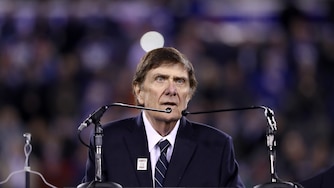
Lt. Gov. Aruna Miller, a former transportation engineer, sat for a briefing on the system Thursday. She heaped praise on the effort, telling researchers that “the timing of this couldn’t be more important.”
In late April, Robert Dempsey, 40, of Ellicott City, and 70-year-old Dipakkumar Patel were killed in separate work zone crashes just four days apart. Dempsey was setting up cones on a Capital Beltway ramp when a driver struck him, according to police. Patel was sitting in his work vehicle when a driver rear-ended him. Police are continuing to investigate each incident.
On Friday, representatives from AFSCME Local 1867, the union that Dempsey and Patel belonged to, called on state leaders to bolster training, improve protective gear for workers and beef up enforcement against bad driving.
“How many more of my coworkers have to die for something to really be done?” said Chris Caine, the union’s president and a State Highway Administration worker.
Road workers have to stay focused on operating heavy machinery or pouring concrete. All the while, 4,000-pound steel boxes careen past them, at times traveling at breakneck speeds, sometimes while the driver is on the phone.
Cars traveling at highway speeds can come up on workers in a matter of seconds, and a system like Bear Alert gives them a nudge to stop, look, and decide if they need to act.
It starts with lidar, a laser scanner that measures changes in light to determine how fast a vehicle is moving and whether it’s staying inside its lane. Bear Alert uses two of them, mounted with an additional camera on a mobile unit powered by solar panels.
The system can read vehicle speeds up to 400 feet away, and programmers can set the devices to track vehicles as they close in on workers.
When a car exceeds a certain speed and distance threshold, radio waves send out a signal to tripod-mounted lights and speakers. It also activates vibrating haptic devices similar to video game controllers that workers carry in their pockets or have sewn into their vests.
It’s meant to have redundancy. If a worker is using a jackhammer, for example, she may not feel the haptic device or hear the siren but could notice the flashing lights.

The research team has the system deployed at a nearby work zone along Hillen Road in front of Mergenthaler Vocational-Technical High School to gather data and feedback from workers. Early results indicate that as vehicles exceeded work zone speed limits, workers found the haptic devices comfortable and reliable, Jeihani said.
Robyne McCullough, spokesperson for the Motor Vehicle Administration, which oversees Maryland’s highway safety office, wrote in an email that the department, “look[s] to leverage every technological and educational tool to encourage safe behaviors.”
Officials look forward to reviewing the data from Bear Alert, which received funding from state and federal safety grants, McCullough added.
It may not be a perfect solution. Construction zones, particularly on highways, can be tight and confined spaces, meaning a worker may not have many options for where to go if a speeding car is coming.
It also can’t stop aggressive speeders and distracted drivers.
Miller said Bear Alert could work well in tandem with other solutions, including the state’s automated camera program, which data suggests has helped reduce work zone crashes by about 12% since lawmakers raised the associated fines two years ago.

Comments
Welcome to The Banner's subscriber-only commenting community. Please review our community guidelines.