
In less than six months, Maryland and its contractor to rebuild the Francis Scott Key Bridge seem to have slipped billions of dollars apart.
The state said in November that it expected the bridge to cost between $4.3 and $5.2 billion, and in April officials began formally hammering down the price with Kiewit, the giant firm selected in August 2024 to design — and likely build — the span.
But U.S. Rep. Andy Harris, a Maryland Republican, said the bridge estimate grew to “as high as 8 or 9″ billion dollars during a Monday morning interview on WBAL Radio’s C4 and Bryan Nehman.
Maryland officials announced last week that the state would move on from Kiewit and find a new builder.
Kiewit and state officials have declined to specify how much the company proposed in negotiations. Last week, a source familiar with discussions between Democratic Gov. Wes Moore’s administration and Kiewit said the company had estimated the bridge would ultimately cost upwards of $9 billion.
Construction projects in the U.S. often balloon in costs.
In the weeks immediately after the Key Bridge collapse in 2024, state officials estimated the bridge would cost under $2 billion. Harris likened the growing estimate to a “pig in a poke” and blamed union labor and minority-owned businesses, in part, for the price increase.
“That estimate of $2 billion, there’s a feeling in Congress that this was bait and switch,” Harris said.
Seeking a new contractor will likely slow the rebuild past its projected 2030 opening date, and it introduces risk that the state won’t be able to find a builder at all. But the state is betting it can find a company that will build within, or at least closer to, the $5 billion range they’d previously pegged.
Much is unknown. There’s a chance that the state will end up with a contractor who makes a similar offer as Kiewit’s estimate, but Maryland Secretary of Transportation Katie Thomson said that, “based on all of the data,” she is not concerned about that possibility.
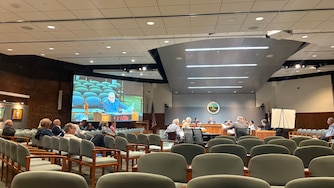
Thomson briefly addressed the switch from Kiewit during the Maryland Transportation Authority’s monthly board meeting last week, but she asked that board members hold questions about the “confidential negotiations” until closed session.

Kiewit and state engineers worked hand-in-hand for over a year from an office in Hanover. However, when push came to shove at the negotiating table, they were far from agreement.
“It was a surprise and disappointing,” the authority’s chief engineer, Jim Harkness, said last week.
The project has placed a microscope on Moore, who has sparred with President Donald Trump over the bridge’s pace and price. Moore said that speed, safety and cost savings are his project “North Stars.”
Both Moore and U.S. Secretary of Transportation Sean Duffy have positioned the move from Kiewit as being in the best interest of taxpayers.
In an interview with The Banner on Saturday, Moore declined to specify Kiewit’s offer, but said “it was enough for me to cancel their contract.”
“They were a huge deviation from what we expected and from what we talked about earlier,” he said.
This isn’t the first time that a government found Kiewit’s offer to be too high.
Last summer, California’s Santa Clara Valley Transportation Authority took a similar off-ramp for a nearly $13 billion subway extension citing cost disputes with the builder, a joint venture of three companies that included Kiewit. And earlier that year, Kiewit’s bid to build a 3.2-mile light rail extension in the southern part of the state came in hundreds of millions of dollars higher than expected.
Kiewit was hired to build a desalination plant in Corpus Christi, Texas, but project estimates escalated to $1.2 billion. That seemed pricey to local officials — who instead found a contractor this year for $978 million.
Kiewit remains active in another ongoing major infrastructure project in Baltimore. It is part of a joint venture that won the $1 billion contract to bore Amtrak’s future Frederick Douglass Tunnel underneath West Baltimore. That’s a key piece of a larger effort to speed up area rail service, but one that a watchdog warned risked possible cost overruns.
Despite the state opting not to proceed with Kiewit on the Key Bridge, the company is not yet done with the project. As part of the company’s initial deal with the state, it will demolish remaining bridge structures and complete some early construction.
“Although we’re disappointed by this decision, we’re committed to completing our current scope,” Kiewit spokesperson Teresa Shada said.



Comments
Welcome to The Banner's subscriber-only commenting community. Please review our community guidelines.