
The Ravens collapsed in every phase of the game as the Cincinnati Bengals rallied from a 13-0 halftime deficit Sunday to humiliate them, 35-13. The Ravens are 0-2 in the AFC North, desperate for quarterback Lamar Jackson to return from his sprained ankle to bail them out. Here are five things we learned from their most emphatic loss of the season.
The Ravens have a second-half problem.
The Ravens’ offensive coaches have a sign in their office that reads: “Nobody adjusts better than us.” It’s coordinator Declan Doyle’s challenge to himself and his staff to stay ahead of what’s coming next.
Right now, the message feels like bitter irony for a team that has been outscored 114-51 after halftime over its first seven games. The problem has accelerated over the last two weeks, with the Ravens getting outscored 48-0 in the second halves of their first two AFC North games, against the Bengals and Cleveland Browns.
Through all their collapses in recent seasons, they have rarely looked so helpless as they did over the last 30 minutes Sunday, after they went to the locker room with a 13-0 lead and a crushing advantage in time of possession.
The Ravens did nothing well — not block, not tackle, not stay onside, not cover — as home fans booed their embarrassing work, then left M&T Bank Stadium in droves. With no Jackson to save them, they looked every inch the last-place team they currently are.
The organization’s leaders grasped how dire it was. General manager Eric DeCosta sat in an empty stall in the postgame locker room, staring straight ahead, speaking to no one.
Read More
First-year coach Jesse Minter criticized his Ravens as “too much of a momentum team.”
“Like quicksand,” veteran defensive end Calais Campbell said, summing up the hopeless feeling as Cincinnati pulled ahead and then away.
We’re past hearing players brush off these meltdowns as the typical ebb and flow of an NFL season. They understand there might be something broken in the mental and emotional machinery of this team, a glitch that prevents the Ravens from finding solace in their core principles when a game turns against them.
“We’re too caught up in what’s happening in the game, when we really need to focus on our job and think one play at a time,” left tackle Ronnie Stanley said. “We have one bad drive and they have one good drive, and we start to feel something happening. For us, it’s just to refocus — focus on our identity and what we need to do and really just not look at the scoreboard. We talk about that a lot, but I don’t think we’ve really put that into action.”
In fact, he said, the Ravens harped on that very point throughout their week of preparations for the Bengals.
That they missed the mark so drastically raises troubling questions. Namely, do they have problem-solvers capable of steering this ship away from the rocks? Fans spent years blaming John Harbaugh for the Ravens’ inability to course correct. Now, the harsh light glares on Minter.
“I think it’s tough conversations over and over and just continuing to work through it and talk through it,” he said when asked for the antidote. “Right now, I think it’s just a big point in the season for us to determine what type of team we want to be.”

The bedrock of the Ravens’ offense is missing in action.
Opponents had averaged 5 yards per carry against the Bengals, with much of that damage coming on outside runs. An outside-zone system, with Derrick Henry as its weapon of mass destruction, seemed the perfect means to attack the Cincinnati defense.
Instead, Henry ran into walls all afternoon, averaging just 2.6 yards per carry after averaging 3.4 against Cleveland. Some of that inefficiency results from opponents crowding the line of scrimmage, confident that backup quarterback Tyler Huntley cannot punish them for doing so. But a lot of the blame goes to an offensive line that simply is not moving bodies, as injuries — the latest to guard Vega Ioane’s knee — keep it from cohering.
The Ravens did a decent job working around their inability to run in the first half Sunday.
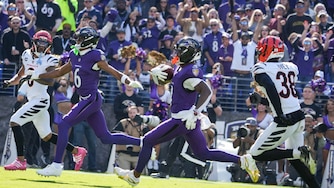
Huntley began the game with a nifty play-action dump to tight end Josh Cuevas for 16 yards. A few plays later, Zay Flowers needed just a few solid blocks to turn a simple pass to the flat into a 48-yard touchdown. If your quarterback can’t push the ball deep, sometimes a lightning bolt playmaker can do it for him.
They did their share of self-sabotage, putting themselves behind the sticks with false starts and another delay of game (after two the previous week). They covered for their sins with remarkable efficiency on third down, relying mostly on short or intermediate passes that dared the Bengals’ poor tacklers — hello, Jordan Battle and Demetrius Knight Jr. — to make open-field stops. Because they kept extending drives, with 12 first downs to Cincinnati’s three, they controlled the ball for more than 22 minutes in the first half.
It turned out to be fool’s gold, because they could not run the ball efficiently, their version of offensive comfort food. Only one of their six second-half drives lasted more than four plays. Their failings weren’t schematic. They could not win basic blocks and, failing that, could not connect on the short passes that gave them breathing room before halftime.
“I’m certainly concerned about that,” Minter said of his team’s stagnant running game. “We [have] to search for those better answers and how people are playing us, continue to try to create continuity on our O-line with what we have going on. We certainly need to find a way to create plays in the run game where we can at least sustain some drives and do those types of things when a game’s going like that.”
No matter who’s calling the plays, a Ravens offense that can’t run effectively isn’t a Ravens offense. Will Jackson, unlikely to be 100% healthy if he returns in Buffalo next Sunday, be the elixir? That has to be the hope, because the Ravens have flatly run out of solutions the last two weeks.

The defense was every bit as fundamentally incompetent as the offense.
Minter did a fine job confusing Bengals quarterback Joe Burrow with varied looks in the first half. The Ravens brought pressure from ever-changing angles and hit vigorously when Burrow did get the ball to his playmakers.
With safety Jaylinn Hawkins injured, Kyle Hamilton played the back end to start the game.
That didn’t stop him from blitzing on third down to drop Samaje Perine for a 2-yard loss that forced the Bengals to punt at the end of their first drive. Hamilton continued moving around for the rest of the half, never allowing Burrow to find his bearings.
The Bengals didn’t move more than 21 yards on any of their four first-half drives. We were watching Minter’s defense come into its own against a legitimately scary offense.
Which made what followed feel like that much more of an evisceration.
Burrow came out of the locker room focused on releasing the ball more quickly. “Which we figured they would,” Minter said. Nothing he did was a tactical shock. But the Ravens’ sudden inability to tackle allowed those sharp, quick cuts to become seeping gashes.
This wasn’t the fault of one or two players. Every defender, up to and including the great Hamilton, fell down on the basics of the job. With the Ravens within one point at the start of the fourth quarter, Hamilton had a chance to drop Chase Brown for a loss deep in Cincinnati territory. He missed the tackle, giving the Bengals traction. Four plays later, linebacker Trenton Simpson had a line on Burrow in the backfield only to whiff, giving the quarterback all the room he needed to find Tee Higgins for 44 yards, the killing blow in an 88-yard touchdown drive.
All hope was lost at that point, though the Ravens weren’t done bumbling. They finished with 11 missed tackles, per Pro Football Focus, with no takeaways and just one sack on the positive side of the ledger. We can blame Minter and his staff all we want, but if his best defenders can’t make a play with the game hanging in the balance, there’s only so much he can do.
“We’re missing some tackles, and all of a sudden, these plays that were maybe third-and-5 or third-and-6 in the first half are now second-and-1 or creating more momentum for them by making yards after the catch and things like that,” he said. “So really just a — starting with me — it was just a bad effort by the defense in the second half and one that I know our guys will look at and not feel good about, and only we can do something about it.”
We have to accept that injuries are baked into the Lamar Jackson experience.
A fourth straight Baltimore football Sunday was defined by the one Raven who didn’t play rather than the dozens who did.
That’s life in Lamar limbo, a state we’re enduring for the fourth time in six seasons. Jackson has missed 3 1/2 games. He missed four last year, five in 2021 and five in 2022. We know the formula by now. When he plays the whole season (save for a rest game at the end of 2023), the Ravens are one of the league’s best, most entertaining teams. When he doesn’t, they’re just OK. It’s simple, and dispiriting, as we consider where this 2026 chapter might be headed.

Setting the football implications aside for a moment, it’s striking, and utterly predictable, how weird the Ravens’ atmosphere becomes when their most important player is hurt. There’s always an information vacuum, fueled by gamesmanship toward other teams and by Jackson’s inclination to keep his own counsel. Fans and pundits fill that vacuum with speculation that ranges from ill informed to insane. Is he rehabilitating diligently enough? Is he quietly indicating his desire to play elsewhere next season?
Jackson posed a simpler answer when he spoke to reporters Friday. He’s dealing with a painful high-ankle sprain, and he’s reluctant to play impaired, as he did for much of last season. He made sense, but his words did not point toward the conclusion anyone wanted to hear. “Insider” reports muddied the waters over the ensuing 24 hours, setting the stage for fans to freak out all over again when the Ravens ruled Jackson out Saturday afternoon.
So we enter another week of conjecture about a verdict that can only come from one person.
We’re not here to impugn Jackson’s dedication, to suggest that he modify his playing style (he already has) or that he take a pay cut to account for his fragility. But we have to reckon with reality. The Ravens have pinned their highest ambitions on someone who hasn’t been a full-time player through what was supposed to be his physical prime.
This might just be the nature of appreciating Lamar Jackson. It might be that part of the thrill comes from recognizing how fleeting the show really is. He’s not some mythic thunderclap like Bo Jackson, done echoing before we could fully figure out what he might become. He’s too accomplished — a pair of Most Valuable Player awards, an express pass to the Pro Football Hall of Fame — for any “what might have been” list.
He’s also not Walter Payton or Jerry Rice or Tom Brady — greats defined by their metronomic presence and production. If any data point puts Josh Allen above Jackson in the current quarterback pecking order, it’s that Allen always plays.
Jackson, who’ll turn 30 in January, is such an unusual player that it’s difficult to guess how the back half of his career will look. His boyhood hero, Michael Vick, produced exactly one standout season after he turned 30. Steve Young, one of the greatest running quarterbacks of the era preceding Vick, didn’t really get going until he turned 31.
We just don’t know. But, if the Ravens and Jackson continue down their path together, we might have to accept that they’re chasing one perfect season, when his health lines up with the team’s greater design.
The Ravens just can’t catch a break on their offensive line.
So much of what we’re talking about, from running efficiently to protecting a recovering Jackson, depends on coherent offensive line play. The Ravens thought they were a step closer to achieving it when Cam Jurgens lined up at center against the Bengals after a lingering concussion kept him from debuting a week earlier. His arrival allowed Ioane to move back to right guard, where the Ravens envision him growing into a Pro Bowl performer.

Finally, they were playing with the five-man unit they hope will carry them through the rest of this year.
As has been the case all season, one step forward quickly gave way to one step back, with Ioane’s knee injury — Minter offered no information on his prognosis — forcing the Ravens to turn back to Emery Jones Jr., who has given little indication he’s a future long-term starter.
Jurgens held his own against Cincinnati’s terrifying nose tackle, Dexter Lawrence. But his performance was cold comfort given the line’s overall struggles, especially with run blocking.
Stanley, the unit’s senior voice, said the constant lineup changes can’t be an excuse. But the Ravens came into the season facing serious questions about their line, and the injuries — Stanley and left guard John Simpson are also playing in pain — have made it impossible for this group to coordinate consistently.
“One person here, one person there can ruin a whole run play,” Stanley said. “Ten other players can be doing it right, but for those things to be successful, everyone has to be on the same page with their technique and fundamentals. Sometimes, we’re lapsing on that.”



Comments
Welcome to The Banner's subscriber-only commenting community. Please review our community guidelines.