
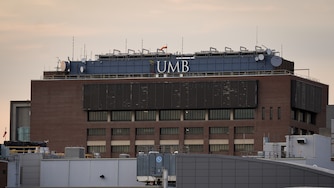
The University of Maryland, Baltimore, was awarded a tax break Wednesday that will abate $80 million over the next 25 years for a proposed “college town” development the university has planned.
The tax discount, known as a payment in lieu of taxes or PILOT, will support a $160 million development that includes a high-rise residential and retail building near the heart of the university’s downtown campus.
The city’s mayor-controlled spending board voted unanimously in favor of the deal.
The PILOT is the first to be granted from a newly created program called Downtown RISE. Designed to bolster downtown development, the incentive erases up to 95% of property taxes for 25 years in exchange for an annual fee that’s substantially less. It’s the same program city officials are using to negotiate a PILOT for a proposed development of high-rise buildings replacing the Harborplace pavilions.
Applicants face approval from the city spending board, along with the Baltimore Development Corp., the nonprofit economic development agency for the city.
UMB’s development, spearheaded by Wexford Science & Technology, calls for a 15-story, 404-unit, 730-bed residential building in the 600 block of West Lexington Street. Intended for graduate students, the housing would be rented by the bed. Dubbed the North Quad, the development would also have about 16,000 square feet of retail.
Read More
Officials with BDC pitched the tax abatement as a win for the city. Currently, the property is a parking lot generating no property taxes, said Jeremy Watson, senior vice president for BDC.
“Without this deal,” he said, “the building doesn’t get built and the city keeps collecting what it gets today, which is zero.”
As he made his pitch, Watson quoted from “Shark Tank,” a reality television series on which entrepreneurs pitch business ideas to investors.
“My money is my military. I send it out, every dollar, to capture and bring back more soldiers,” Watson said, quoting Kevin O’Leary, a regular on the show. “If you look at this abatement, we’re sending it out and we’re bringing back 2.43 soldiers with us. That’s a fair deal.”
Council President Zeke Cohen, one of five members of the spending board, said he had watched a lot of “Shark Tank.”
“Kevin and Mark Cuban and all those guys and women would be very disappointed if this board was not pushing and scrutinizing,” he said, referring to other investors on the show.
The North Quad project fits into a broader plan for the area that was presented to the University System of Maryland Board of Regents this year. A proposed South Quad along Fayette Street would be developed during a later phase of the project and may apply for a separate PILOT, according to materials submitted to the spending board.
Part of UMB’s Pharmacy Learning Center would be turned into a gathering space, possibly featuring a pub and an outdoor entertainment venue, according to the development plan. Next to that would be a recreation and sports area. One rendering shows basketball courts, a sports field and courts for pickleball or tennis.
Wednesday’s meeting began late as Baltimore Comptroller Bill Henry and officials from UMB hammered out an assurance that the university would keep the properties on the city tax rolls once they become eligible to pay their full share of taxes at the end of the PILOT. The university is a nonprofit and does not pay property taxes on most of its land holdings.
University President Bruce Jarrell committed to keeping the property on tax rolls. Henry said he’d like an agreement in writing.
Jarrell said the university is committed to improving the west side of downtown, which has deteriorated as nearby shopping districts, once the city’s most prominent, have failed.
“It’s part of a whole vision, and that vision is really Lexington Street, the Lexington Market, down Eutaw Street, past the Hippodrome, Everyman, CFG Bank Arena, right to the Eutaw gate of the Orioles,” Jarrell said. “We want that to be vibrant.”
The PILOT faced opposition from With Us For Us, a coalition of progressive advocacy groups and unions. Speaking for the group, Joan Jacobson said the tax discount was too steep and too long.
“We are pleased that some taxes will come from a piece of land that is nontaxed now, but still, we strongly believe that labor agreements and a small, brief tax discount would better benefit the city,” she said.



Comments
Welcome to The Banner's subscriber-only commenting community. Please review our community guidelines.