
Join the huddle. Sign up here for Ravens updates in your inbox.
Eleven months ago, the Arizona Cardinals were in trouble. Starting quarterback Kyler Murray was out with a foot injury, their passing game was limited, and the team’s losing streak was up to three.
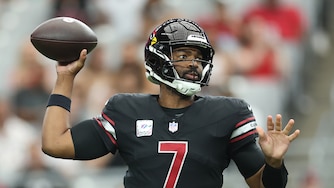
On came Jacoby Brissett, back in the stopgap role he knows well. Over his winding NFL career, he had already been called on to replace the Indianapolis Colts’ Andrew Luck, the Miami Dolphins’ Tua Tagovailoa and the Cleveland Browns’ Deshaun Watson.
In his first month as Arizona’s starter, Brissett could not offer salvation; the Cardinals lost his first two games as QB1. But he did provide a spark. From Week 6 to Week 9, Arizona’s scoring offense improved by nearly seven points per game, its passing attack by nearly 90 yards per game and its third-down conversion rate by over 15 points. In a streak-snapping primetime win over the Dallas Cowboys, Brissett went 21-for-31 for 261 yards, two touchdowns and no interceptions.
“I’m just trying to go out here and win games and be a good teammate,” he said after the game. “And do the best I can when I get my opportunities. That’s all I can ask for.”
Brissett arrived in Baltimore last week under similar pressure and expectations. With starting quarterback Lamar Jackson (thumb) and backup Tyler Huntley (toe) sidelined indefinitely by injuries and the Ravens’ playoff chances fading fast, general manager Eric DeCosta finalized a trade Friday for Brissett, sending a 2027 fourth-round draft pick and a 2028 seventh-rounder in exchange for the Cardinals’ veteran and a 2027 fifth-round selection.
The Ravens (4-5) need their own spark. They’ve scored a combined 43 points over their four-game losing streak, or two points more than they had in their season opener. Brissett is not the long-term answer in Baltimore or anywhere else — he went 1-11 as a starter last year and was benched after going 3-5 in Arizona this season — but he can at least provide the competence the Ravens lacked in blowout losses to the Buffalo Bills and Jacksonville Jaguars.
Here’s a look at the good, the bad and the uncertain in Brissett’s player profile as the Ravens prepare for a must-win “Monday Night Football” game next week against the Los Angeles Chargers. All stats are courtesy of Sports Info Solutions and Pro Football Focus.
The good: Intermediate throws
The Ravens’ intermediate passing game has withered without Jackson. Huntley, often reluctant to test tight windows, is just 8-for-17 on throws of 10 to 19 air yards in his five games (three starts). Undrafted rookie Joe Fagnano is 3-for-6 and attempted just one such pass against Jacksonville on Thursday, when his ankle injury clearly limited his willingness to push the ball downfield.
Brissett should be an upgrade, if not a Jackson-level intermediate-range wizard. He throws with more conviction and arm strength than Huntley and Fagnano, gunning for targets both outside the numbers and between linebackers. Brissett averaged seven intermediate throws per game in Arizona this season, going 30-for-56 (53.6%) for 508 yards and two touchdowns while averaging an impressive 0.43 expected points added per attempt with a 53.6% success rate.
Maybe the most important feature of his Cardinals passing catalog was his connection with wide receiver Michael Wilson on out routes. Brissett found him seven times this year on intermediate and deep out-breakers for 186 yards, with just three misfires.
Wide receiver Rashod Bateman is the Ravens’ closest analogue to Wilson, who caught fire with Brissett last year en route to a career-high 1,006 receiving yards. Ja’Kobi Lane, primarily an outside receiver, and Zay Flowers, their most dangerous threat, could fill the out-route role as well.
“For him [Brissett] to believe in me both last year and this year and give me a plethora of opportunities to showcase my talents, regardless of what happens from here on out, I will forever be indebted to Jacoby,” Wilson told local reporters Wednesday. “He will 100% be the catalyst quarterback that helped me reach my heights and give me opportunities to continue to ascend.”
Brissett was also solid between the numbers in Arizona, where All-Pro tight end Trey McBride was a regular matchup problem. Brissett threw with anticipation and accuracy, layering passes between opposing linebackers and safeties.
The bad: Pressured throws
Over his two years in Arizona, Brissett was never especially sack-prone. His 5.9% sack rate this season would lead the Ravens, a testament to his ability to deliver the ball quickly and on time.
But that doesn’t mean the statuesque 33-year-old is unbothered by pressure. Quite the opposite.
On pressured drop-backs this season, Brissett is 39-for-95 (41.1%) for 407 yards, one touchdown and four interceptions, averaging a dreadful minus-0.62 EPA per play with a 25.4% success rate. And 18.3% of the pressures on Brissett have turned into sacks, tied for the 13th-highest mark among 35 qualifying quarterbacks.
Brissett’s limitations have been most apparent on obvious passing downs. When pressured on third- and fourth-and-long (7-plus yards to go), Brissett is just 8-for-23 for 96 yards. He has thrown two interceptions, taken two sacks and managed only five first downs.
And although Brissett is a weapon on quarterback sneaks, converting 13 of 16 this season, he’s not much of a scrambler. He has just nine scrambles for 61 yards, earning a first down three times.
The Ravens’ offensive design and weapons could make life easier for Brissett; according to Fantasy Points, their receivers, led by Flowers, have one of the best separation rates in the NFL. But that potential is contingent on functional pass protection. The Ravens have allowed a pressure rate of 40.3%, seventh worst in the league; the Cardinals entered Week 9 having allowed a pressure rate of 35.1%, 12th best.
The uncertain: Deep throws
Entering Sunday, 26 quarterbacks had attempted at least 10 unpressured passes of at least 20 air yards. Only four had a better on-target rate than Brissett (66.7%). But only seven had a worse completion rate (30.8%) on those deep shots, as Cardinals receivers struggled to win in contested-catch spots and to finish leaping grabs.
Brissett is 4-for-13 for 112 yards, no touchdowns and one interception on unpressured long balls, and 6-for-29 (20.7%) for 167 yards, no touchdowns and three interceptions when going deep overall.
Perhaps a change in scenery and receiving rooms will do him well. The Ravens desperately need Brissett to unlock more explosive plays in their passing game. Jackson is 8-for-15 (53.3%) for 306 yards, a touchdown and an interception on deep passes, but Huntley is just 1-for-6 (16.7%) for 31 yards. Fagnano’s longest pass is just 19 air yards.
With defenses having little to fear downfield, the Ravens’ offense has felt cramped in recent weeks. Opposing safeties have lined up closer to the line of scrimmage, limiting the Ravens’ run game, and have dialed in on intermediate routes, seemingly unbothered by the threat of passes going over their heads.
Brissett’s arrival can help, players acknowledged Thursday, but only so much.
“There’s a lot of things that we need to fix on our end,” left tackle Ronnie Stanley said. “I don’t think anyone can just come in and fix all the problems.”




Comments
Welcome to The Banner's subscriber-only commenting community. Please review our community guidelines.