
Prince George’s County leaders and planners are exploring whether smaller homes and clustered communities could help address the need for more affordable housing.
But there are some problems:
Most of the county’s residential land isn’t zoned to allow the types of developments under discussion.
And it’s unclear whether residents seeking affordable housing would want to live in them.
The exploration comes as Prince George’s County faces a projected shortage of 36,000 housing units by 2030, according to county planners.
“We are not keeping pace with the amount of rooftops or houses that [the Metropolitan Washington Council of Governments] has said we need moving into 2030,” said Andrea Gilles, chief of the community planning division at the Maryland-National Capital Park and Planning Commission. “But it’s also not just about housing units. It’s also about the types of housing that we’re providing in the coming decades to meet the needs of changing populations.”
Read More
Casey Dawkins, a University of Maryland professor of urban studies and planning, said the shortage reflects a combination of rising housing costs, stagnant incomes and a lack of new construction.
“Incomes haven’t been rising as fast as housing prices have,” Dawkins said. “There’s a growing number of people who simply don’t have enough income to sort of buy that first home.”
The supply of housing also hasn’t kept pace with population growth, he said.
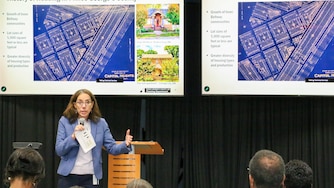
Last week, County Council members Jolene Ivey and Sydney Harrison hosted a town hall in Largo to lay out their discussions with county planners and gather public feedback on “microhousing communities.”
Ivey said she and Harrison have met with planning department staff for months to learn about different types of smaller homes and the challenges to building them. They wanted to bring residents into the conversation early, she said, because potential buyers and neighbors should have a say in whether these developments make sense.

During the town hall, Ivey joked that she wasn’t ready to live in a tiny home. But she has young adult sons who would be excited by the prospect of owning a tiny home.
“People are interested,” Ivey said. “Maybe not for themselves. Maybe they’re thinking about their children ... young adult children who would very much like to own a home, but can’t afford to with the way prices are right now.”
What compact housing could look like
During the town hall, Gilles described the range of “compact housing,” including tiny homes of about 400 square feet or less, whether built on wheels or permanent foundations; 300-square-foot pallet homes, sometimes used for transitional or supportive housing; cottages around 900 square feet; and clusters of smaller detached homes built on smaller lots or grouped around shared courtyards or green space.
“What the research is telling us is that there is a desire for many different housing types that we don’t see today,” Gilles said. “Tiny homes, compact homes, micro homes are just a few of the options that are available for us to explore.”
Gilles said some people may be drawn to smaller homes because they can cost less than a traditional house while still offering a home of their own. She said compact housing is often easier to navigate and requires less upkeep, making it attractive as homeowners age.
Brittney Drakeford, an urban planner and Prince George’s County native, said smaller homes and lots are not new to the county. Older neighborhoods, particularly inside the Beltway, such as Cottage City and Seat Pleasant, include examples of smaller-scale housing that has become less common in newer development.
Drakeford said those smaller “streetcar suburbs” tend to be more walkable and have attractive amenities. But many of the homes in those neighborhoods are old and can be difficult to maintain.
“Not only could some of those homes not be built today, [but] there are also challenges for people who live in those communities in maintaining those houses to keep them in good condition,” Drakeford said.
Current lot coverage requirements and zoning regulations make it virtually impossible to replicate neighborhoods like Cottage City, where Drakeford lives, which she said helped make homeownership possible.
“There is research that indicates housing that is on smaller lots and also houses that are smaller supports affordability,” Drakeford said.
Zoning hurdles
For compact housing to become a viable option in the county, planners would need to determine how the developments fit into existing zoning rules and what changes are needed. Currently, 94% of all residential land in the county is zoned for single-unit housing development, according to the Prince George’s County Planning Department.
Ivey said one possible approach is to divide larger single-family lots into smaller parcels to make room for multiple smaller homes.
“One of the biggest barriers is probably the zoning itself,” Dawkins said. “I would imagine that doing something of that type would require a new zoning category, or reducing allowable lot sizes.”
Dawkins said any major change or new development will always face some resistance, but this could be a pathway to creating more affordable housing options. But it’s not a silver bullet; it has to be done alongside other initiatives, Dawkins said.
“To address the housing crisis, we have to be innovative and allow for more flexible housing arrangements,” Dawkins said.
Some county-owned land could accommodate the developments. Jonathan Butler, director of the county’s Department of Housing and Community Development, said his agency has identified about 10 parcels suitable for compact housing. The county is evaluating those sites with planners.

“It represents an opportunity for Prince George’s County to expand homeownership, to increase housing affordability, and that ultimately creates generational wealth and revitalizes our neighborhoods,” Butler said.
Other communities offer examples of what’s possible. Tiny-home communities have taken shape across the nation in places like Colorado, Georgia and Texas. Some communities are also using tiny homes to address homelessness, which is a different purpose from the housing options being discussed at last week’s “microhousing town hall.”
The town hall opened with a tour of a tiny house that, in some ways, illustrated the zoning challenges the county currently faces. The 280-square-foot home, built by Prince George’s County Public Schools students, went up for auction in October but drew no bids. County Executive Aisha Braveboy purchased the tiny home on wheels for the county.
Under current county rules, a home on wheels cannot serve as a permanent primary residence.
For now, county officials are continuing to gather feedback before deciding what compact housing could look like. Ivey said she and Harrison plan to hold more community listening sessions around the county, where residents can share what kinds of housing they would want to see and what concerns they have.
Ivey also encouraged residents to reach out to her or Harrison with their thoughts.
“We have all kinds of housing already in Prince George’s County, except for this,” Ivey said.
Have a tip for our Prince George’s County reporters? Tell us here.



Comments
Welcome to The Banner's subscriber-only commenting community. Please review our community guidelines.