
Mike Elias and I agree on at least one thing: We’re tired of this.
For the last two seasons, the Baltimore Orioles have entered the season trumpeting playoff expectations, and twice they’ve fallen short. The 2026 team was a lot closer than in 2025 — thanks in near equal parts to Pete Alonso, a scrappy starting rotation and a historically mediocre American League wild-card race — but staying home for the postseason is always the same, whether you miss the cut by four and a half games or by 40.
Baltimore is going on 12 years without a playoff victory, eight of those under Elias as the organization’s chief baseball strategist. And look who is in charge — who is still in charge — of pulling the Orioles out of this slump.
“It’s a very bitter feeling, especially doing this two years in a row now,” Elias said Monday in a particularly dispiriting season post-mortem. “And it’s a full organizational review.”
I don’t doubt the sincerity that the Orioles are ready to shake up their organization, even if it means holding some of their most powerful people to account. The team already has seen the departure of Matt Blood and shifted Sig Mejdal’s responsibilities before the season ended. Even as the Orioles were supposedly chasing a wild-card spot in August and September, most of us already had a strong sense of where this was all going.
But it’s truly incredible that Elias could keep a straight face while talking about getting to the bottom of his organization’s troubles. We don’t need a blue-ribbon investigation to see his fingerprints all over the scene.
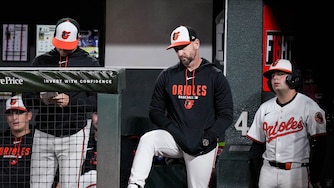
Just think: Elias sat on a dais with Craig Albernaz, his hand-picked manager from less than a year ago who, it must be acknowledged, has not exactly endeared himself to Baltimore fans in a rocky first season on the job. There is a reasonable case (though I’m not sure I agree) that Albernaz could be dismissed after one year, but I think we all can recognize how bad it would look for Elias to fire a second manager in two seasons. With Elias still in place, firing Albernaz was a non-starter.
Elias acknowledged the disappointing career trajectories of some of the Orioles’ once-heralded draft picks, including Gunnar Henderson, Jackson Holliday and Colton Cowser — players whom Elias and his staff selected and developed.
“There’s a lot of variability and it’s really hard to be a player and kind of stay on top of your game, but if there’s anything we’re doing organizationally to give us more than our fair share of that problem, we’re looking at it,” he said. “And if I’d have that solved, it would have been solved by now.”
It’s only been eight years. Maybe in another eight he’ll find the answer.
But even as he talked about taking account, Elias remains evasive on his role in the failures — which makes sense, because he’s not about to lay out the case of why he should be fired. I’m not sure it matters, because he seems to have uncommonly stable currency with the ownership group led by David Rubenstein and Michael Arougheti.
For Rubenstein, he’s more or less told us that he defers to Elias’ expertise. For Arougheti, I sometimes wonder if he fears looking like a New York-based interloper in Baltimore’s baseball affairs. I would argue that three years into his ownership, plenty of fans would welcome his intervention if it helps get the franchise back on track.
Here’s what Elias gets after back-to-back underwhelming seasons: more staff, including a general manager he’ll have a say in hiring (to which I’ve asked: is this a truly appealing job?). The Orioles are looking for “outside voices,” Elias said, which seems to imply that new blood is required for a franchise that has completely stalled out. But incredibly, the voice at the very top will stay the same — even though there’s nary a playoff victory to point to as proof of concept.
I will say here: Elias has accomplished things, because that 2022-early 2024 stretch never felt like a total flash in the pan. He has evolved with the expanding resources of the team’s owners, signing extensions and free agents. The acquisition of Alonso this past offseason was a coup, but the victory was wasted by the front office’s inability to build a cohesive roster around an MVP-caliber talent.
I’m as flummoxed by some of the young Orioles stalling out as anyone, especially a player as talented as Henderson. But there’s a difference between media and fans not understanding what’s going wrong with a star and Elias, who has managed every step of Henderson’s career, not having the answers.
Everything about the Orioles feels stuck.
They have returned to a disappointingly middle-class MLB team after a painful rebuild, hoping for a brighter future which fans are justifiably cynical about.
As a columnist, I feel stuck — writing again and again about how the president of baseball operations must be held accountable for his shortcomings. Is anyone up in the Warehouse listening? I might as well be shouting at the Camden Yards left-field wall.
Elias feels stuck, too, as strange as it might seem to frame it that way. Every time he sits in the Orioles dugout, or in front of a press conference to recap another season that undershot expectations, there is an out-of-body surrealism to the exercise. He talks about searching for solutions to problems that he helped create, about changing a culture that he helped establish, about fixing players that he was charged to develop.
If I squint hard enough, I can see him as Sisyphus, rolling a rock up the hill again and again, then trying to publicly account for why he can never reach the summit. Even if he doesn’t always publicly flay himself in press conferences, it’s easy to imagine that Elias understands that so many of these flaws — the weight of the stone itself — can be traced back to his own doing.
For the Orioles, it’s a kind of purgatory. We’re all in it. Elias is, too.


Comments
Welcome to The Banner's subscriber-only commenting community. Please review our community guidelines.