
The Orioles’ disappointing season feels unusually heavy, and quite different from similar seasons we’ve experienced in the past.
There are more questions about the roster and many of the players it’s built around than there were six months ago. The Orioles also give the appearance of having a front office in flux, if not disarray.
The improvements that were meant to come quickly under new manager Craig Albernaz — described by president of baseball operations Mike Elias a year ago as “ready to hit the ground running” — never materialized.
However you count the problems, a second straight October without playoff baseball means there’s no hiding from them. And, for each of them, I keep coming back to how Albernaz must ultimately be the solution. That’s an uncomfortable spot for the organization, based on how this year has played out.
In accepting his Most Valuable Oriole Award last Wednesday, Pete Alonso noted that the clubhouse is full of players with “talent coming out of their ears and their eyeballs,” and the challenge now is turning that talent into wins.
I’d extend that beyond just Albernaz’s remit of improving things at the major league level, where he’s constantly called attention to the Orioles being below the standard required for consistent winning baseball.
Read More
Let’s remember why Albernaz was hired to begin with. Last October, Elias introduced him as “one of the up-and-coming managerial talents, but also coaching and player development talents, in the sport.” The expectation was that a team built around young, talented position players would quickly benefit from Albernaz’s skill set and the staff he assembled.
They can point to Adley Rutschman’s first half and Coby Mayo’s second as proof of concept. I can maybe be convinced that Gunnar Henderson’s last two months go in that category, though the first four months were extremely disappointing.
Colton Cowser proved himself an everyday defensive center fielder but finished with fewer than 400 plate appearances due to his issues with left-handed pitching. The most inexperienced of the bunch — Samuel Basallo, Jackson Holliday and Dylan Beavers — can point to injuries that derailed their seasons, but they weren’t at their best even when on the field.

The performance of the Orioles’ homegrown group of position players remains the singular driver of their fate. For all those players (except for Rutschman, who now plays in Boston), attention to detail in their overall preparation, how they handle their at-bats and how they elevate their defensive consistency will continue to dictate this team’s upside into 2027.
Albernaz is quick to note a few things on those fronts. When he points out the moments where they are lacking, he emphasizes that improving them is his job as the manager.
That leaves a couple of conclusions. One is that he didn’t do a good enough job fixing them on the fly, though Monday he discussed the implementation of cutoff and relay drills on the first day of every series to bone up on that early-season deficiency. He said that is “not commonplace” at the big league level and led to improvement.
That he had to do that at all speaks to how deep the issues ran. The Orioles weren’t a good team last year and almost immediately began this season inconsistently. They never overcame those deficits, and no matter what his vision for his first big league club, that central issue overwhelmed everything.
He knows that. You can see how it consumes him. I don’t think I’ll ever forget his exasperated rage after a loss to the Brewers, when he singled out Jeremiah Jackson’s first-pitch groundout after nine straight balls as “not winning baseball” and exemplary of the need to elevate standards around the Orioles.
I get the sense that was only the most public and emphatic delivery of a message that Albernaz has sent many times in many ways to Elias and the Orioles’ front office. Elevating those standards probably means managing differently, now that he has a year of experience and knowledge of how the Orioles do things. But it’s also going to impact the rest of the organization.

The two areas of the front office that Elias is seeking to change, through the departure of vice president of player and staff development Matt Blood and the shifting duties of assistant general manager for analytics Sig Mejdal, have a significant application to Albernaz’s job.
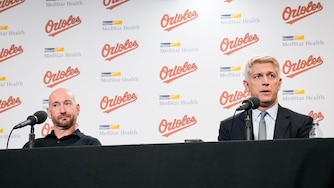
Elias said Monday that Albernaz has a “huge say” in player development. It’s hard to be an “organizational guru during the season, but he is very involved and will continue to be” with his “high-quality knowledge and opinions in that space,” he said.
At another point, Elias said in response to a question about analytics that the Orioles “haven’t done well executing on that front, or well enough on that front by appearances of the results,” so they are looking at making changes.
It should be no surprise that the areas of baseball operations that most directly impact his team are set to be overhauled. Albernaz’s first year didn’t go as planned, but his influence is clearly growing with the Orioles.
For any of it to make a difference at Camden Yards — for the Orioles to win enough to fill it back up and for all the skepticism around this team to dissipate — Albernaz’s standard is probably going to chart the direction.
That goes for Elias’ own offseason work, too. He admitted around the trade deadline that this team wasn’t built around defense. That was clear all year and can’t persist as he identifies both offseason upgrades to the major league lineup and depth for when things go sideways.
Fixing what Albernaz believes needs to be addressed is only fraught because his first season here proved so disappointing.
His energy and enthusiasm in the winter and spring generated those positive feelings among the fanbase. People in the organization buzzed about how special he was and the difference he was already making. He was assured in how ready he was for the task, preaching constant improvement, accountability and communication.
Instead, this team had all the same problems it did last year. Moments like his much-discussed disagreement with Basallo over playing through injury and the pointed language aimed at bit players after losses in the last home stand don’t do him any favors.
All that, really, is framed by the team’s record. If this season were a success, he’d have been behind it. Letting him further make his mark on the organization in all the areas he was hired to improve would feel like an earned natural progression.
It instead feels as if the Orioles are almost backed into a corner, with no choice but to trust all the reasons they picked Albernaz and acknowledge that all the things he couldn’t fix quickly ran deeper than him.
After years of trusting players early in their careers and seeing his team’s fortunes rise and fall with the volatility of that, Elias must now center the feedback of the first outside voice he’s given a say to help bring winning baseball back to Baltimore.
Development is messy, as Albernaz likes to say, and it always will be. He’s getting a chance to clean that up, and Elias’ tenure in Baltimore rides on it.


Comments
Welcome to The Banner's subscriber-only commenting community. Please review our community guidelines.