
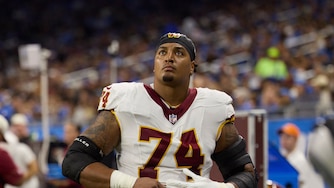
ASHBURN, Va. — The hardest part about Brandon Coleman’s crazy offseason plan was finding just the right way to tell his wife.
Lost in his career, and lost in his thoughts, the Commanders offensive lineman knew he needed to go somewhere. Somewhere that wasn’t familiar. Somewhere that wasn’t comfortable. Somewhere that wasn’t ... here.
But the place and person he picked were admittedly a little extreme.
“Middle of nowhere,” he said with a chuckle.
The destination: Tuscaloosa, Alabama, on a football pilgrimage of sorts.
His host: Laremy Tunsil, the player who took his job at left tackle last season, only to get hurt early in camp this year, pushing Coleman back to left tackle with the task of protecting the franchise quarterback.
Read More
Neither of them knew it would play out that way during this summer foray an hour outside of Birmingham and five from Atlanta. All Coleman knew was Tuscaloosa offered the University of Alabama’s facilities and just about nothing else. It’s a place where players go to be left undisturbed in an oppressively humid football cocoon.
Coleman was ready for it. But he wasn’t sure if his wife, Emily, would be on board.
“I started off by saying, ‘You don’t have to come,’” he recalled. “But she was like, ‘No way.’ I owe her a lot for that.”
So the Colemans packed up the essentials from their Dallas-area home, where they usually spend the offseason, and headed for the abyss.
For close to a month, the Washington Commanders’ most important offensive lineman followed Tunsil’s regimen. Learning. Tinkering. Reinventing a former third-round pick into someone who could finally protect Jayden Daniels. He was searching for any detail that could lift him from fledgling lineman to foundational piece.
“You spend time around Laremy, you are bound to pick up a thing or two,” Washington head coach Dan Quinn said.
And Coleman did.
But only when he arrived did he realize that his biggest problem wasn’t on the field at all. It was in his head. And three weeks in Tuscaloosa showed him something he never knew he needed.
It might just change Washington’s season.
Slowing it down
The days started leisurely in the small college town. Alabama practices in the mornings, hoping to avoid the heat. So Coleman and Tunsil had the sunrise to themselves.
Coleman ate breakfast with Emily and went over the plan for the day. He had to arrive at the facility by 11 a.m. and be ready for weightlifting at noon.
It was a far cry from the frenetic pace of a training camp, where days usually start before dawn and practice begins by 8:30 a.m. In Alabama, there was time to think.
Tunsil went to Ole Miss, an archrival of the Tide, but developed contacts all over his offseason home. One of his main strength coaches is Alabama’s Dominic Studzinski, or “Coach Dom” for short. The high-energy weightlifting wizard met Tunsil when he was at Mississippi and later reconnected with him in the NFL. Studzinski’s strength program weathered coaching staffs at Auburn, LSU and Notre Dame.
Under his direction, Tunsil and Coleman’s day followed an almost militant structure. When the weightlifting began, it was all regimented. Sessions were segmented into the same five basic lifts every day. It’s designed to hit all the main muscle groups that will be tested most over an NFL season. Depending on whether it was an upper-body or lower-body day, they’d add specific auxiliary lifts from there.
Tunsil learned early that having an exotic lifting plan won’t pay the same dividends as a simple one that’s repeatable. If there’s a secret, it’s “lifting heavy” on the fundamentals, said one of his protégés, Josh Conerly Jr., a second-year lineman who also trains with Tunsil in the offseason.

After 90 minutes, the schedule shifted outside for conditioning. But it wasn’t typical sprints. Instead, Studzinski worked through specific mechanical techniques to properly move a 300-pound frame. They graduated to basic speed training and only occasionally reached sprinting pace.
Tunsil’s meticulously crafted movement is what turned the former 13th overall pick into one of the NFL’s highest-paid offensive linemen. He protects the quarterback’s blind side with ballerina-like feet on a hulkish frame. Titans general manager Jon Robinson once described Tunsil’s footwork as so precise that he could “cut grass with his feet.” It’s because of how he trains.
Twice a week, Tunsil called in his football guy for minute parts of the game. They’d work in 90-minute blocks, repping just one skill the entire time.
“It can be one single step into a counter, over and over and over again,” Conerly said. “It can be repping one set versus a counter. Outside zone, inside zone, step back.”
The training is meant to be boring. It ingrains the muscle memory so much that eventually your mind shuts off from football and wanders elsewhere in the Southern heat.
“At that point, you are really just learning about yourself,” Conerly said.
And Coleman really needed to learn about himself. He came out of TCU as Washington’s left tackle of the future. In college, he helped the Horned Frogs make a magical run to the national championship game in 2022, and expectations followed from there.
He started 12 games as a rookie, protecting Daniels’ blind side. It is hard to say it didn’t work, as Washington went to the NFC championship game and Daniels had the most prolific rookie season in the history of the league.
But Coleman was just average. Pro Football Focus graded him 51st out of 89 tackles, and Washington thought they could upgrade. They brought in Tunsil and moved Coleman to left guard. His run blocking flourished, but his pass protection went down to 67th in the league.
Coleman tried everything to get back to his former self. He lunged at new techniques and grasped at any tip. It’s why he went to Alabama in the first place.
But somewhere in the boiling temperatures, he figured it out. Seeing this highly regimented, quiet life, he realized he didn’t have any stability. In Washington, he’d come into the facility at different times each day and “just kinda do whatever,” he said.
“It was all wishy-washy,” he said.
He’d triage the latest fire. See the trainer if something flared up. Worry about what he was having for lunch and dinner. His mind always cluttered.
“I was always thinking about foods I need to eat, thinking about recovery processes, like what I need nutrition-wise,” he said.
And here, as he did the same drop step for 90 minutes, he finally had clarity.
“I took my head out of thinking about myself,” he said. “I don’t care how bored I was out there. I was doing the same s--- every day. And it is on autopilot and your mind relaxes.

“You see why Laremy is so consistent — it’s because he does it all the time. He’s just working on the basics for eight years.”
So as he left Alabama, Coleman decided his ticket to the top was getting back to basics. And he knew exactly where to start.
Building the team
Between practices, as Tunsil and Coleman cruised through the Tuscaloosa streets lined with the famous water oaks, Coleman kept seeing the left tackle on the phone.
It was different people every time. At first, Coleman was confused.
“I mean this dude is always calling somebody,” he said. “He’s always checking in and always talking.”
But then Tunsil let him in on the secret. He was calling his football contacts. Coaches who could help him with techniques he saw on film. Chefs who could help his diet. Strength guys to fine-tune his workouts.
In short, he was getting everything in order, so all he had to do was focus on football.
“He’s got a guy for everything,” Coleman said. “So that’s what I did. Having people around me that know what I need. As weird as that sounds, instead of taking care of everything myself, letting people that do that professionally do it for me. That’s just the investment and sacrifice that I saw.”
Coleman came back to Dallas and hired a nutritionist and chef. In Washington, he picked one trainer whom he’d work with all the time. His workouts went back to the boring details.
“That’s being a pro,” Coleman said. “Last year, I’d come into the locker room and be doing anything. Now I have a lengthy routine to get ready. Everything is exact. Nothing is left to chance.”
And less than two weeks into camp, it paid off. Tunsil went out with a torn triceps muscle that would force him to miss most of the season. Washington moved Coleman back to left tackle, hoping he could keep Daniels upright. Last year, the second-year quarterback missed over half the season with injuries.
It is not an exaggeration to say Daniels’ health and Washington’s season rest on Coleman’s improvement.
“He’s had a great offseason,” Quinn said.
But when Coleman got the job, nothing in his routine changed.
“I was gonna do the same s--- every day,” he said. “It’s just autopilot.”
And that’s the point. His mind was finally quiet.



Comments
Welcome to The Banner's subscriber-only commenting community. Please review our community guidelines.