
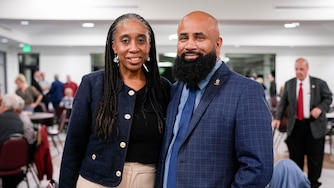
Sharonda Dillard-Huffman calls her husband, Artus Huffman, her best friend. They’ve raised three children together, navigated the challenges of ill parents, and are now campaigning for political office together — she for Baltimore County Council and he for a seat in the Maryland House of Delegates.
They’ve also filed for bankruptcy — three times in the last decade.
Their political ambitions — and Dillard-Huffman’s proclivity for excoriating current council members — have led opponents to shine a spotlight on their finances.
The Dundalk News Facebook page, which has 40,000 subscribers, shared the 62-page bankruptcy filing earlier this month. Several current council members acknowledged they’d seen it and said it prompted questions about how Dillard-Huffman would handle a position requiring fiscal oversight of the county budget as well as multiple contracts.
The Huffmans, both Democrats, owe $631,242 in student loans to various creditors as well as $98,000 in federal taxes, according to a voluntary petition for Chapter 13 bankruptcy filed April 1. A Chapter 13 filing allows people to reorganize their debt to catch up on missed payments instead of trying to wipe out the debt altogether.
Other creditors include various banks and toll authorities in Maryland and Delaware. The couple also owe more than $7,000 on the water bill for their 1,500-square-foot house in Essex.
Huffman and Dillard-Huffman say they filed for bankruptcy so they could satisfy their financial obligations. Like many Black couples, Dillard-Huffman said, they didn’t come from generational wealth and have struggled as part of the “sandwich” generation — in their case, caring for their disabled son and Dillard-Huffman’s mother.
The couple said they pay their taxes but believe their employers did not withhold the proper amount, causing them to fall behind.
“All these things come together, and sometimes you can’t manage everything,” Dillard-Huffman said. “This is an opportunity to reallocate our funds.”
She said the bankruptcy makes the couple relatable to possible future constituents, many of whom share similar struggles, and that it should not tarnish her candidacy.
“I’m not asking to be the auditor. I’m not asking to take people’s funds,” she said. “I’m not responsible for the budget.”
Roger Hartley, president-elect of the American Society for Public Administration and a professor of public and international affairs at the University of Baltimore, said the Huffmans’ fitness for office in light of their financial situation is “absolutely a fair question.”
“For some voters, they want an explanation, and when they hear it, they may be fine with it,” he said. “Others will see it as, ‘You will be making decisions on budgets, and if you can’t make better decisions in your personal lives, how can you make them for the state and the county?’”
Huffman said the couple’s financial challenges wouldn’t hurt his ability to make budget decisions and oversee state tax dollars — and that those challenges are relatable to voters.
“Like with other families, we’ve had some financial issues,” he said. “The economy is not the best right now and we’re trying to make sure that we pay what we owe.”
Court records also say that for the past six months, Dillard-Huffman has been driving with an expired license and registration after failing to show up for a hearing to fight a traffic citation after being pulled over in Annapolis. A spokesperson for the Maryland Motor Vehicle Administration confirmed that her license is still suspended as of this month.
Dillard-Huffman said she was not aware of the suspended license until recently. She said she has a new trial date.
Both jobs they seek involve oversight of billions in tax dollars. Councilmanic District 8 includes Essex, Bowleys Quarters, Rosedale and parts of Middle River. House of Delegates District 6 encompasses Essex, Edgemere, and parts of Rosedale and Dundalk.
Dillard-Huffman’s platform includes addressing housing, mental health and disability issues, and overall good governance. Huffman is focused on education, affordability, veterans’ issues and making state government more responsive to working families.
The Baltimore County Council approves the county’s annual $5 billion budget and can cut programs and items that don’t align with council priorities or represent a good use of taxpayer money. Council members review and approve fiscal matters, including real estate contracts, legal expenditures and emergency gear for police and firefighters.
“We are dealing with complex, difficult financial issues. Understanding the importance of balancing the budget is fundamental to the job,” said David Marks, a Republican who has represented the greater Perry Hall area on the council for 16 years and is running for reelection.
If elected to the General Assembly, Huffman would have a vote on the approximately $70 billion state budget and the ability to request grants for local projects known as legislative bond initiatives. The extent of his participation in budget negotiations will depend on his committee assignment within the 141-delegate chamber.
Six candidates are running for the three District 6 seats. Huffman and fellow Democrats Rayneika Robinson and Megan Ann Mioduszewski are challenging Republican Dels. Robin Grammer Jr., Ric Metzgar and Bob Long.
Long said voters need to consider a candidate’s fiscal acumen. He noted that as a real estate broker, he must have his credit reevaluated every two years.
“You have to know how to spend money and have to balance the budget,” Long said.
Dillard-Huffman’s Republican opponent, conservationist and truck driver Josh Sines, said he was aware of the bankruptcy filing but declined to comment.
Education and experience
Dillard-Huffman earned her master’s degree in public administration through in-person and online courses at Strayer University; she also said she has studied in person and online at the University of Phoenix. Huffman earned a master’s degree in special education and teaching at Grand Canyon University, a for-profit Christian college based in Phoenix with a large online enrollment, as well as a doctorate in educational leadership and administration at Capella University, which is primarily online. They both have undergraduate degrees from Morgan State University.
Dillard-Huffman said she was “young and dumb” to borrow funds to earn her master’s, which took 15 years because she was a working mother.
Huffman called student loan companies “predators.”
“We didn’t understand the logistics of it,” he said of borrowing money for their education.
He said if not for the mountain of interest accruing, the debts he and his wife accrued would be easier to address.
Financial experts say many large financial deficits start out as smaller ones — not paying a medical bill or a toll, only to see the problem compound. Dillard-Huffman believes that may have been what happened with the $7,000 they owe the city for the water bill. In three-bedroom, two-bath homes like theirs, water bills are usually about $80 per quarter.
“I do not know why I owe that much on my water bill,” she said. “It’s just something they said I owed.” Her husband said he has been trying to fight it because “there’s no way we do that much water use.”
A spokesperson for the city’s Department of Public Works said they could not comment on the Huffmans’ bill.
Dillard-Huffman earns $150,554 as an inclusive housing manager in Montgomery County; her husband earns $129,168 as a school administrator for Baltimore County, according to their bankruptcy filing. Because of that stability, Huffman said, they’ve helped less fortunate family members.
Dillard-Huffman has been vocal at council meetings about the compensation for full-time council members. The salary board recommended $140,000, but the council later increased its pay to $119,750, well above the median household income for Baltimore County. According to the U.S. census, the median household income is $87,884.
Dillard-Huffman said she thinks the council lowballed the new salary because they knew what she made and sought to punish her for her critiques. She blasted members for approving a pension increase tied to salaries that would have given retiring members a windfall, calling the episode “pensiongate.” The council later rescinded the legislation because of widespread criticism.
Huffman believes his wife’s outspokenness prompted some people to attempt to embarrass them by posting the bankruptcy online. He said he and his wife always knew it could be weaponized against them. He said he hopes that voters focus on the work the couple have done since coming to the area two decades ago — he to take a job at Martin State Airport and she to assess flood-damaged properties as an insurance adjuster after Hurricane Isabel in 2003.
“My community involvement, my wife’s — the things that she has done in her career — shows how we are good stewards and we would be good elected officials,” he said.
Dillard-Huffman pointed out that “perfect credit and a perfect life” should not be the standard for office, and that other candidates have had blemishes.
“I have the education and the experience to be an excellent councilwoman,” Dillard-Huffman said. “And me not paying some bills is not going to change my character.”


Comments
Welcome to The Banner's subscriber-only commenting community. Please review our community guidelines.