
Jason McGill and Jeff Latta share a couple of key things in common. They’re both from Hagerstown and participate in ministries to help local people.
But they are on opposite sides of a heated issue that has sharply divided their hometown. McGill believes a planned Immigration and Customs Enforcement detention facility on the outskirts of town will harm their community, while Latta sees it as “wonderful” job creator.
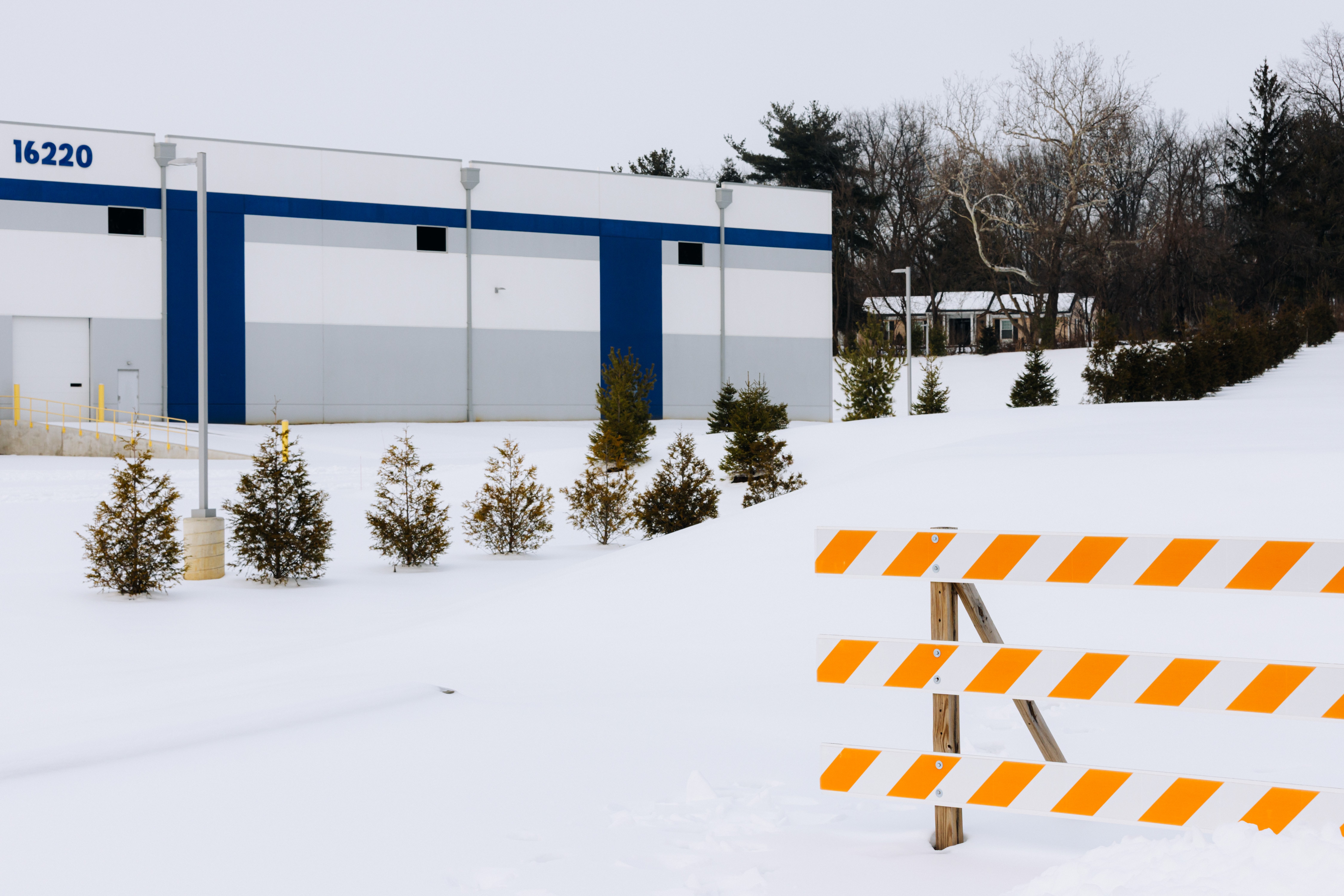
Such is the tense debate in Western Maryland’s Washington County, where the federal Department of Homeland Security bought an 825,000-square-foot warehouse with plans to retrofit it into a detention facility for up to 1,500 immigrants.
Opponents say county government is failing residents by refusing to try to stop ICE from moving in.
“I would want people to stand up for my rights, so we need to stand up for their rights as well,” said McGill, who runs a local bookstore and nonprofit.
Others call it a necessary part of President Donald Trump’s stepped-up immigration enforcement strategy.
“There has to be somewhere for them,” Latta said of detainees suspected of residing in the country without legal status.


Almost everyone is grappling with what it means to have the immigration crackdown come to their backyard. Will more detention beds tax infrastructure such as the water supply? What about traffic, security and the capacity of local emergency services?
County officials have said they don’t have the answers because, in part, the federal government hasn’t shared plans with them.
Maryland Democrats took a crack at effectively banning ICE detention facilities in the state years ago by passing the Dignity Not Detention law. Now, in Trump’s second term, they are trying to push even further to match the White House’s more aggressive strategy.
Read More
This month, Gov. Wes Moore expressed concern over the facility’s economic and infrastructure impact and “a troubling lack of transparency” over the site’s acquisition in a letter to DHS Secretary Kristi Noem. U.S. Rep. April McClain Delaney, who represents the Hagerstown area in Congress, introduced a bill to prohibit federal funding for the site. There’s also a new bill introduced in Annapolis to ban facilities similar to the one in the federal plan.
In Howard County, Executive Calvin Ball revoked the permits for a planned Elkridge ICE facility last month, and the Baltimore County Council passed legislation Tuesday banning immigration detention centers after reports of a newly leased ICE office in Hunt Valley.
But in politically conservative Washington County, one of Maryland’s nine former 287(g) jurisdictions where the local sheriff’s department had a collaborative agreement with ICE, a muted government response has set the stage for a fierce debate.
Dividing a community
The warehouse sits on the outskirts of Williamsport, a small, bucolic town just southwest of Hagerstown dotted with plaques commemorating the area’s Civil War history.
In the shadow of a decommissioned power plant on the eastern shore of the Potomac River, Williamsport was once a crossing point for Union and Confederate troops and a way station along the Virginia Path, a major route for enslaved people fleeing captivity to Pennsylvania.
Locals say the massive, white-and-blue building on a winding residential road was designed as a mundane distribution facility, but a big box company like Amazon never moved in. Now the Department of Homeland Security is preparing it for its own kind of logistics.


In 2024, 65% of Williamsport’s roughly 2,000 voters cast ballots for Trump, who rode explosive rhetoric about immigration to the White House for a second term, putting it five percentage points higher than all of Washington County but far from the reddest census tract in Maryland.
During The Banner’s visit this month, many were reticent to talk about the proposed facility. There are a number of houses right across the street, but homeowners declined to talk or didn’t respond to requests. A patron at a local bar joked they’d need a couple more drinks before offering an on-the-record opinion.
For now, the opponents and supporters have been more vocal in the county seat of Hagerstown, the bigger and more politically liberal nearby city.
“I’m very concerned about watching what happens when ICE comes into a local community and the impact that it has on individuals and businesses,” said Dawn Didion, 64.
Didion, a Hagerstown resident who joined a recent demonstration outside a County Commission meeting, said she and her allies watched what has transpired in Minneapolis and other cities and fear the same show of force in their community.


Last week, the County Commission voted unanimously to express full support for ICE in “their efforts to maintain public safety and uphold the rule of law.” But Didion said that’s not the reality she sees.
ICE agents “cross any line they want to. They believe they are above the law,” she said.
Although Washington County is majority non-Hispanic white, the area has a small but visible Latino immigrant community, said immigration attorney Alexander Zeno, along with slowly growing pockets of African and Haitian immigrants. Some opponents of the warehouse cited the plight of Melissa Tran, a beloved Hagerstown resident deported to her native Vietnam last year.
“We live in a very diverse community, and these people contribute to our community every day,” 29-year-old Claire Connor said.
As news of the facility spread, the all-Republican county commissioners have tried to keep a lid on public discussions despite protests.
At the Feb. 3 meeting, County Administrator Michelle Gordon read a prepared statement, ceding the federal government has wide latitude and the county was powerless to stop it. No public comment was allowed.


That was apparently because earlier disruptions at meetings unrelated to ICE had caused the commissioners to pause public comment. Instead, after Gordon read the statement, the commissioners moved on to routine matters like snow removal while shouts of “ICE out now” and “do your job” could be heard from outside their chambers.
After Commission President John Barr highlighted the county’s recent Groundhog Day celebration as an expression of community values, some of the few dozen protesters seated in front of him holding signs with anti-ICE messages let out gasps and sighs.
For Taj Smith, president of the local chapter of the NAACP, there was no forgiving the commissioners for their failure to try to use zoning and infrastructure regulation to gum up, or even stop, ICE’s plan.
“At a minimum, they should be saying, ‘Let us figure out what our options are, we’re working on it ... we hear what you’re saying,” said Smith, who is running for a seat on the commission in November.

Hagerstown resident Shaun Porter said concerns like Smith’s are woefully misplaced. Porter supports the facility and questioned why demonstrators directed their ire at their local government when this was a decision made in Washington.
Attending a recent commission meeting to counter the protesters outside, Porter said the facility will “facilitate what we want to see happen” by allowing for the arrest and deportation of more people in the country unlawfully.
There was even a flash of violence at the demonstration. A man sporting a bright red MAGA cap allegedly struck a protester outside the Feb. 3 meeting after a confrontation and was handcuffed by a sheriff’s deputy.
County officials are saying little about a development they say they could not block even if they wanted to.
Danielle Weaver, a spokesperson for Washington County government, said in an email there were “no plans for further discussion” of the facility.
Stitching it back together
Just down the street from the county building, Latta and his team at the Mount Hope Center, a food pantry and prison ministry, see dozens of people in line to receive fresh produce every day.


The aging building feels like a creaky VFW hall, its marque displaying a clock with the words “time to pray.” Team members ask people to show a photo ID to receive food, and, lately, they’ve been noticing more people using foreign passports.
“We’ll help anybody that comes in. We don’t ask any questions,” said Mike Williams, Latta’s colleague.
Latta and Williams support the future ICE facility as a job creator, a way to repurpose vacant space and a necessary part of immigration enforcement. But the center’s director, Wanda Singleton, has a different view. The mention of it — and the images of ICE enforcement around the country — made her bristle.
“The Statue of Liberty is there for a reason, to welcome people. There’s gotta be a way to do that without terrorizing people,” she said.
Singleton wants a moderate, practical yet compassionate approach to immigration she hasn’t seen from multiple administrations. Even Latta and Williams said they support people who can work and support themselves coming to the U.S. to seek a better life.

Down the street at Eliza’s House, McGill, its director, opposes the facility but also wants to get people to talk about it.
Like Mount Hope, Eliza’s House is a place where people who are unhoused can get food and clothes. But it looks quite different, a bit more modern, even serving as a space to just hang out, do crafts and hold meetings.
“Everything that we center here is love and community,” McGill said.
McGill believes the ICE facility does the opposite. It punishes, alienates, divides. He hopes Eliza’s House can be a place where community members learn from one another, combat misinformation and encourage mutual care.
“We have to be out there speaking truth to power,” McGill said. “The more you come here, the more you’re going to learn about the truth.”




Comments
Welcome to The Banner's subscriber-only commenting community. Please review our community guidelines.