
The Baltimore County Council passed an emergency bill Tuesday night to block detention centers from operating in the county, amid efforts by the Trump administration to expand its immigration detention capacity.
The 6-0 vote came days after County Executive Kathy Klausmeier requested the emergency session following reports that U.S. Immigration and Customs Enforcement was opening a legal office in Hunt Valley. Republican Councilman Todd Crandell was not present.
“This legislation responds to a troubling national pattern of immigrant families being detained in facilities that have opened without notice or consideration of community impact,” Klausmeier said in a statement. “I thank the councilmembers who took swift and decisive action to support our communities and will continue working to ensure that every resident feels safe and secure.”
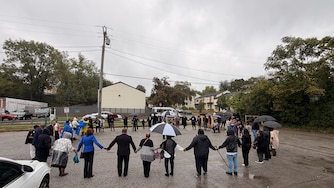
Because the council chambers are undergoing renovations, the vote was held in the Planning Board Hearing Room. The much smaller venue was overflowing with immigrant rights supporters, some carrying signs that read “ICE OUT!” and “No concentration camps in Baltimore County.” Applause erupted when the emergency measure passed.
In response to the vote, Tricia McLaughlin, spokesperson for the Department of Homeland Security, said, “The biggest losers are the people these politicians were elected to serve.”
“While the Baltimore County Council continues to try and stop ICE from arresting and removing pedophiles, rapists, gang members, and murderers onto the streets, our brave law enforcement will continue to risk their lives to arrest these heinous criminals and make Maryland safe again,” said McLaughlin, a public face of Trump’s deportation campaign who announced her resignation Tuesday.
Plans for the Hunt Valley office, located at 201 International Circle, were first reported last week by Wired magazine as part of an investigation into ICE’s planned expansion nationwide. Klausmeier confirmed that the U.S. General Services Administration, which manages government properties, had leased an office in Hunt Valley, though she said its intended use was unclear.
The legislation approved by the council Tuesday applies to detention centers and not the Hunt Valley office, which Wired reported would be used by the Office of the Principal Legal Advisor, ICE’s legal arm. But it was a sign of growing concern from both sides of the aisle about ICE’s expanding presence in the county and across the state.

The measure, introduced by Councilman Julian Jones and co-sponsored by his three Democratic colleagues, changes zoning rules to prohibit the county from issuing a permit for a detention center, jail or other facility used for “involuntary confinement,” and allows for suspending or revoking any permits that have been issued since Jan. 1, 2026. County- and state-run facilities are exempt.
Dakarai Turner, a spokesperson for Klausmeier, said the county has not received any permit requests this year for an immigrant detention center.
But Jones, who is running for county executive, argued that preventive action was necessary. Congress approved $45 billion in funding for increased immigration detention last summer, fueling a massive expansion of ICE’s enforcement. In Maryland, proposals for new detention facilities have surfaced in Howard and Washington counties.
“I don’t want to wait until I see them stringing barbed wire to act,” said Jones, a Woodstock Democrat. “I’d rather act in advance.”
The legislation marks the latest attempt by local lawmakers to push back against Trump’s aggressive deportation campaign, which has come under heightened scrutiny after federal agents fatally shot two U.S. citizens during protests in Minneapolis.
Earlier this month, lawmakers in Howard County approved a bill to block a private detention center nearing completion in Elkridge. Meanwhile, state lawmakers passed a measure banning local law enforcement agencies from partnering with ICE on civil immigration enforcement activity. It was signed into law Tuesday by Gov. Wes Moore.
In Baltimore County, the council passed a pair of bills earlier this month to formally establish an Office of Immigrant Affairs and restrict the county’s ability to cooperate with ICE. Both passed 4-3 on party-line votes.
Unlike most legislation, which must be considered over two work sessions, emergency measures are expedited but require approval from five council members. Republican Councilmen David Marks and Wade Kach joined the council’s four Democrats in supporting Tuesday’s bill.
Marks said constituents have expressed concern that ample warehouse and office space in his eastside district could be repurposed by ICE.
“I have not talked to a Republican or Democrat anywhere in my district who wants a detention center,” the Perry Hall Republican said.

Marks added that he’s spoken with a representative for the Hunt Valley property, who told him the 50,000-square-foot space would not be used as an immigration detention center and would instead serve as a “paperwork center.”
Before casting his vote, Kach, whose district includes the Hunt Valley office, criticized what he described as lax immigration policies under former President Joe Biden that allowed “dangerous people” to enter the country. He accused his Democratic colleagues of disregarding victims of crimes committed by immigrants. Some in the crowd jeered and booed his remarks.
In the end, though, he voted for the bill “in the name of working together, trying to solve a problem,” he said.
Local jurisdictions ultimately have limited power over the federal government’s authority to conduct immigration enforcement.
Jones said there was little the council could do to prevent the federal government from leasing office space, as it did in Hunt Valley.
But Councilman Izzy Patoka said local governments still must act within the authority they do have.
“While this bizarre activity that goes on at the federal level, we at the local level have to stand strong,” said Patoka, a Pikesville Democrat who’s also running for county executive. “We have to come together in rooms like this so that we’re not just spectators watching this go by. We need to be involved.”
U.S. Sens. Chris Van Hollen and Angela Alsobrooks, both Maryland Democrats, submitted a joint letter supporting the emergency legislation, which Jones read aloud at the beginning of Tuesday’s session.
U.S. Rep. Johnny Olszewski Jr., who represents Baltimore County in the House, also applauded the council’s efforts.
“I have heard directly from constituents who are deeply concerned that a significant ICE presence in our community could bring the same fear and instability that families in other neighborhoods across the country have experienced,” Olszewski said in a statement. “I appreciate the proactive leadership of County Executive Kathy Klausmeier and the Baltimore County Council, including tonight’s emergency legislative session to explore potential local guardrails and oversight.”
Some Republicans in the county’s state delegation criticized GOP council members who supported the measure.
In a joint statement, Dels. Ryan Nawrocki and Kathy Szeliga, who represent eastern Baltimore County, said the council was banning detention centers based on “speculation rather than facts.”
“Passing an emergency law to regulate a federal agency preemptively is unnecessary political theater,” Szeliga said. “ICE removes violent offenders from our communities, and Baltimore County should be assisting federal authorities to protect the public, not fighting them.”
This article has been updated with comments from a Department of Homeland Security spokesperson and state Dels. Ryan Nawrocki and Kathy Szeliga.



Comments
Welcome to The Banner's subscriber-only commenting community. Please review our community guidelines.