
In Georgia, a school district transporting more than 133,000 students says its buses arrive on schedule 99.94% of the time. In Northern Virginia, another district carrying approximately 125,000 students reports that 94% of its routes run on time.
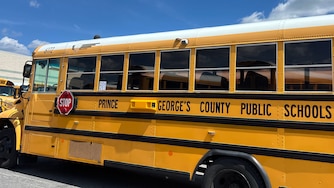
Prince George’s County Public Schools, which transports roughly 87,000 students, reported a 79.5% on-time arrival rate during the first two months of the school year — down more than 4 percentage points from the previous year.
And that district in Georgia — Gwinnett County Public Schools — uses the same school bus routing software provider as Prince George’s.
The contrast raises a question for one of Maryland’s largest school systems: What does it take to get tens of thousands of students to school safely and on time?
Transportation researchers and officials from Gwinnett and Fairfax County Public Schools told The Banner that reliable bus service depends on more than sophisticated routing software. It requires accurate student data, sufficient drivers, realistic schedules and backup plans for when things go wrong.
“Technology creates the operational plan, skilled frontline staff execute it safely on the road, and clear communication keeps families and schools aligned,” Charley Humble, Gwinnett’s executive director of transportation, said in an email.
Read More
What other districts are doing
School transportation challenges in Maryland aren’t unique to Prince George’s. Neighboring Montgomery County has faced a contentious transition to electric school buses, including a legal dispute over a $168 million contract. Baltimore County has also long grappled with driver shortages, late pickups and route disruptions.
After years of similar problems, Prince George’s County Public Schools turned to BusPlanner to improve bus routing, track vehicles more accurately and give families more reliable information about their children’s whereabouts. The district began rolling out the $3.2 million routing and tracking system, including its Chipmunk app, over the summer.
But the transition has brought a new wave of problems. Roughly 10,000 students initially lacked bus assignments, while some families reported hourslong commutes and difficulties tracking their children’s buses. The issues prompted a leadership shake-up, additional staffing and a school board request for an internal audit.
BusPlanner’s chief executive previously acknowledged that the company had not adequately stress-tested the application before its rollout.
And Prince George’s faces another challenge: its sprawling geography and extensive network of specialty programs, which can send students far beyond their neighborhood schools.
Although students generally attend schools within assigned boundaries, those enrolled in immersion, Montessori and other specialty programs may travel across large portions of the county. PGCPS warns families that commutes to those programs can take approximately 90 minutes each way.
The challenge is familiar in Baltimore City, where students can apply to middle and high schools across the city. Unlike Prince George’s, Baltimore generally relies on public transit rather than yellow buses to get students to school, with exceptions for students who require specialized transportation.
Gwinnett, meanwhile, has used BusPlanner’s core routing software since 2013, alongside a separate GPS tracking system called Samsara. The Georgia district has ranked first in the nation in school bus fleet size and student ridership for five consecutive years, according to School Bus Fleet’s annual survey.
Humble attributed Gwinnett’s reliability to staggered school schedules that allow drivers to complete multiple runs, dedicated routing specialists who continually update student information and review routes, and backup capacity to absorb staffing disruptions.
Gwinnett employs more than 2,000 transportation professionals and operates a four-tier routing system, allowing buses to serve different groups of students each morning and afternoon.
Fairfax, which ranks second nationally in student ridership, operates more than 1,600 buses serving approximately 125,000 students across 45,000 bus stops.
The Virginia district also introduced new transportation technology this school year: a navigation system that works with student identification cards equipped with radio-frequency identification technology.
“Daily coordination among drivers, schools, families, and transportation staff is crucial to our success,” spokesperson Steven Brasley told The Banner in an email.
Humble also cautioned against making sweeping route changes over summer break, recommending that districts introduce adjustments gradually to identify problems before they become widespread.
“Large, abrupt changes over the summer create operational friction and confusion for families, drivers, and schools,” he said.
Transportation problems plagued the Prince George’s summer school program in July. And on the first day of school the following month, the new tracking app crashed.
District officials later acknowledged that the transition required transportation employees to learn unfamiliar processes and contributed to incomplete or inaccurate routing information.
When the algorithm meets reality
Elise Miller-Hooks, a George Mason University professor who studies transportation network optimization, said designing school bus routes involves solving an extraordinarily complicated mathematical problem.
Routing software must account for student locations, bus capacity, school start times and traffic patterns. But a route that appears efficient on a computer might prove unreliable on the road.
Miller-Hooks said districts should test routes against real-world conditions, including heavy traffic and bad weather, before putting them into service. They must also build extra time into schedules to account for unpredictable delays.
“You need to understand better what’s under the hood,” she said in a phone interview, emphasizing the importance of having staff who understand the software’s algorithms and limitations.
The National Highway Traffic Safety Administration similarly advises districts to consider the accuracy of information used to develop bus routes, along with the safety of the routes themselves.
Its federal guidance emphasizes evaluating pedestrian access, roadway hazards, bus stop locations and how buses approach students. The shortest route isn’t necessarily the safest, particularly if it requires children to cross busy roads.
But even a well-designed route cannot reliably operate without enough drivers and buses.
Melissa Tilashalski, an assistant teaching professor at the Johns Hopkins University who has studied vehicle routing, said transportation systems need enough capacity to absorb disruptions, including driver absences. Otherwise, students bear the consequences through longer waits and rides.
“Right now, the buffer is with the student time,” she said.
What’s next for PGCPS?
District officials say they are making progress, though the latest numbers show the work is far from complete.
Unassigned transportation trips fell from a peak of 358 at the beginning of September to 123 by the end of the month, according to the district’s Oct. 22 presentation to the school board.
The district also reported 33 driver vacancies as of Oct. 14, down from 41 reported in September. It expanded its routing staff from eight to 12 employees and established a weekly team of transportation personnel and other staff to address routing platform issues.
The district’s customer service operation has also improved its response times. As of Oct. 13, the average initial response to a transportation inquiry was 30 minutes, down from approximately 3.3 days in August. Still, 770 requests remained unresolved.
In an Oct. 15 email response to The Banner, Prince George’s County Public Schools said no transportation runs serving Dora Kennedy French Immersion or Robert Goddard Montessori exceeded two hours, following adjustments to lengthy routes. In early September, the district reported that approximately half of these bus routes exceeded 100 minutes, with some specialty routes approaching two hours.
Denise Douglas, associate superintendent of communications and community engagement, said the district is working with BusPlanner to improve data accuracy, route planning and communication with families.
The district expects to launch a public transportation dashboard by Thanksgiving, while a school board-requested internal audit is expected to be completed in early January 2027.
“Our priority is not simply implementing a technology solution,” Douglas said, “but ensuring families experience tangible improvements in service reliability, communication, and student transportation outcomes.”
For Prince George’s, the challenge now extends beyond fixing a troubled technology rollout. It’s ensuring that improvements in staffing, route planning and oversight translate into something families can measure: buses arriving safely and on time every day.
This story is published as part of the Baltimore News Collaborative, a project exploring the challenges and successes experienced by young people in Baltimore. The collaborative is supported by the Annie E. Casey Foundation. News members of the collaborative retain full editorial control.



Comments
Welcome to The Banner's subscriber-only commenting community. Please review our community guidelines.