
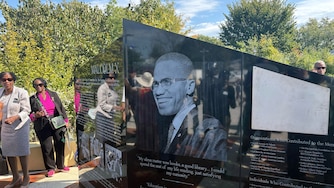
Hundreds of people gathered Wednesday morning for the unveiling of a monument honoring civil rights activist Malcolm X at the Michael E. Busch Annapolis Library.
The largely privately funded memorial is double-sided and features photos of Malcolm X from his public life and a brief biography.
Inside the memorial is time capsule filled with predictions from public figures and elected officials about what race relations will look like in the United States 50 years from now, said Carl Snowden, the convener of the Caucus of African American Leaders.
Snowden and the caucus were the driving force behind the monument, which cost $300,000 and was manufactured by Florida-based PG Memorials. It is the first permanent public art installation at an Anne Arundel County Public Library.
Though Malcolm X has no direct ties to Annapolis, many people explained why they felt it was appropriate for the controversial figure to be honored outside a library in the state’s capitol.
State Sen. Shaneka Henson, who represents Annapolis, said her question is, “Why not Malcolm X?”
Read More
While Martin Luther King Jr. preached nonviolent resistance, Henson said, Malcolm X talked about achieving civil rights “by any means necessary.”
“Those two counterparts, those two sides of the same coin, were both needed to accomplish the job that was done for liberation,” Henson said.
Malcolm X left a complicated legacy. The civil rights activist was the face of the Nation of Islam for more than a decade, which advocated for Black separatism and critiqued King’s emphasis on nonviolence. Some condemn the organization as antisemitic.

Malcolm X split from the Nation of Islam in 1964 and went on a pilgrimage to Mecca. His official website says the trip was “life altering.” He was assassinated shortly after.
“He returned to the United States with a new outlook on integration and a new hope for the future,” his online biography reads. “This time when Malcolm spoke, instead of just preaching to African-Americans, he had a message for all races.”
Skip Auld, CEO of the Anne Arundel County Public Library, said Malcolm’s personal history included discovering “the transformative power of reading.”
“This story belongs in a library. Libraries bring together people and ideas that challenge us, that unsettle us, and sometimes make us uncomfortable,” Auld said. “They invite us to listen, ask questions, and reconsider what we think we know.”
Sen. Chris Van Hollen said it was important to acknowledge all the complications of American history, especially as “the current administration in Washington threatens to erase Black history.”
As an example, Van Hollen pointed to a short-lived directive at the Naval Academy and other military academies last year that banned nearly 400 books from libraries.


“Malcolm X knew that we had to confront injustice. We must fight back against these efforts to rewrite our history,” the Democratic senator said.
The library system, and speakers at the monument’s unveiling, did not shy away from Malcolm X’s complicated history.
A brochure from the library system acknowledges that Malcolm X made antisemitic statements that “should neither be ignored nor excused.”
Auld, the library CEO, said he had many conversations with library staff and others that helped him understand “how deeply hurtful” Malcolm X’s words and legacy can be for many, especially Jewish people.
“I hope this memorial encourages people to read Malcolm’s words and reflect on his courage, imperfections, and evolution,” Auld said.
The brochure says the memorial “is not an endorsement” of antisemitic, sexist or misogynistic statements or views expressed by Malcolm X, but rather an opportunity to examine his legacy in the historical context — including “the significant evolution of his views.”
Jennifer Mizrahi, a representative of the Jewish Federation of Annapolis and the Chesapeake, said she was pleased that speakers acknowledged Malcolm X’s complicated legacy and that it meant “so much” that the library system acknowledged the Jewish community.
Mark Bedell, superintendent of Anne Arundel County Public Schools, put it bluntly, saying there will be people “who do not and will not agree” with the monument.
“But we also cannot forget, for a single moment, that progress, whether for racial justice or anything else, isn’t built on perfection,” Bedell said.
Bedell said he studied Malcolm X in college and that there is convincing evidence that the activist “broadened some of his views late in life.”
“I believe today is about persistence,” Bedell said. “That there is always time to seek what is right, that we cannot yield to challenges because the road is difficult, and that the quest to create a society where every single person feels a sense of belonging continues today.”




Comments
Welcome to The Banner's subscriber-only commenting community. Please review our community guidelines.