
The man in his mid-20s was now a target for authorities — not because of any violent criminal history, but because of his friends.
He had recently been shot and was known to be associated with people prone to gun violence. And authorities worried about what might happen next.
“It means someone could retaliate on his behalf,” Reginald Williams of the Mayor’s Office of Neighborhood Safety and Engagement told a group of public safety officials behind closed doors inside a West Baltimore church.
Over the next several minutes, Williams and his colleagues devised a plan to stage interventions with the gunshot victim and his friends, first with customized messages to highlight their risk of ending up injured, dead or imprisoned. Then the group would be given a way out: a list of the resources available should they choose to change course.
The battle-tested approach has been the hallmark of Baltimore’s Group Violence Reduction Strategy, a key component of Mayor Brandon Scott’s comprehensive crime plan. New research has bolstered the efficacy of the program, crediting its work with helping to drive Baltimore’s historic declines in violence.
Read More
And the program is growing, with the latest extension into North Baltimore.
The approach, however, has been beset by a slower-than-promised rollout across the city. It also continues to draw the ire of the city’s top prosecutor, who claims it’s ineffective and secretive.
Scott remains undaunted as the city has now witnessed a 60% decrease in its homicide rate between 2022 — when GVRS launched — and 2025. That was about a 25% greater decline than those seen in similar cities, according to a study by the University of Pennsylvania’s Crime and Justice Policy Lab, which has advised the city on the program.
Researchers Aaron Chalfin and Max Kapustin, who are not part of the advisory team, focused their analysis on the first 18 months of the strategy, which started in the Police Department’s Western District, historically one of the most violent precincts in America. The researchers told The Banner they are confident that GVRS helped reduce homicides and nonfatal shootings in the district by a third and carjackings by 40%.
According to the researchers’ paper, which is not yet peer-reviewed, the violence did not spill over from West Baltimore into other parts of the city. Nor did it correspond with a rise in overall arrests.
“You arrest 0.1% of a population in a place and see big declines in violence,” Chalfin said in an interview. “You really can see that precision law enforcement can be very impactful.”

But Baltimore State’s Attorney Ivan Bates, who cut ties with the mayor’s violence prevention office over concerns about its transparency, isn’t buying it.
In a statement, Bates said the researchers’ work appeared incomplete because they didn’t account for prosecution rates over the studied period. He touted that his office “removed approximately 4,000 violent repeat offenders from the City’s streets since 2023” without the program.
Scott once promised the program would be expanded citywide by mid-2024. The rollout is far behind schedule, at times hampered by insufficient staffing in the police unit tasked with enforcement.
Jack French, a spokesperson for the mayoral neighborhood safety office, said officials have prioritized expanding when resources are ready, rather than meeting arbitrary timelines.
Baltimore tried this strategy twice before, in the late 1990s and again in 2014, but it fizzled out each time. It’s a model that’s seen success in Boston, New Orleans and Oakland, California. In April, GVRS expanded into a sixth police precinct, the Northern District. French said data will dictate when officials expand in the three remaining police districts.
In addition to targeting those suspected of violent crimes for arrest, the program offers services to those deemed to be at risk of violence.

Among them was Jakwon Harden, who was raised in the Lexington Terrace projects of West Baltimore.
He described himself as a curious child who explored with friends when he wasn’t playing football or basketball. But adolescence brought outside influences, he said, “that encouraged me to make the wrong decisions and do stuff that wasn’t my character.” Harden, now 20, said he was later arrested for armed robbery and incarcerated. Last year, after his release, officials tried to intervene.
Harden brushed off the program at first, but one message resonated.
It came from Roca, one of the organizations working with GVRS. Mentors there teach young people aged 16 to 24 about a psychological approach to help them more productively connect their thoughts, feelings and actions.

Roca also helps them with some of the basics of leading a more upstanding life, including helping clients obtain important personal documents, such as birth certificates, and connecting them with job training and additional education.
“Ultimately, the goal would be that when they’re away from Roca, once they’ve graduated from Roca, they’ve planted those seeds to help them process what’s happening to them in real time and manage their stress,” said Bernice Walker, MONSE’s service partner manager for Roca. “And it’s not that survival mode, fight, flee or freeze, which is where a lot of bad decisions are made.”
Harden said being away from his family while he was locked up made him realize what would happen if he continued making bad choices. Roca, he said, taught him how to avoid them.
“Actually instead of reacting on feelings, thinking about why I’m feeling that way and thinking about ways I can change,” Harden said. He’s now working to complete his high school degree before entering a trade school.
Before Harden or anyone else is approached, the city’s anti-violence strategy team holds two meetings each week to craft a comprehensive plan.

The first is a confidential law enforcement briefing where officials go over every homicide and nonfatal shooting that happened citywide in the last week. Then they single out which ones involved three or more people who might be willing to commit more violence on behalf of one another.
With that information in hand, they decide which group members should be arrested — and which might benefit from the services they provide.
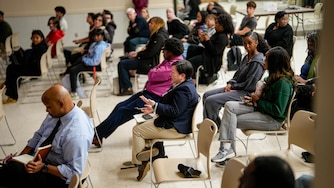
The second meeting happens at Doxa Ministries Church Without Walls in West Baltimore. Representatives from MONSE, Baltimore Police, the state’s Division of Parole and Probation, and service providers are joined by well-known community figures to come up with a plan for how to approach those selected.
“Is anybody familiar with this young man?” Williams asked about the gunshot victim whose picture faced the room full of officials.
A state agent told Williams the man was on probation for auto theft and that he had reported being unemployed. Nobody else had any information.

Nevertheless, that was enough to get started.
Three days later, an intervention team assembled to find the man.
Williams was part of the convoy that included two detectives with Baltimore Police’s Group Violence Unit. They were joined by Joyous Jones, a community figure who lost her only son to a suspected drug overdose, and a representative from another social services provider called the Youth Advocate Programs.
After striking out at the homes of several men on their list, they arrived at the residence of the man shot in North Baltimore. They approached the home, and a shirtless man inside opened the door.
Williams later recounted the conversation, which took place outside the earshot of a Banner reporter. He recalled explaining that he was with the mayor’s office and emphasizing that the person was not in trouble.
“My objective here is to keep you alive, safe and free,” Williams said he told the man.
Then he turned it over to Jones, who has a unique approach to conversations with gunshot victims.

“If you’re here on purpose, then make it for a purpose,” Jones said she usually tells them. “And I say it from a motherly standpoint. I don’t drill it down their throats, but I give them a stern motherly love. And I hug everybody. I’ve had some really tough characters that melted like butter.”
Williams returned to his Jeep Compass after a few minutes. He reported that the man had been nervous at first because he had seen the police, but then opened up a little.
“He even told Ms. Joyous that he was looking forward to receiving services,” Williams recalled.




Comments
Welcome to The Banner's subscriber-only commenting community. Please review our community guidelines.