
After one young Latina woman moved to Paddington Place in Annapolis more than 15 years ago, she recalled neighbors warning her family to steer clear of the people living in the last house on the right.
Across the street, an older Latina woman with grown children said she never allowed her kids to play in front of that same brick-faced two-story. Even now, when she walks her dogs, she avoids the sidewalk in front of the house.
“They are racist,” said a third neighbor, a Salvadoran mother, about the people who lived in the house. Her family moved to the neighborhood about 20 years ago, when only one other Latino family lived on the street.
The house at 1010 Paddington Place is where the Smiths, who are white, lived — 43-year-old Charles Robert; his mother, Shirley; and his father Charles Randall “Randy” Smith, who died in 2020.
“We knew that he [Charles] looked for trouble with everyone around here,” said the Salvadoran mother. “All the Hispanic people.”
But she said she never knew the Smith family had guns in their home until June 11. That’s when, according to police, the younger Smith shot six people, most Latino, killing Nick Mireles, 55; of Odenton, his son, Mario Mireles, 27, of Annapolis; and Christian Segovia, 24, of Severn, and injuring three others. Authorities have not said whether they believe the victims were targeted because they were Latino.
The victims were attending a birthday party at one end of the street at the home of Mario Mireles’ mother when a dispute over parking ignited the toxic relationship that had been brewing between the families for years.
The Salvadoran mother said bullets from Charles Smith’s gun that Sunday pierced a hole in her second-story window feet above where her daughter was sitting in the grass with her boyfriend and her dog.
A second bullet hit the ground in her yard, close to the tree her daughter, daughter’s boyfriend and dog were sitting under, she said. And another bullet hit her neighbor’s house — the wall closer to her driveway — near where her son was parked, she said.


It wasn’t random, she believes, because Smith had a history of conflict with her family, too.
In December, she said, Charles Smith walked into the street and yelled at her daughter because he said she was taking too long to park their car.
“These Mexicans,” she recalled him saying. “These sons of bitches.”
Now the mother doesn’t know how safe her family is, and she’s not the only one.
Many in the neighborhood and the Latino community said they believe the shooting was racially motivated, including family members of the victims who have called on authorities to bring hate crime charges.
Smith is being held without bond as he faces three charges each of second-degree murder, attempted second-degree murder, first-degree assault, and related gun charges. But authorities have yet to determine whether to charge Smith with a hate crime, according to a spokesperson for the Annapolis Police Department. The FBI deferred all questions to Annapolis Police.
An attorney for Smith did not respond to interview requests for this story. Efforts to reach Shirley Smith were unsuccessful.
Some Paddington Place residents waved away conversations about the neighborhood. People they had known for years and had grown up with had been killed steps from their homes. The unease of a still fresh and brutal mass shooting lingered.
But those who agreed to speak to The Banner under the condition of anonymity because of fear for their safety, some in Spanish, reported racist language and intimidation directed at Latino residents from members of the Smith family.
The Smiths were one of the first residents on Paddington Place, according to public home ownership data. But since the couple bought their home nearly 40 years ago, the names and faces of the people living in the split-level ranchers dotting the sidewalk-lined street have changed.
As in many Maryland suburbs, the area just off of Edgewood Road has grown racially and ethnically diverse, especially in the last two decades. Census data show the white population surrounding Paddington Place has dipped amid burgeoning Black and Hispanic populations. The Hispanic population alone has nearly quadrupled, now making up 10% of the area and similar to Maryland’s statewide demographics and statistically representative of Maryland’s 11.5% Hispanic or Latino population.
Change is even more dramatic on Paddington Place. When the Smith family purchased their home in 1984, none of the homes had Latino owners. Today, of the 12 homes on the street, more than half do, all but one of which moved in after 2000.

One neighbor described the Smiths as a “bad egg” family. The young woman who moved in more than 15 years ago described the rest of the neighbors as close-knit; they regularly texted each other.
She said the father, Randy, had “a reputation” for yelling, “Go back to Mexico,” out of his car window as he drove down the street. Although she had never witnessed the elder Smith doing so, she knows others that have and said it’s not uncommon for Hispanic people living in Annapolis to hear someone tell them this. It’s something she’s had to learn to shake off.
Latino community leader Roxana Rodriguez has lived in Annapolis for 27 years. The entrepreneur has known Mario’s mother for years. The family would come to her restaurant, Caliente Grill, she said.
She said the shooting of Latinos allegedly by a white man has put the Latino community on edge: “It’s really devastating.” And she has heard stories of people changing their behavior because of the shooting.
One of her Latino tenants in another neighborhood had a conflict with a neighbor about where she put a trash can.
“The owner — who was not Hispanic — came out and said, ‘Don’t touch my property,’ ” Rodriguez recalled.
The tenant, Rodriguez said, thought about arguing back, but remembered that something as minor as parking set off the shooting on Paddington Place.
Carlos Cuevas, a clinical psychologist and co-director of the Violence and Justice Research Laboratory at Northeastern, said it’s typical for people to change their behaviors because they’re concerned with being targeted.
Hate-motivated attacks “aren’t just about victimizing the individual,” Cuevas said. “They’re offenses that send a message to the community.”
Federal data shows that Latinos, and particularly immigrants, increasingly have been targeted nationally.
The FBI hate crime data shows crimes targeting Latinos rising from 299 in 2015 to a high of about 700 incidents in 2021, the latest numbers available.
One factor fueling conflicts across the country is the Great Replacement Theory, a conspiracy theory alleging that white people are being systematically replaced by immigrant and minority communities, one expert said.
Michael Jensen, research director of the START Consortium at the University of Maryland, a government-funded think tank studying the origins and impacts of terrorism, said that the 2019 mosque shooting in Christchurch, New Zealand, the 2019 Walmart shooting in El Paso, Texas, and the 2022 grocery store shooting in Buffalo, New York, have all been tied to this theory. Authorities in Annapolis have not tied the shooting to the theory or identified race as a motive.
Yelling phrases like “go back to Mexico,” also dehumanizes people, Jensen said.
“It lowers the barrier to violence, when you stop seeing the other person as human and start seeing them as evil and a threat,” Jensen said.
As demographics change, racial tensions in some communities have erupted into harassment and sometimes violence.
Darrius Varnell Dickerson, who said he was Smith’s friend and fellow veteran, met Smith in 2021 when he said the men were recovering from their military experiences at Perry Point VA Medical Center in Maryland. Since then, the two regularly texted and have hung out a few times.
A U.S. Army veteran, Smith suffers from post-traumatic stress disorder, his then-attorney, Mark Howes, told a judge June 13. Another friend who met Smith after he left the military said he had witnessed Smith being triggered by noises.
Dickerson said Charles Smith had told him there were “definitely” MS-13 gang members living near him but provided no evidence of why he believed that.
“He [Smith] didn’t feel as safe as he would like in his own neighborhood,” Dickerson said, adding he didn’t believe the shootings were racially or ethnically motivated.
Although two of the men Smith is charged with killing that night had unresolved criminal cases, The Banner found no evidence in public records of gang-related activity.
Public records revealed a troubled past for Charles Smith and previous confrontations between the Smith and Mireles families.
In 2012, Smith was charged and acquitted of stabbing an off-duty sheriff’s deputy in Georgia. Smith told the jury he blacked out after the alleged attack and woke up in a jail cell. Smith testified at trial that the deputy’s dog attacked him — biting through his finger almost to the bone — while he was on a walk in his neighborhood, according to a transcript. Smith said he pushed the dog away in self-defense and that the sheriff’s deputy threw him to the ground and caused him to hit his head. He testified he didn’t remember what happened next.
In 2016 Shirley Smith sought a peace order against Mario Mireles, alleging he backed his car out of his driveway forcing her to quickly brake. Weeks later he hit her car with a wet towel or blanket as she drove past, she wrote. She filed a second peace order against Mireles’ mother, Harcinia Ruiz, saying Ruiz had come to her workplace, a grocery store, to harass her.
In his peace order request, Mireles alleged Shirley Smith had “always had problems with me and my neighbors say[ing] racist thing[s],” since he was 11, he wrote. She had driven her car past him fast and close, “as in targeting me,” he wrote in the application, adding “This has bin my first time ever being shocked thinking my life was going to be on the line.”
The court denied all three peace orders.
Many questions about the deadly shootings on Paddington Place are still unanswered.
Annapolis Police spokesperson Bernie Bennett said investigators are trying to determine the age of bullet holes found in the Smiths’ home. Smith had told police at the scene that he fired his gun because someone had shot at his house.
Bennett said officials are awaiting a ballistics update on all the bullets found at the scene from the Bureau of Alcohol, Tobacco, Firearms and Explosives and the Federal Bureau of Investigation. The FBI confirmed they assisted Annapolis police in processing the crime scene.
And investigators have yet to determine whether hate crime charges should be added to Smith’s existing charges. Maryland’s hate crime statute allows prosecutors to add years and financial penalties if a crime was motivated by hate toward a person or group belonging to a constitutionally protected class, such as race or ethnicity.

José Anderson, a professor of criminal law and procedure at the University of Baltimore School of Law, said a prosecutor has broad discretion whether to level a hate crime charge.
Prosecutors must determine whether they have “tangible facts that would constitute probable cause to show that the criminal activity was motivated by racial hatred, or other racial animosity,” he said. The process is “fact dependent” and could include a demonstrated history of racial hatred, Anderson said.
“If you have statements of many witnesses who have identified a long time period of conduct that seems to be focused on racial factors, then that would be the kind of information that would support a charge of hate crime,” he said. A judge, however, has discretion over what evidence is admissible at trial, he added.
To win a hate crime conviction, the prosecutor must prove the defendant guilty of acting on racial hatred beyond a reasonable doubt, Anderson said.
Oftentimes, the legal system at large tends to emphasize a higher burden of proof than is legally required by law, said Brendan Lantz, a criminal justice professor at Florida State University who studies hate crime. The act itself does not need to be explicitly racist, he said, but prosecutors must prove race was a motivating factor.
”There’s a lot of discrepancy between what could be and what is treated as a crime,” he said.
The Banner reached out to the Anne Arundel County State’s Attorney’s Office, the FBI and the Annapolis Police Department to ask whether hate crime charges are being considered and if so, when authorities will make a decision. All three agencies declined to comment because the investigation is ongoing.
But only when all stakeholders — community members, families of the deceased and political leaders — are engaged in determining policy can there be substantive change, Cuevas said.

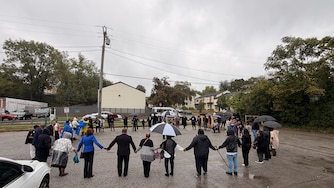
At a vigil for Mario and Nicholas Mireles and Christian Segovia, Annapolis Mayor Gavin Buckley promised that “from the governor’s office to the … mayor’s office — we will fight for you.”
But Julian Segovia, Christian’s brother, asked: “We see it time and time again, administration after administration — what has changed?”
Rodriguez, the Annapolis restaurant owner, said the path forward is to rebuild a breakdown of trust and a sense of community. Neighbors need to connect, she said. She held a fundraiser Sunday for all of the neighbors of Paddington Place, which includes giving every child on the street a teddy bear, “So they can hold onto something,” she said.
One silver lining, she said, is that the broader community has come together.
“I think that everybody has felt like this tragedy was their own,” she said. Rodriguez described the Annapolis she knows as a loving and welcoming place.
And part of moving forward is for the system to deliver justice, which for her means “making sure that Smith understands what he did,” she said. “Because people are not alive anymore.”
“It’s hard because whatever was done, it’s not gonna come back to what it was.”
Penelope Blackwell, Brenna Smith and Taylor DeVille contributed to this report.
brenda.wintrode@thebaltimorebanner.com, clara.longo@thebaltimorebanner.com, nick.thieme@thebaltimorebanner.com, penelope.blackwell@thebaltimorebanner.com
Correction: This story has been updated to correct Christian Segovia’s age.



Comments
Welcome to The Banner's subscriber-only commenting community. Please review our community guidelines.