
You can be forgiven for feeling a little whiplash.
Twice now the Orioles have traded from their disappointing major league roster midseason only to turn around and immediately hop back into win-now mode with real upgrades in the offseason that cost real money.
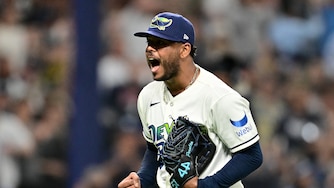
That’s what their five-year, $125 million deal for Freddy Peralta, a two-time All-Star and the reigning ALCS MVP, represents to the Orioles’ rotation and roster as a whole. It’s the kind of signing you make without a ton of care for the future (and there’s nothing wrong with that), and it’s the kind of signing that begets more moves of the same type.
He helps set up the Orioles’ rotation for the rest of the decade, and that allows them to use all the young pitching capital they’ve accumulated to solve the rest of their roster problems.
Peralta spent the bulk of his career with the Brewers, for whom he had a 3.59 ERA and 1.13 WHIP over parts of eight seasons before he was dealt to the Mets last January for his final year before free agency. His numbers weren’t great there, but he turned things around after a deadline trade to the Rays and looked much more like the previous version of himself in the postseason.
The Orioles clearly value him as the pitcher he was outside Queens. Peralta has a unique arm slot and pitch shapes, which are traits the Orioles covet, and the stuff doesn’t appear to have diminished as the results dropped off in the first half. Everyone knows the risk of paying starting pitchers into their 30s, when the threat of injury increases. But the Orioles simply can’t hide behind that anymore if they have as much of David Rubenstein and Michael Arougheti’s money to spend as they constantly say they do.
Read More
They’ve tried on top pitchers in free agency before, but it’s notable both that they tried and succeeded here.
Tarik Skubal’s $450 million megadeal with the Mets this weekend really jumpstarted the free agent pitching market. Most pertinent to the Orioles, it cleared the way for Trevor Rogers to pick his destination.
Over the last 18 months, the Orioles made it clear they weren’t willing to bet on Rogers long-term when they chose to keep Kyle Bradish and Shane Baz but didn’t reach a deal with the left-hander. Signing an older pitcher to slightly more money can finally put that to bed.
After those Bradish and Baz deals, and with a wealth of upper-minors pitching prospects who can potentially break into the rotation as early as the middle of next season, the Orioles could have used Rogers’ former spot in the rotation as a placeholder of sorts with another Chris Bassitt-type on a one-year deal until the prospects are ready.
We can never rule out them still adding that type of arm, but signing Peralta changes the calculation on so many things. When it comes to pitching, best-laid plans have a way of finding themselves crumpled in the bin, but the top three spots in the Orioles’ rotation are now locked in for the next four seasons, with Bradish and Peralta under contract for the next five.
That plan allows them to aggressively move their coveted pitching prospects to fill other needs on the team, most notably in the outfield. I’ve spent the fall talking to evaluators inside and outside the organization about the Orioles’ pitching prospects and it’s not just people around here who think they can be big league starters.
It’s a fair bet, even by the standards of the old “there’s no such thing as a pitching prospect” adage, that if you already have proven homegrown quality in by my count a dozen pitchers who can turn into viable major league starters in the next two years (Anthony Eyanson, Joseph Dzierwa, Caden Hunter, Luis De León, Boston Bateman, JT Quinn, Trey Gibson, Michael Forret, Braxton Bragg, Pat Reilly, Nestor German and Kyson Witherspoon), enough will come through to fortify the rotation behind Peralta, Bradish and Baz. Brandon Young looks every bit a peer to them in 2026.
The Orioles could honestly trade half of those pitching prospects and end up in the same spot long-term. So they should. There’s no better moment to capitalize on all that momentum the pitching development operation is building — especially for a team that’s under pressure to get back to the playoffs in 2027.
The first half of this decade was defined by how many good hitting prospects the Orioles had. The best of them — Adley Rutschman, Gunnar Henderson, Jordan Westburg and Colton Cowser — helped them get to the playoffs twice and turn the organization around. Others ended up going brown on the vine in the minors and were traded past peak value, if not outright released.
Letting some of these pitchers even get on the 40-man roster impacted their value relative to what it could have been a year ago, and it feels crazy to say this about the Orioles and pitching, but they simply can’t sit on all this depth and let it go to waste.
They’ll get a compensatory pick for Rogers signing with the Cubs. They have some potentially special pitchers coming stateside from the Dominican Republic next year. They’re going to have the ability to replenish.
In the meantime, if they don’t use some of these young pitchers to find an everyday solution (or two) in the outfield and bring in someone behind the plate to pair with Samuel Basallo, they risk repeating the cycle of the last two seasons.
The best way to prevent that — and to ensure the Orioles are as good as they should be in 2027 — is to use the pitching depth they have to acquire major league help. Signing Peralta more than clears them to do that.


Comments
Welcome to The Banner's subscriber-only commenting community. Please review our community guidelines.