
Join the dugout. Sign up here for Nationals updates in your inbox.
Nationals president of baseball operation Paul Toboni made significant strides in his first season as the team’s lead decision-maker.
The farm system saw many hitters take significant steps forward. He upgraded the technology throughout the organization. Opening day starter Cade Cavalli developed into a front-line starter and signed a four-year contract extension. The team was in playoff contention for much of the first half and went on to win the most games since 2019.
But not everything was rosy, as Toboni would be the first to admit. When asked to reflect on the season and give the highs and lows, Toboni’s mind immediately went to the disastrous blown eight-run lead against the Giants and the two Phillies losses in June in which the Nationals held a lead in the ninth.
This will be a consequential offseason for the Nationals. For every White Sox team that busts on the scene and makes the postseason after years of ineptitude, there’s a Mets team that fails to make good on its financial investment.
“You kind of get comfortable with this, ‘Oh, we have this great culture, so we’re just going to keep rolling,’” Toboni said. “‘Oh, we’re trending positively; that’s going to continue in the next six months’ … That’s not the case.”
With that, let’s look at four big questions facing the Nationals as they enter an offseason clouded by the threat of a lockout.
1. Where will CJ Abrams play next season?
I know, I know. You’re probably sick of reading about where Abrams will play next season or if he’ll even be on the roster on opening day.
After the team moved Abrams off of shortstop in mid-August, it seemed increasingly likely that Abrams would be traded. He still views himself as a shortstop. But the team backed down and said Abrams would instead split time between shortstop and second base after they saw his play in the field improve. Abrams had conversations with manager Blake Butera and Toboni and ended the season in a good headspace.
But there is no commitment that Abrams will be the team’s shortstop next season.
“I would feel very strongly about him getting reps at shortstop because I think it just helps you be a better second baseman,” Toboni said. “But on the flip side, like he’ll be getting a lot of reps at second base, too, because there’s a world where he’s starting second baseman next year and playing a ton over there, and I think he’s got a chance to be a Gold Glover over there.”
There’s also uncertainty about Abrams’ future. He’s a free agent after the 2027 season, and though the Nationals showed they’re more open to spending after signing Cavalli to a four-year, $47 million extension with a club option for 2031, Abrams’ next contract will be more hefty after starting for the National League All-Star team and posting career-highs in homers (33) and RBIs (106), even with his poor defensive play.

Abrams has grown into a trusted voice in the clubhouse. Though he’s not the most vocal leader, his work ethic and production give him credibility with his teammates. His laid-back demeanor also brings levity over the course of a 162-game season.
And Abrams enjoyed playing more meaningful baseball this season. He lauded the front office for the changes they’ve made and the intentionality the group has brought to the team’s pregame work. He said in September that he felt how “everything was about the player and what they need.”
“I love D.C., and I love what we got going right here,” Abrams said.
2. What does the rotation look like after Cade Cavalli?
Entering his first season, Butera knew the team had potential offensively and watched as the unit soared past projections. But now the Nationals need to figure out how to get their pitching group up to speed.
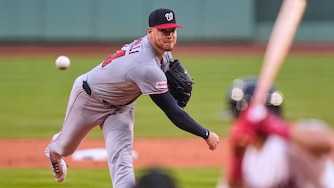
Cavalli was one of the few bright spots for the big league team on the pitching front this season after posting a 3.02 ERA over 32 starts.
But the Nationals need more from their rotation. The pitching staff as a whole posted just 4.8 WAR, the lowest in the majors. Their starters threw the second-fewest innings in the majors — though that figure is skewed by how often they used an opener — just ahead of the White Sox.
Lefty Connelly Early made just one appearance for the Nationals after coming to Washington in a midseason trade from Boston for Curtis Mead. Still, he was impressive, throwing three scoreless innings. You can likely pencil him in for a spot.
After that? It’s anyone’s guess. With Stephen Strasburg’s onerous contract mercifully coming off the books, the Nationals have approximately $33 million in salary relief, so they have some maneuverability this offseason. The Nationals need more certainty out of their No. 3 starter this season because they have ample options to fill out the back end of the rotation (Andrew Alvarez, DJ Herz and Jackson Kent).

While it’s unlikely the Nationals shop at the high end of the market for starting pitching — Tarik Skubal, Michael King and Sonny Gray — there are some dependable veterans the Nationals could be in the market for that would stabilize the rotation. According to league sources, the Nationals are viewed in a more favorable light than in recent seasons. They could be a legitimate destination for several free agents, pending that they’re ready to spend.
Right-hander Clay Holmes (3.29 ERA over 101 1/3 innings in 2026) would be an interesting option. Though he struggled with walks towards the end of his season, Holmes misses barrels and induces ground balls at a high rate despite having below-average stuff (93 mph fastball). He also brings the pedigree of being a two-time All-Star reliever.
The Brewers’ Dustin May signed a one-year, $12.5 million contract with the Cardinals last offseason, with a $20 million mutual option for 2027. May performed modestly for the Cardinals, posting a 4.38 ERA over 21 starts and becoming a valuable commodity at the trade deadline. While it’s unlikely that the budget-conscious Brewers agree to their side of the option, May has a tantalizing arsenal. No matter what, the Nationals need to pour resources into the rotation.
3. How many relievers does the team add this offseason?
The numbers for the bullpen weren’t pretty. Nationals relievers sported the highest walks per nine innings (4.62), the third-highest home runs per nine innings (1.38) and the third-highest ERA (4.99).
If the Nationals take any lesson from the four teams that made the championship series, it’s that they had impressive bullpens. Milwaukee (3.40), Cleveland (3.54) and Los Angeles (3.74) finished in the top 10 for ERA, and Tampa Bay (3.99) ranked 14th.
The Nationals’ front office sat through and witnessed the heart-wrenching blown saves that kept the team from a potential playoff spot. They made moves at the deadline to bring pitcher depth to the organization. Though the unit had some bright spots toward the end of the season, with Erik Tolman, Jack Sinclair, Will Dion and Yovanny Cruz showing promise, it would behoove Washington to add a known commodity to the group.
4. How does the collective bargaining agreement affect the offseason?
Frankly, no one knows. The annual general managers’ meetings take place in November in Las Vegas. It’s usually where the groundwork and initial discussions take place before the winter meetings.
But with the CBA expiring on Dec. 1 and a likely lockout, there’s a strong chance the winter meetings won’t happen. So will there be more movement before the Dec. 1 deadline?
“I don’t know,” Toboni said. “I really don’t. I could see a world where there was a rush. I could also see a world where there are players out there that are comfortable not signing until like we get through November and into December, and there’s no agreement in place. We’ll see where it goes after that.”




Comments
Welcome to The Banner's subscriber-only commenting community. Please review our community guidelines.