
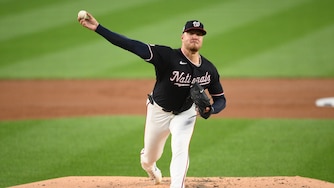
Cade Cavalli roared after striking out Dodgers outfielder Teoscar Hernández.
He sensed his night was over, and he left his team in a position to win the game after six innings of two-run ball.
Thriving at Dodger Stadium in front of 52,785 fans was just another example of Cavalli’s evolution this season from interesting pitcher to legitimate frontline starter, and a stabilizing force for a pitching staff short on experience.
The question was not talent, but availability. He dealt with injuries early in his career that derailed him, leaving him unable to show the promise in that powerful right arm.
But last season, as he spent most of the first half in the minors working his way back from injury, Cavalli found the right technology to ensure that his body could feel great over a full season. The solution arrived when he was at his lowest as he was questioning his baseball future.
“I was on my rehab assignment, and I wasn’t feeling great,” he told The Banner. “And I was like, ‘Man, I gotta do something different, I gotta figure something out like for my career.’”
After Friday’s start against the Los Angeles Angels, Cavalli has now allowed three earned runs or fewer in 29 of his 31 starts this year, the most in the majors. He leads Nationals starters in just about every category, including innings pitched (164 2/3), ERA (3.12) and strikeouts (194). His recovery routine has played a big role in his ascent.
Cavalli missed the entire 2023 season after undergoing Tommy John surgery and dealt with some of the anxiety that comes with such a significant injury — “Am I ever gonna play again?” he remembered feeling. He appeared in just three minor league games in 2024 before being shut down due to dead arm.
On a rehab assignment last year in Double-A Harrisburg, he saw former teammate Michael Soroka, who was working back from a right bicep strain, lying on a table with pads hooked up to his body. He asked Soroka — no stranger to the tedious nature of the rehab process — what the contraption was.
Soroka used ARPWave Neuromuscular Therapy, which aims to help reduce or eliminate pain that restricts movement or impedes physical activity. The machine delivers an electrical stimulation to the direct source of pain to promote blood flow and increase strength and range of motion.
Cavalli had a similar machine at home made by NeuX Technologies, but didn’t know how to best use it. After seeing Soroka benefit from his device, Cavalli wanted to see if NeuX could work for him.
So the right-hander called up Dan Dixon, senior vice president of NeuX — and a former college football player at Oklahoma and Northwestern — about formulating a nutrition plan and workout regimen.
Restorative energy is the basis for Dixon’s work. It’s difficult for athletes to recover from repeated high-velocity movements — like throwing a baseball at triple digits — so through the NeuX and changes to Cavalli’s diet, the two worked to help replenish the right-hander’s energy between outings. That meant drinking more orange juice and consuming the proper carbs.
“I used to just drink my coffee black, and I put some cream and sugar in there to spark the metabolism,” Cavalli said.
A lot of Cavalli’s routine between starts revolves on keeping his muscles loose.
The NeuX machine is helpful on his day after starts, when he tends to keep his activity light by throwing the football around at a softer velocity.
“A lot of the work at the beginning is for my legs because I need to let my legs get back back underneath me,” Cavalli said.
Getting his legs in a good spot has helped him maintain his velocity throughout this season.
He sleeps wearing a sam SPORT device, which sends low-intensity ultrasound waves into soft tissue that aids recovery by improving circulation.
Monitoring his workload between starts has also been key in Cavalli’s ascent. Back in 2023 when he made the team out of spring training, he felt that he needed to air it out in bullpen sessions to prove his worth. Searching for an advantage is common among major-league players, but pitchers have to be delicate with their day-to-day work, cognizant of not overloading their arm.
“It was detrimental to my health, going and doing that every day,” he said.
One thing that Cavalli has added this season is the PULSE Throw Workload Monitor, a small blue device that pitchers attach to their elbows. Made by Driveline, a private player-development company that uses biomechanics, technology and data to identify ways players can move more efficiently, the PULSE records the quantity and quality of pitches by force thrown in a given day. Last season, Cavalli monitored his workload by “feel.” Now, he can reflect on his scores, which are pretty similar on a week-to-week basis.
Pitching coach Simon Mathews used it with pitchers in Cincinnati, and though he said it’s not a “magic answer to anything,” he strongly believes in its utility.
“I think not overloading your arm is just as important as not underloading your arm,” Mathews said. “For a guy like Cade, especially, it can be a sort of like accountability tool to your routine, and Cade’s been unbelievable with it all year.”
Being unable to take the mound for the Nationals over nearly two full seasons gnawed at Cavalli as a competitor. Heck, the righty was “embarrassed,” according to manager Blake Butera, after he exited his Aug. 29 start against the Marlins with right calf tightness after taking a comebacker. Posting each start is a badge of honor for pitchers.
His nasty stuff and aggressiveness on the mound give teammates a higher level of confidence when it’s his turn in the rotation.
“His stuff is electric, and then sometimes he gets mad, and you can see it, and [opposing teams] don’t really have a chance after,” All-Start shortstop CJ Abrams said following Cavalli’s Aug. 24 start against the Rockies.
After that seven-strikeout performance in a 13-3 win over Colorado, Butera said that Cavalli is the pitcher that “picks us up in big times.”
“It’s really nice for him to say that,” Cavalli said. “Just been a dream since I got drafted in the Nationals.”
The new routine has allowed Cavalli to stay healthy and hold his velocity deep into outings. As the season progressed, he seemingly got better.
Cavalli’s second-half ERA (2.05) ranks fifth among qualified starters, and his 66 innings rank third behind workhorses Sandy Alcantara and Jesús Luzardo.
But suffering serious injuries leaves a feeling that never dissipates. There are reminders all over his body — the scar from Tommy John surgery, the isolating feeling of being away from teammates. Those tests linger with Cavalli, but ultimately resulted in a new appreciation for the game, and the ability to reach new heights.
“I think that when you go through it, you see how much you truly love this game,” he said. “If you can just go put into action of hard work, staying a good teammate, loving on others around you, rooting for others and just hoping that your time’s going to come, I think that is a true testament of your character. I’ve given my almost my entire life to it, but if if it were to end tomorrow with an injury or whatever, I’ll be okay. I got really good friends here. I made a lot of great relationships. ”


Comments
Welcome to The Banner's subscriber-only commenting community. Please review our community guidelines.