
The 2026 elections are shaping up to be historic for Black leadership in Maryland.
Baltimore, Howard, Montgomery and Prince George’s counties are likely to elect Black executives, the most ever at one time, with a fifth Black candidate running in Wicomico County. And from Congress to the General Assembly to county councils, candidates have a chance to notch landmark wins or expand already strong Black representation across Maryland.
That would continue the state’s barrier-breaking trend of recent election cycles. Maryland has the nation’s only Black governor in Wes Moore, and in 2024 became the first state to have an elected Black governor, U.S. senator and attorney general at the same time.
The historic political gains by Black politicians in Maryland are not only symbolic, candidates and political observers said; they show that a variety of Black leaders are now electable, voicing an array of Black community concerns. But as that representation grows, so do questions about what it can deliver and whether the gains will translate into a shared political agenda.
“It means you’re no longer in a position where you have to accept the one Black person has been chosen to be the spokesperson,” said Karsonya “Kaye” Wise Whitehead, a professor of communication and African and African American studies at Loyola University Maryland.
“I think Black political power opens up the roads for everyone else to travel. It’s not just about Black people getting what they need, because representation is not the same as solidarity,” she explained.
Read More
The examples of that political power are many.

Maryland has what’s believed to be the oldest and largest legislative Black caucus in the country with 66 members. Depending on election results Tuesday, half of state Senate Democrats could be Black. And they will have more power: Five Black senators were elevated to new leadership positions last week, including Baltimore’s Antonio Hayes chairing the committee handling business and healthcare regulation, and Cory McCray becoming vice chair of the budget-writing committee.
Maryland has three Black members of Congress and could likely add a fourth Tuesday in state Del. Adrian Boafo, who would replace Steny Hoyer, a long-serving member of Democratic leadership. That’s more Black representation than in most states.
Maryland has one of the highest percentages of Black residents in the country at 32%, according to census data, but experts said wealth, social organizations such as the NAACP and Black fraternities and sororities have also helped build Black political power.
University of Maryland, Baltimore County political scientist Jé St Sume attributes the state’s Black political mobility to its being home to two of the nation’s wealthiest counties for Black people in Charles and Prince George’s.
The potential gains in the general election could add to the strong Black political foundation.

Baltimore County state Del. N. Scott Phillips said that Maryland has developed a Black electoral power base that has supported Black leaders at both a local and state level despite not having a majority Black population.
“There’s a message here that while we don’t make up the majority of the state, we didn’t make up the majority of Baltimore County or Montgomery County, we’re developing leaders that can lead at any level — With or without a super-majority African American population,” said Phillips, head of the state’s Legislative Black Caucus. “I think that’s a powerful statement.”
Having this power has not yielded automatic agreement or wins for issues centered on Black Marylanders, such as reparations and redistricting, he said. Those divides are a reminder that Black Marylanders don’t operate as a monolith
Take redistricting, which has bitterly divided Democrats for a year. The Legislative Black Caucus — like the rest of the state’s elected officials — also could not come to an agreement on the issue during the General Assembly session and took no position.
“It’s been evolving,” Phillips said.
Changing Baltimore County leadership
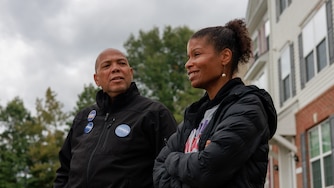
On a recent crisp autumn morning, a half-dozen hopefuls hopped out of their vehicles and spread through the quiet Rosedale neighborhood in Baltimore County, campaign literature in hand.
The mission: help Arkia Wade become the first Black woman on the Baltimore County Council.
The first-time candidate is running to represent Dundalk and southeast Baltimore County. A few houses ahead, Julian Jones, the current council’s lone Black member, was doing his part to help Wade. Jones, a strong favorite to become the next executive in a county that hasn’t elected a Republican to the post in 36 years would be the first African American in the position.
Wade won her primary by 41 votes. Someone with Jones’ experience on her side could make a difference in a tight race, she said.

“To have the support of the next county executive door-knock with me, I can’t say enough,” Wade said between houses.
Jones said he wants Democrats on the council that are ”like-minded enough to support the agenda.”
“You definitely want to make sure that you’re helping candidates out, particularly candidates of color who this is their first time. They need some help and they need some guidance,” he said.
Wade, along with Makeda Scott, in northwest Baltimore County’s District 3, and Sharonda Dillard-Huffman in eastern Baltimore County’s District 8, each has a chance to become the first Black woman on the County Council.
Wade is the granddaughter of William C. Wade, a longtime Turner Station physician who provided free care to Black families during segregation and has a Dundalk street named after him. She faces MAGA Republican Tim Fazenbaker, a former liquor store owner. Former Republican county executive candidate A. Scott Pappas and restaurant owner Donna Sekora are running as independents.
“I’ve never done this before in my life. I never really had any ambition to run for office, and to have a mentor like that is huge,” Wade said.

Jones is accustomed to being a pioneer. He was the first Black lieutenant, captain, battalion chief and division chief in the Anne Arundel County Fire Department. He was also the first person elected chair of the Baltimore County Council three times in 12 years on the board.
He knows what it is like to “be the only one.”
“When people see the County Council, they should see people that look like them,” he said.
‘Maturing’ Black communities
The number of Black candidates reflects the state’s changing demographics.
Boafo, who beat a field of 23 candidates in June’s primary to secure the Democratic nomination to represent Maryland’s 5th Congressional District, is the son of African immigrants.
“Our state is changing,” said Niambi Carter, an associate professor at the University of Maryland’s School of Public Policy. “These communities are maturing — these Latino communities, Caribbean communities, African communities, and they want to see representatives that look like them and they’re electing those people.”
In the primary, candidates with strong ties to community activism excelled this year, said Earl El-Amin, a longtime community leader in Baltimore’s Ashburton/East Arlington neighborhood.
The tradition of community activism and Black political power in Baltimore dates back to the mid-20th century, when a group of male pastors, academics and community activists who called themselves the Goon Squad organized people on civil rights and political issues. The Freddie Gray uprising brought out young activists that are also politically minded.
Politicians like Baltimore Mayor Brandon Scott, Malcolm Ruff, Tiffany Welch and Sabrina Tapp-Harper, all had strong ties with community activist groups, El-Amin said.

The shift in power is evident in Tapp-Harper’s victory over incumbent Sam Cogen to become the first woman to lead the Baltimore City Sheriff’s Office in its 181-year history.
Cogen had the support of Moore, Baltimore State’s Attorney Ivan Bates, Maryland Attorney General Anthony Brown and U.S. Rep. Kweisi Mfume. Tapp-Harper had the endorsement of Scott, who went six-for-six with primary endorsements.
But what may have given Tapp-Harper an edge was the support of Black women and her deep Baltimore roots.
Dillard-Huffman wants to be able to make the same type of history.
She, Wade and Jones were among several dozen who gathered at a recreation center to launch canvassing efforts nearby.

“I don’t have generational wealth. I don’t have a whole bunch of rich friends. I’m not an insider. So it has been sometimes more difficult for me to campaign,” she explained. “It’s a different road for me. But I do appreciate every kind of support I get.”
Dillard-Huffman promised to stick with politics — regardless of the outcome of the election.
“I’m not going anywhere,” Dillard-Huffman said. “I’m just digging in deeper.”
Rona Kobell and Sapna Bansil contributed to this story.




Comments
Welcome to The Banner's subscriber-only commenting community. Please review our community guidelines.