
Last year, Maryland’s governor and state lawmakers wrangled over raising taxes, cutting spending and rolling back parts of the state’s public school improvement plan.
Maryland politics in 2026 have had a decidedly more national vibe.
Pushed over the edge by pitiless immigration enforcement in Minnesota and elsewhere, Democratic leaders passed laws to restrict U.S. Immigration and Customs Enforcement’s Maryland efforts. In the process, they disregarded Republican warnings that the state could face swift retribution in the form of aggressive immigration sweeps.
And national Democrats, seeking to squeeze out more seats in the U.S. House, are escalating pressure on holdout Senate President Bill Ferguson and his caucus to hold a redistricting vote.
Meanwhile, Gov. Wes Moore’s every move is scrutinized through a 2028 lens, with cable TV hosts regularly asking him if he’s positioning himself for a presidential run.
And that, in turn, makes Moore a useful target for Republican President Donald Trump’s social media sniping.
The result?
Maryland political issues feel synonymous with national issues. And the small state is getting outsized attention.
“When the governor of your state is in conflict with the president of the United States, you can’t ignore that fact. Or when you have congressional leadership coming to Annapolis to encourage mid-cycle redistricting,” said Mileah Kromer, director of the Institute of Politics at the University of Maryland, Baltimore County. “It’s no wonder they’re addressing some of these issues.”
Lawmakers front-loaded the annual General Assembly session with deep debates on issues of national interest, a reflection of the political climate and Democrats’ frustration with the Trump administration and the Republican-led Congress.
It’s given Democratic lawmakers wins to tout to constituents who are eager to do something — anything — about Washington. And they’ve frustrated Republican lawmakers who want more focus on pocketbook issues.
Legislative leaders say they’re doing both — and they’re reflecting what constituents have asked them to do.

Sen. Jeff Waldstreicher, a Montgomery County Democrat, said he’s been getting an earful from residents when knocking on doors.
“I hear from them three things: They want us to address the affordability crisis here in Maryland. They want us to grow the economy so we can continue to invest in programs that benefit our community,” he said. “And: They want us to push back on the lawless Trump administration.”
The “lawless” Trump administration was invoked multiple times on Friday, as the Senate Democrats’ weekly press conference focused on bills aiming to shore up Maryland laws where the federal government is backing off, as in preventing discrimination in adoptions and offering consumer protection.
“When Washington is stepping on us, when they are rolling back, Maryland must step up,” said Sen. Mary Washington, a Baltimore Democrat.

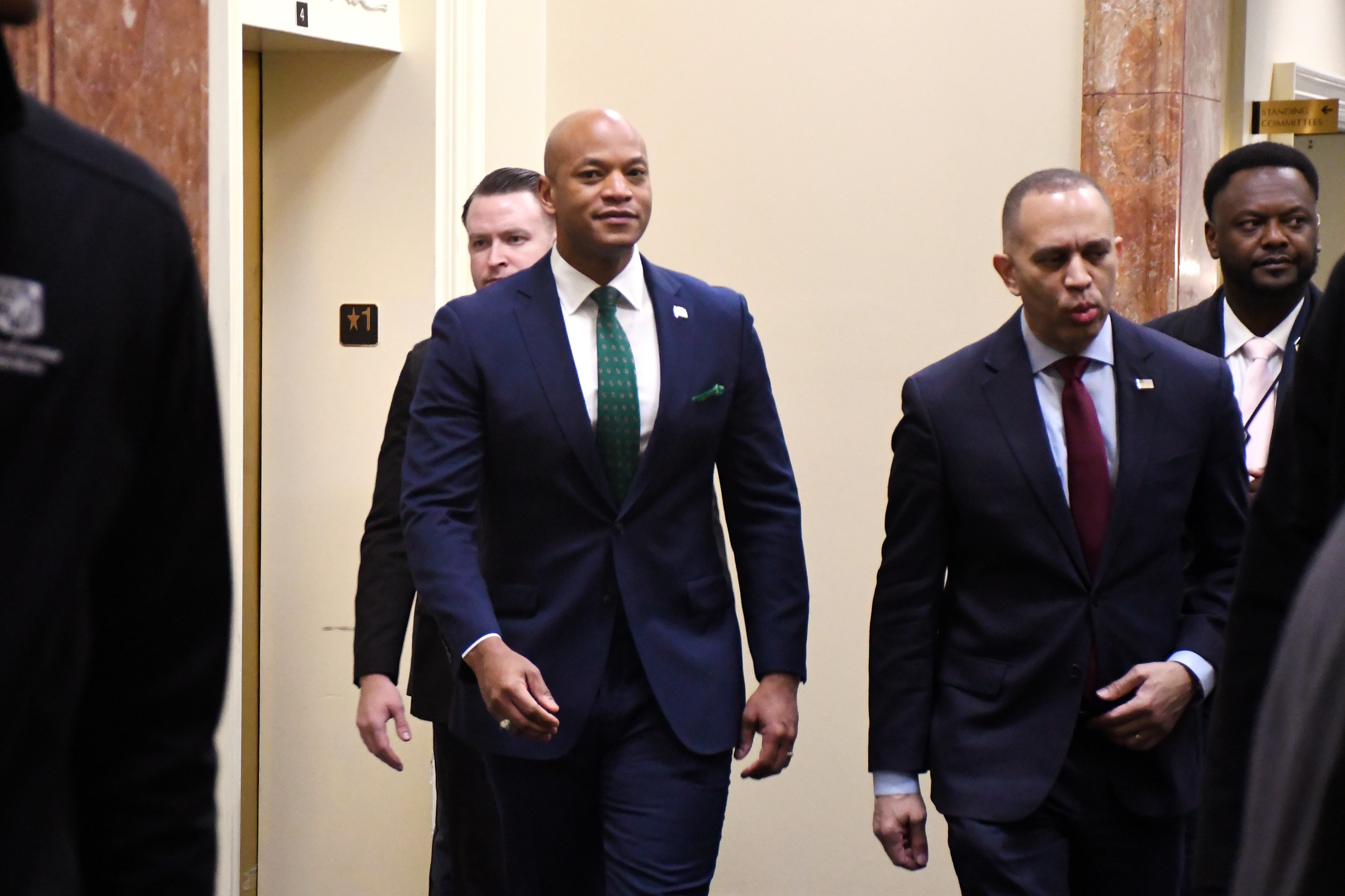
Moore has put much of his time and influence behind a new map of congressional districts in hopes of giving Democrats a sweep of all eight seats, squeezing out Republican U.S. Rep. Andy Harris. Moore even accompanied U.S. House Minority Leader Hakeem Jeffries around the State House last week as he made a push for a new map.
While the map sailed through the House of Delegates, it has stalled in the Senate.
Moore’s countless national media interviews on redistricting are contributing to the dynamic.
He insists that he’s not doing it for national attention or for his own future prospects; rather, he says, it’s the right response for Maryland. The questions that come his way, though, are often framed with a potential presidential campaign in mind, despite the governor’s protestations that he isn’t considering a White House run.
Del. David Moon, the Democratic majority leader in the House of Delegates, said the national issues took focus in the early part of the session as the result of deadlines — not because they are any more important.

The attempt to redraw congressional boundaries needed to move quickly through the House because of impending election-related deadlines. And it was important to ban cooperation agreements with U.S. Immigration and Customs Enforcement before the agency could ramp up activities in Maryland, Moon said.
While those issues were the focus of hours of debate on the House floor, other work has been happening on affordability, housing, health care and economic development in the lower-profile committee sessions, Moon said.
“It’s not like the conversation’s starting tomorrow,” Moon said. “The committees have been working overtime while some of these front-loaded floor debates have been happening.”
Democratic leaders insist that they can react to national issues and solve Maryland problems.
House of Delegates Speaker Joseline Peña-Melnyk has often said that lawmakers “can walk and chew gum at the same time,” a refrain that Democrats have picked up and repeated.
Senate President Bill Ferguson said that Maryland families are watching national news and saying: “This is crazy.” And lawmakers had to act to stand up to the Trump administration, he said.
On Friday, Ferguson posted an image on social media featuring a picture of a screaming Trump with the all-caps headline: “Maryland Over MAGA.”
At the same time, though, Ferguson promised that “a full package” of bills addressing energy, housing and health care will pass the General Assembly this year.
Democratic leaders are quick to point out that Maryland has been uniquely harmed by the Trump administration’s policies eliminating federal jobs and cutting funding. Already, 25,000 people who worked for the federal government have lost their jobs, Moore often points out.
Republican lawmakers counter that their time has been wasted on “virtue signaling” on national issues instead of finding ways to boost the state’s economy and bring down costs for residents.
“We’re just spinning our wheels because it gets in the D.C. media and it sort of fills people’s checkbox of ‘I was anti-Trump,’” said Del. Jason Buckel, an Allegany County Republican who serves as the House minority leader.

At the start of the 90-day session in January, both parties made proclamations about wanting to address affordability issues in Maryland. All that’s been produced on that front so far, Buckel noted, is a bill moving forward that limits electric companies from baking executive perks into consumer rates. The savings? About 80 cents a month.
Trump himself has driven national attention to Maryland in recent weeks. First, he uninvited then reinvited Moore to a meeting at the White House for the nation’s governors. Then he got his facts wrong as he blamed Moore for a Potomac River sewage spill.
The focus on responding to Trump falls in line with what Democrats across the country want to see from their elected leaders, said UMBC’s Kromer. Democrats are the largest party in Maryland and make up more than two-thirds of the legislature.
That said, Kromer believes that “100%” that the conversation in Annapolis will soon shift to addressing affordability issues and balancing the state’s budget, where Moore has proposed spending cuts to keep the books in balance.
Some Marylanders have real, valid fears about immigration enforcement. Others are struggling to pay rent and utility bills. All those issues need to be addressed, she said.
Roger Hartley, a public affairs professor at the University of Baltimore, said Democratic voters have made clear that “they want their leaders to fight back” against the Trump administration. That’s especially important for those who will vote in the Democratic primary in June.
Hartley said lawmakers “can’t miss” on affordability issues.
“If you ignore that, you might get your voters excited and active about ICE and Donald Trump,” he said. “But when the pocketbook is the issue — and that was the issue of the last election and one of the reasons Donald Trump won — that would be a big miss if they don’t get back to it.”





Comments
Welcome to The Banner's subscriber-only commenting community. Please review our community guidelines.