
A last-minute White House move to cancel $810 million in federal funding has drawn sharp criticism from state and local leaders who warn the lost dollars will ripple through Maryland and Prince George’s County, affecting funding for community programs ranging from minority-owned business grants to healthcare access and housing initiatives.
The proposed freeze targets money already approved by Congress across six federal departments. Local officials warn the county and state budgets cannot absorb or replace the loss.
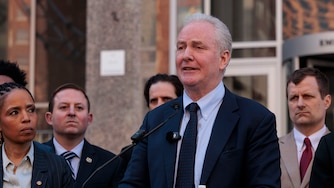
“Canceling nearly $1 billion in federal funding — funding that was approved by both Democrats and Republicans in Congress for programs and agencies that serve communities in Maryland and across our country — is wrong, illegal, and will have devastating impacts,” said U.S. Sen. Chris Van Hollen, who serves on the Senate Appropriations Committee.
Van Hollen said he is working with local, state and federal partners to push back on the decision.
Prince George’s County Council at-large member Wala Blegay warned that local communities are already feeling the strain of earlier federal funding cuts, particularly in healthcare, family services and mortgage assistance for seniors. Blegay pointed to local safety nets that have lost federal funding, like the Health Assures program, which provides healthcare for uninsured and undocumented residents.
“All those monies are pretty much gone,” Blegay said. “For Health Assures, we had to put money aside ourselves, which we don’t have. The reality is that right now we are already trying to fill the gaps on programs that were funded by the federal government.”
Read More
Blegay said county leaders are being forced to make hard decisions about which vital services they can sustain, but even when they can find county money to fund programs, it often covers only a fraction of what was originally planned.
A ‘pocket rescission’
In an official message sent to House Speaker Mike Johnson on Sept. 25, President Donald Trump requested 11 specific rescissions across six federal departments. The vast majority of the package, more than $567 million, targets U.S. Department of Health and Human Services refugee and entrant assistance programs, with the remainder targeting housing counseling, minority business development and health equity initiatives.
Under federal budget law, a president can temporarily freeze funds for up to 45 days while Congress considers a cancellation request. Submitting the request fewer than 45 days before the fiscal year ends on Sept. 30 leaves the funds frozen until they expire, a strategy known as a “pocket rescission,” which allows the executive branch to bypass a congressional vote.
“What the President is doing is illegal and violates the Impoundment Act,” U.S. Rep. Glenn Ivey, who represents Maryland’s 4th District, said in an email. “It violates the constitutional power of the purse established for Congress. This action doesn’t give Congress time to respond, so these cuts are likely to go through.”
Federal watchdogs maintain the practice is illegal. According to official legal guidance from the Government Accountability Office, the Impoundment Control Act does not permit withholding funds through their expiration date. In legal decisions dating to the 1970s and reaffirmed in 2018, the agency determined that presidents cannot shorten the lifespan of congressionally approved funding without a new law.
“GAO stands behind its legal position that pocket rescissions are illegal and not authorized by the Impoundment Control Act,” Government Accountability Office spokesperson Sarah Kaczmarek said in an email to The Banner.
Targeting ‘wasteful’ spending
The administration defended the $810 million package as a “historic action to eliminate wasteful and harmful spending” that “does not benefit American citizens.” In an official briefing statement, the White House argued the cuts target “wasteful, duplicative, and sometimes outright harmful” initiatives across federal agencies, specifically taking aim at what it characterized as “pro-illegal immigration programs” and grants promoting “DEI, discrimination, and radical woke ideologies.”
Maryland House Speaker Joseline Peña-Melnyk strongly pushed back against the administration’s rationale, emphasizing the real-world impact on refugees seeking stability.
“The largest portion of this rescission package — more than $567 million nationally — comes from refugee and entrant assistance programs that help people establish stable, self-sufficient lives in their new communities,” Peña-Melnyk said in an email. “These are not abstract budget numbers. Behind every one of these programs are people trying to build stable lives, families trying to get on their feet, and community organizations helping them become successful and contributing members of our communities.”
Pablo Blank, director of immigrant integration at We Are CASA, called the administration’s actions a distraction from other ongoing “crises,” such as the rising cost of healthcare for Marylanders and families across the country.
“Federal grants are very important to help people,” Blank said. “It’s a way for the most vulnerable individuals of our society to have access to services that they cannot get through their jobs or through their income alone.”
Blank noted that these cuts won’t affect just immigrants but also low-income families who rely on social services and support from community nonprofits.
In addition to the $567 million targeting Health and Human Services refugee programs, the proposal outlines reductions across five other departments. The requested cuts include $56 million from the Department of Housing and Urban Development’s housing counseling programs for low- and moderate-income families, $28 million from HHS healthcare quality research, $25 million from the Department of Education’s migrant student education initiatives, $15 million from the Department of Homeland Security’s immigrant legal and social services, $10 million from the Minority Business Development Agency and $5 million from the HHS Office of Minority Health.
Ivey warned that the proposed $10 million reduction to the Minority Business Development Agency will directly hit local entrepreneurs in Prince George’s County who rely on federal procurement support and startup assistance.
“This slashing of Minority Serving Institutions by Trump and his cronies is another in a long line of efforts targeting Prince George’s County,” Ivey wrote. “From big picture items like NASA, BARC to the FBI HQ to all the programs that benefit the people of MD04, they have torn down the progress our country has made towards inclusive economic development and programs that work.”
Ivey added that federal procurement contracts are a major pillar of the local business economy in District 4.
“The $10M cut to Minority Business Development Agency hurts minority owned firms’ access to federal procurement, which is a big part of Maryland businesses in my district,” Ivey said. “[Office of Management and Budget] Director Russ Vought doesn’t control the budget. Congress does. My colleagues and I will continue to fight in Congress, especially after the midterms, to right this ship.”
Prince George’s County Council member Wanika Fisher, who chairs the council’s General Assembly Committee, called the administration’s actions devastating for local families.
“The government is supposed to help the people, not cause harm,” Fisher said in an email. “As chair of the General Assembly Committee, I will continue to work with my colleagues and our state partners to ensure every Prince Georgian remains legally, financially, physically and emotionally supported during these trying times.”
Peña-Melnyk said it’s too early to tell which Maryland grants will be affected by these clawbacks.
“The General Assembly will continue to evaluate the impact of federal funding decisions as we prepare for the next state budget,” Peña-Melnyk said. “But we also have to be clear about the scale of what is happening. Maryland cannot simply replace every federal dollar that Washington chooses to withdraw.”
Have a tip for our Prince George’s County reporters? Tell us here.



Comments
Welcome to The Banner's subscriber-only commenting community. Please review our community guidelines.