
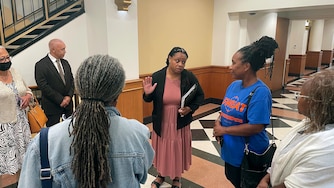
Tonya Sweat, a write-in candidate for Prince George’s County executive, and her close supporters have been indignant since election night.
The Associated Press, whose team of election analysts, researchers and race callers declared winners up and down ballots across the country, called the race for County Executive Aisha Braveboy almost immediately after polls closed on Tuesday.
Early returns from the Maryland State Board of Elections showed Braveboy’s victory was decisive.
They also revealed a notable number of write-in votes. But none were awarded to Sweat, the only write-in candidate who had registered with the elections board for this race.
How could the State Board of Elections website show that Sweat received zero votes, despite tens of thousands — nearly 38,000 so far, according to the unofficial tally as of Friday afternoon — casting write-in votes?
Sweat has alleged, without evidence, that corruption within the state and local elections boards has compromised the election.
Read More
The State Board of Elections, though, has offered a different explanation.
Votes for write-in candidates are initially reported differently than those cast for candidates listed on the ballot.
The state’s ballot-counting machines only process that a voter has filled in the write-in bubble. They will not identify the specific name a voter has written, according to the State Board of Elections.
The board first reports the total number of write-in votes. Then, during the approximately 10-day canvassing period following Election Day, canvassers manually review the write-in votes to determine how many each registered candidate received.
The canvassers consider a voter’s intent, according to Jared DeMarinis, the state elections administrator. A ballot cast for Sweat that misspells her name will still count toward her total.

But before certifying the election results, the elections board reports the total number of votes that each registered write-in candidate received.
This is why write-in totals for former presidents or cartoon characters don’t appear on the state board’s website.
“Any noise about how this process is occurring is mis- and disinformation because this has always been the process,” DeMarinis said in an interview. “It’s the way the machines work.”
Sweat has remained wholly unconvinced. In an interview Friday, she said, “If that’s how this always has been done, that means it’s always been inaccurate.”
In an email sent Thursday to state and local elections officials, she also threatened “federal legal action for the violation of my civil rights and disparagement of my character and reputation.”
Election results
Sweat had a rollercoaster ride to the ballot, which included unsuccessfully suing the county elections board over its determination that she didn’t secure enough signatures to appear on ballots as an unaffiliated candidate.
Her message, centered on calls to improve transparency and accountability in local government, resonated with some Prince George’s voters.
“She loves her county and she wants to just do good for her county,” said Kenia Rivera, a 22-year-old registered Democrat who voted for Sweat.
Kayode Aderibigbe, a 23-year-old independent, said he had grown “disenchanted” with the county’s current leaders.
“It felt like she had a better grasp of what the people really cared about compared to our current administration,” he said of Sweat.
The tens of thousands of write-in votes cast seem to have made a dent in Braveboy’s vote total.
As of Friday afternoon, Braveboy received more than 190,000 votes, roughly 83% of all votes cast in the race, according to the latest unofficial tally.
She received fewer votes than other state- and countywide Democrats running in Prince George’s, including Gov. Wes Moore (222,000).
In other jurisdictions where Democratic county executive candidates won, their vote totals were more in line with the governor’s.
Braveboy received about 14% fewer votes than Moore. In Montgomery County, Will Jawando received about 4% fewer. In Howard, Baltimore, Anne Arundel and Frederick counties, the county executive-elects each received more votes than the governor.

Among these jurisdictions, Braveboy was one of only two incumbent Democrats running for county executive.
Her general election opponent was also likely among the most progressive. Sweat ran as a Democrat in the 2025 special election that Braveboy won.
John Willis, a former Maryland secretary of state who recently retired from the University of Baltimore’s College of Public Affairs, said the unique political dynamics of each jurisdiction make it challenging to compare races across county lines.
Willis said Braveboy shouldn’t be worried about the difference in vote totals, and he predicted that the gap between Braveboy and other candidates will shrink as canvassers continue counting before they certify the results.
And it’s not unusual, he said, to see dissatisfaction with an incumbent county executive, considering they “make decisions every day, and every time they make a decision, somebody’s mad.”
The county executive’s spokesperson, Brian Fischer, said in a statement that Braveboy is “deeply grateful” to the residents who voted for her.
He said Braveboy’s first year or so in office was challenging, as she had to quickly assemble an administration while handling “urgent fiscal and operational challenges.”
Fischer added that Braveboy has heard from voters who were pleased with her leadership and those who shared concerns they want her to address.
“She takes both seriously and recognizes where improvement is needed,” he said.



Comments
Welcome to The Banner's subscriber-only commenting community. Please review our community guidelines.