
With less than three weeks before Election Day and early voting starting sooner, technicians are testing Montgomery County’s hundreds of ballot marking machines and ballot scanners.
Demonstrating these tests to the public in a secure room Thursday at the Board of Elections headquarters in Gaithersburg, elections officials hope to build trust in elections during a time of rising mistrust among the American electorate.
The work is tedious and repetitive, but that’s what the technical part of an election should be, said State Administrator of Elections Jared DeMarinis, who attended the demonstration.
“It’s nothing spectacular. You don’t have fireworks here or sparklers or anything like that,” DeMarinis said. “It better be boring!”
Before early voting begins on Oct. 22, every voting machine in Maryland will have been checked using the process showcased in Gaithersburg, known as logic and accuracy testing.
“The logic part verifies that the recorded votes are correctly counted, while accuracy confirms that the voting selections made by the voter are correctly recorded,” said Boris Brajkovic, the county’s election director.
Read More
It took about 45 minutes to test two machines — one that marked ballots and another that scanned them.
The test
Each ballot marking machine and scanner have flash drives that include information particular to it: where the machine is going to be used and what the ballot its handling should look like.
The machines are not connected to the internet so there is no possibility of internet hacking, said elections IT technician Xiri Xinda.
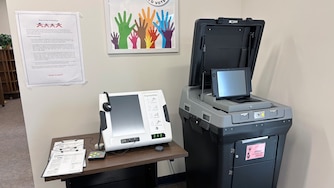
Montgomery County voters may mark their choices on a paper ballot or use a ballot-marking machine from which their picks are printed. Both types of ballots are processed by ballot scanners.
Elections technician Tim Gartrell turned on a ballot-marking machine, checked to see that it reflected the information on the flash drive and then simulated voting. Every candidate appeared on the ballot and all could be selected.

He then printed out the marked ballots, checked the scanner against its flash drive and fed those printed ballots to it.
The count was accurate. The mock ballots will be destroyed to make sure they aren’t counted in a real election.
Test completed, Gartrell “zeroed out” the scanner to make sure no votes remained in the system. A printout of the test, on a receipt-style piece of paper several feet long, is kept for records. Results are sent to the state elections board for their review.
“The purpose of doing this test today is to guarantee that every single machine works as it’s intended to,” Xinda said. “Before it leaves here, it’s guaranteed to work 100%.”
After the test, the machines are secured with several tamper-resistant seals and locked in a secured room within the elections office building. The machines aren’t reopened until it’s time to use them for the election, when bipartisan teams of election judges inspect the machines to ensure they were not disturbed.

The machines have several fail-safes, election officials said.
Each ballot is collected within the ballot scanner in a locked and sealed box, so if there’s an issue with the system, officials can count them by hand. The machines also include a slot for submitting ballots in case the tech systems shut down and voters can only mark ballots by hand.
The system is “safe, secure, accurate and transparent,” said Board of Elections President David Naimon. “This is how we demonstrate that the machines actually work the way that they are intended” and if they don’t, “we fix it.”
Naimon said that members of the public are welcome to observe the ballot canvassing process, which started Tuesday and is scheduled to run through Nov. 18. More information is available on the board’s website.


Comments
Welcome to The Banner's subscriber-only commenting community. Please review our community guidelines.