
At least three things are inevitable around these parts: death, taxes and the Baltimore Running Festival.
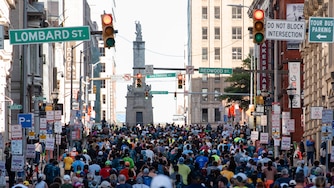
Every year since 2001, the race known colloquially as the Baltimore Marathon has wound its merry, sweaty way through the city, usually on the second or third Saturday in October. It’s hectic. It interrupts the normal flow of travel. It is a pain in the patootie. I get it. But it is inescapable. Stop complaining about it and figure out how to get around that day. Or don’t.
“There will be traffic,” Mayor Brandon Scott is seen on video saying about the annual event, which comprises four races ranging from 3.1 miles to 26.2 miles. “Do not tag the mayor. Do not act surprised — ‘I didn’t know this was happening.’ It’s been happening for decades. It’s going to continue to happen. You know what that means.”
You would think everyone would know. And yet residents do indeed act shocked and brand-new as if the event has not occurred for a quarter century at roughly the same time every year, causing the same vehicular stoppage and frustration.
The race is “a Baltimore thing,” said Afia Padonu, community relations manager at Charm City Run in Fells Point. She said the store has gotten complaints over the years from residents about the race, which passes the store’s corner.
But why complain? I moved back to Baltimore, from a place where I had a big backyard and a driveway, because I wanted to be somewhere that felt alive. I wanted to live in a city that people wanted to visit, where there were activities and festivals and conferences and, yes, races. Top-tier cities have them. Chicago. New York. Miami. Sure, these events temporarily shut down streets and cause inconveniences. But isn’t the vibrancy and business of a city why you choose to live there? What, you don’t want to be great?
Read More
The Baltimore Running Festival is truly Baltimore, tracking through neighborhoods of every conceivable demographic. And just about everyone along the route seems to show out. On race day, I have felt the overwhelming joy and pride of the Baltimoreans lining the streets, cheering and offering water and gummy bears. It’s an amazing testament to the city to take a tour through the place that birthed you and have that energy returned to you, a thousandfold.
The grand pageantry of races holds true whether you’re running a six-minute mile or walking a 15-minute mile. You are all at the same event, passing the same scenery, experiencing the same high. It is exquisite. It’s glorious.
And Baltimore does a fine job of posting the traffic changes online and placing lit-up signs and posters on relevant routes — reminders that are literally in your face.
“Drivers should anticipate traffic congestion and delays, and are strongly urged to allow extra travel time,” Kathy Dominick, a spokesperson for Baltimore’s Department of Transportation, said in a statement. “Anyone who must drive is encouraged to plan ahead by scheduling travel early Saturday morning before the races begin, or later in the afternoon after the event concludes.”
So, you should do that.
“There are banners everywhere. Signs everywhere,” Meghan Fugate, Charm City Run’s store lead in Fells Point, told me. “The city does as good of a job as you can.”
Listen, if this is not your jam, it probably seems stupid, particularly if you can’t get to work, the farmers market or the grocery store. It seems elitist and selfish, and as both a resident and a regular festival participant, I understand. I have neighbors who are hampered by it and glare at me every year. I’m sorry.
Then again, I’ve had my personal movement limited for months on end for Ravens and Orioles games I do not attend. But I hold space for those sports fans, for the people who pump money into the city for the events that make it impossible to park in my neighborhood — so much so that some of my neighbors skip town during the high-traffic times. You live here. It’s part of the landscape. It’s reasonable to expect people who aren’t involved in those activities to figure it out — without making those who are feel bad about it. It’s one day!
And that one day of running will bring about 15,000 people to the city this year and has generated approximately $600 million in economic impact since it began. “It’s a money-maker for the city, and for small businesses,” Fugate said. “People from all 50 states come here for it. But as a running store, of course we hear the complaints. It’s a blessing and a curse.”
I will be clear that I am happily part of the problem. This weekend will mark the sixth time I have participated in the festival, completing distances from the 5K to the full marathon. Running, or run-walk-shuffle-crawling, the way I do it, is a very specific activity that can technically be cheap but gets exponentially pricey once you add shoes, gear and race fees.
But most everyone has a hobby, a thing that makes them happy and complete outside of work — running, fantasy baseball, weekend volleyball or gardening. That thing costs time and money. And sometimes that thing is in public.
The race affects me even when I’m not running. I live on a one-way street along the route that shuts down Friday evening, so I have to walk extra miles to make the starting line or splurge on a hotel room. I make do.
So at the risk of sounding like a jerk, the Baltimore Running Festival is not going away. I am truly sorry if you have to plan around it, but you might. Or if you can’t beat it, maybe join it?
“Consider cheering for people,” Padonu said.
We’d love to see you out there. Just not cursing us out.


Comments
Welcome to The Banner's subscriber-only commenting community. Please review our community guidelines.