
A massive, game-changing development. Hundreds of millions in tax incentives. MCB Real Estate and P. David Bramble.
No, it’s not Harborplace.
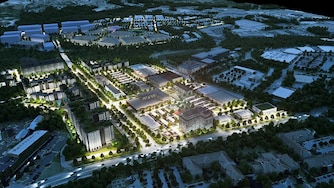
Baltimore-based MCB is also behind a $2.7 billion multiphase project sprawling 280 acres in eastern Montgomery County. Known as Viva White Oak, the long-awaited development includes 1,000 townhomes, 1,000 apartments and a big-box store in the first phase.
Viva White Oak and Harborplace are two of the most ambitious commercial real estate projects planned in Maryland right now, and either would be among the biggest in MCB’s nearly two-decade history.
And while it’s common for commercial real estate firms to juggle multiple projects, both are launching at an unusually challenging time. Banks across the country cooled on construction loans in 2024 after interest rates rose, data shows, putting more pressure on developers to raise money from investors who are also trying to navigate economic uncertainty.
However, industry experts say certain projects still find funding. MCB has charted similar paths in Baltimore and Montgomery County: find an underutilized site with high upside, get buy-in from elected officials and secure sizable tax incentives.
Read More
With its low-rise buildings and promise of suburban amenities in an economically stagnant area, Viva White Oak has faced virtually no public opposition. Montgomery County approved Viva White Oak in 2016, but development stalled out. In 2023, MCB Real Estate invested in and took on the project.
“We’ve been anxiously waiting for something to be developed on this land,” said Rachael Evans, chair of the nonprofit Friends of White Oak. “We have no issues. We’re excited.”
The Montgomery County Council in July unanimously approved a $420 million tax increment financing district, the first in the county’s history, to help get the project underway. The county will issue bonds that will be repaid by diverting property tax revenue generated by the project. The money from those bonds, records show, will be used to pave roads, run utilities and get the site ready for construction.
In Baltimore, which has the highest property tax rate in the state, the mayor’s office seems poised to give MCB’s Harborplace project incentives that could wipe away 95% of the development’s property tax bills over 25 years.
Construction permits list a start date next month, but some retailers in the doomed pavilions say they’ve been told they can stay until the end of the year. Voters approved a ballot question in 2024 in favor of the proposed redevelopment, though some community members continue to oppose the project and recently filed a lawsuit challenging several aspects of it.
For both projects, the next key step is for MCB to assemble what developers call a “capital stack,” the mix of financing needed to actually build.
MCB has not responded to questions about how it is financing Harborplace; developers generally don’t publicly disclose the amounts and sources of their funds.
Construction loans surged across the country during the COVID-19 pandemic, but banks have since tightened lending considerably, according to Sam Chandan, who leads a global real estate finance institute at New York University’s Stern School of Business.
Large banks are warming back up to construction lending, Chandan said, but they’re treading cautiously, extending smaller amounts than before.
That puts pressure on developers to raise more money from investors, typically family offices, private funds and institutional investors that give money in exchange for an ownership stake. That’s called equity.
“Equity is tough to come by,” said Mart Martindale, a managing director at the commercial real estate brokerage firm Kidder Mathews.
A few years ago, equity investors made up as little as 25% of a project’s capital stack, Martindale said. Now, with banks’ reluctance to lend, developers are leaning on investors for nearly half of that money.
Expected returns for investors have gotten tighter, Martindale said. Meanwhile, shiny investment opportunities — like the historically expensive build-out of AI infrastructure — can be hard to pass up, said Burton Hollifield, who teaches financial economics at Carnegie Mellon University’s Tepper School of Business.
“There’s a lot of competition for capital,” Hollifield said.
For commercial real estate, the north star for investors is, was and continues to be demographics, said Steven Goldberg, head of real estate investment banking at the financial services firm Baird. Is the regional population growing or shrinking? Are rents expected to go up or down? What is the health of the job market?
A mixed-use development in Texas might get financing, he said; an identical project in Maryland might not. Securing anchor tenants and leasing commitments — particularly for office space and large retailers — can be persuasive to potential investors, Goldberg said.
Bramble, MCB’s co-founder and managing partner, has said he would not build his planned office building at Harborplace without an anchor tenant.
At Viva White Oak, MCB has secured a retail commitment from Costco, which is slated to open in the first quarter of 2029.
There are also plans for several mixed-use buildings, but the timeline for those is further out — a presentation from MCB said that phase of Viva White Oak would not be completed until 2044.
“We are on pace to break ground this year,” said Alexandra Hughes, a spokesperson for MCB Real Estate. “Broadly, we feel very bullish on the ability to resurrect the Viva White Oak site as an important asset for East County.”



Comments
Welcome to The Banner's subscriber-only commenting community. Please review our community guidelines.