
A Costco, an elementary school, a hotel, a park, a grocery store, trails and up to 4,700 housing units. They’re all planned for Viva White Oak, a $2.7 billion mixed-use project that developers plan to break ground on by the end of the year.
Proponents say it will transform eastern Montgomery County, opening up shopping, housing and business opportunities for an area that many complain has lacked the investment of the wealthier communities to the west.
Located on 280 acres near the U.S. Food and Drug Administration’s headquarters and Adventist HealthCare White Oak Medical Center, Viva White Oak represents the largest private investment in the history of eastern Montgomery County and the first time the county has approved tax-increment financing for a project.
Shana Davis-Cook, who grew up in eastern Montgomery County and lives in the nearby Hillandale neighborhood, said she welcomes the stores, restaurants and sense of community Viva White Oak promises.
A member of the nonprofit Friends of White Oak, Davis-Cook said she’s now “constantly having to get in the car and drive to other parts of the county or to neighboring counties.”
The first steps planned for the mostly undeveloped land: grading, road construction and utility work. That will take about two years, said Kristin Mink, who represents the area on the County Council.
Read More
Work will then begin on the Costco and a town center with retail space and a grocery store.
By 2033, MCB Real Estate, the Baltimore-based firm leading the project, plans to have completed construction of about 2,000 housing units and a medical office building.
The full build-out, which will include additional housing and lab space for businesses that want to be near the FDA and Adventist HealthCare, isn’t expected until 2044.
Mink said Viva White Oak is also under consideration as the site of a fourth campus for Montgomery College.
The county estimates the project will generate $62 million in annual revenue after completion and create 19,000 construction jobs and 9,000 permanent jobs.
It is also expected to ease Montgomery County’s housing crisis. The first phase of Viva White Oak is planned to include about 1,000 townhomes and 1,000 apartment units, with a mix of rental and for-sale properties. The development will also include 300 senior housing units.
“This is very much overdue for this side of the county,” Mink said.
Some are disappointed, however, that developers are planning to designate only 12.5% of the project’s housing as “moderately priced dwelling units.” That’s the minimum proportion county law requires.
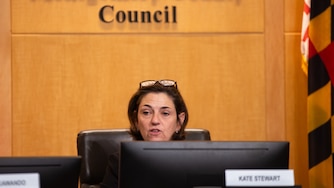
The county should have held out for more, said County Council President Natali Fani-González.
“I think as a government it is our duty to always push the envelope and require affordability in all these new applications,” she said. “Our communities deserve more than just the basic.”

A long time coming
The Viva White Oak site, just north of the Capital Beltway and west of its New Hampshire Avenue exit, has long seemed ripe for an ambitious project.
In the past few years, as businesses and housing have sprung up in Bethesda and along the I-270 corridor, some projects have emerged in the eastern part of the county — White Oak Town Center along Columbia Pike and the mixed-use development Hillandale Gateway, which is expected to be completed next year.
But nothing on the scale of Viva White Oak.
Talk of developing the site dates back to 2002. A 2014 county plan for the area identified it for a mixed-use development to boost the entire eastern part of the county.
An earlier version of Viva White Oak, headed by a different firm, had stalled until a few years ago, when MCB stepped in.
“It’s been a long process to get to this point,” said Friends of White Oak board chair Rachael Evans.
A county study concluded that Viva White Oak was most financially feasible with a tax-increment financing agreement between developers and the county.
In February, the County Council approved the agreement, which allows the county to issue bonds to help fund public infrastructure for Viva White Oak. The bonds will be repaid by a portion of future property tax revenue generated by the development.
The burden won’t fall on taxpayers, Mink said, and infrastructure for Viva White Oak won’t compete with other county needs.
County Executive Marc Elrich, signing off on legislation authorizing up to $420 million in bonds earlier this month, noted that the White Oak land, mostly sand and gravel, called for an unusually large investment in roads and other infrastructure.
“It’s an extraordinary project that requires doing a lot of things you wouldn’t do in other parts of the county,” he said.

An ice rink? A biotech campus?
Viva White Oak’s plan includes extensive amenities and a campus for life science companies.
It envisions a public park and trail network. Evans said she’s pushing for an ice rink like the one in downtown Silver Spring.
Next to the park, the plan shows an elementary school.
Anchor tenant Costco foresees a 162,000-square-foot store with a gas station.
Davis-Cook said she’s excited that Viva White Oak is designed to be walkable and bikeable.
“Those are the kinds of things that help to facilitate the sense of community,” she said.
Viva White Oak’s developers hope the adjacent FDA headquarters draws healthcare and life sciences companies to the area. State and local economic development officials also see Montgomery County as a hub for investment in these industries.
“We have a real lack of good-paying jobs in East County, especially private-sector jobs,” Mink said. “There’s a lot of really powerful employment opportunities that are going to be coming into Viva White Oak.”
Affordability
While the county mandates that at least 12.5% of units in new developments with 20 or more units be moderately priced, it has required a higher proportion for some projects.
Fani-González said she had hoped the county would require at least 15% at Viva White Oak, but some of her colleagues didn’t want to negotiate for more because they were worried the developer would walk away from the project.
Mink said she’s satisfied with the 12.5% because of the existing stock of affordable housing in White Oak. Eastern Montgomery County residents don’t want a disproportionate share, she said.
“I think that where we landed for this project was appropriate. I think that it was also appropriate to make sure that we were not making major changes late in the game,” Mink said. “The entire county needs to be carrying their fair share of housing at all different income levels.”
Robert Goldman, president of Montgomery Housing Partnership, which works to expand access to quality affordable housing, said he likes to see a higher percentage of moderately priced units when possible, but gets why the county didn’t negotiate for more.
“There’s a real desire on the county’s part to see it get developed,” he said. “I understand the trade-off, and so I’m not terribly upset.”
Carrie Kisicki, the Maryland housing advocacy manager at the Coalition for Smarter Growth, said she hopes future projects in White Oak will exceed the county’s affordable housing minimum.
Still, she said, even Viva White Oak units that aren’t designated as moderately priced will help people live more affordably by shortening costly commutes.
“I am really excited to see folks in this part of the county get a great place after waiting a very long time for the kind of investment that’s happened in other parts of the county,” Kisicki said.




Comments
Welcome to The Banner's subscriber-only commenting community. Please review our community guidelines.