
After a grueling yearslong campaign to transform a decaying shopping center in Timonium into an apartment complex with retail, developer Mark Renbaum may be one step closer to making Lutherville Station a reality.
On Tuesday, housing advocates urged the Baltimore County Council to pass a resolution that would grant the project a transit-oriented development designation.
That status would unlock state support — grants, loans and tax credits — for the proposed 325-unit mixed-use apartment complex that sits next to a light rail station.
Lutherville-Timonium residents, who have largely been staunch opponents of the project, have objected to how quickly the process has moved. They are concerned the redevelopment will attract crime, overcrowd local schools and change their community.
“The term I’ve been using is ‘premature,’” said Eric Rockel, vice president of the Greater Timonium Community Council. “I think there needs to be a lot more public information so people understand this particular action doesn’t result in a groundbreaking in three weeks.”
Rockel said residents still have a lot of unanswered questions.
The project’s zoning attorney, David Karceski, told the council that Renbaum has followed a lengthy procedure to obtain the transit-oriented designation, including hosting a two-hour community meeting in July where Karceski answered all the questions residents asked.
“Every detail of that process was followed,” he said. “To say that it wasn’t is not an accurate recount of the facts, and is simply an effort to try and delay this project for more than the seven years we’ve already been working on it.”
Council member Nino Mangione, who represents Timonium, supports the resolution. He told the council he’s in negotiations with the developer to classify the project as a planned unit development — a specific county zoning separate from the state status — to protect residents.
Mangione stressed that a transit-oriented designation does not mean Lutherville Station has been approved.
“Passing this resolution does not mean that construction begins,” the Hunt Valley Republican said. “The project must still navigate Baltimore County’s standard reviews, the processes, local zoning checks and public hearings.”

What is a transit-oriented development?
In March, Karceski applied to the Maryland Department of Transportation to receive transit-oriented status, which requires applicants to be adjacent to existing or planned transit.
The state developed the program to encourage walkable, public-transit-friendly development projects, said Steve Lafferty, Baltimore County’s planning director.
Lutherville Station, which sits next to a light rail stop, could become the county’s second such development after Metro Centre at Owings Mills, he said.
When the Lutherville Station developer first requested the designation in 2022, Baltimore County and various state agencies had a chance to consider how to reimagine an abandoned mall.
“[Lutherville Station] repositions a declining property and provides housing opportunities and mixes of use again in taking advantage of light rail,” Lafferty said.
In May, The Banner reported that county residents are having more trouble affording rent than many other tenants in Maryland, and Baltimore County is short at least 19,000 homes for low-income families.
Steven Palmer, Maryland’s housing ombudsman, testified at Tuesday’s meeting that transit-oriented development status will help address Maryland’s housing crisis.
“It’s an undeniable, logical location for housing,” Palmer said.
Community concerns
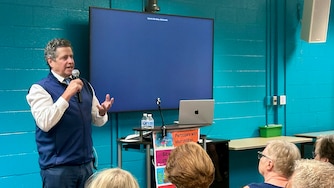
Over a hundred Lutherville-Timonium residents gathered inside a packed meeting room in the Baltimore County Public Library’s Cockeysville Branch in late July, demanding answers about a project they say has threatened their slice of suburbia.
Robin Campbell, chair of the county’s Advisory Committee on Public School Capacity, raised concerns that the project could overcrowd the community’s schools.
Another resident, Patricia Wynn Ferguson, told Karceski she is not antidevelopment, but her biggest fear is that Lutherville Station will attract crime.
Ferguson said fights at malls in Towson and White Marsh — and the malls’ proximity to public transportation — are exactly why this project should be reconsidered.
“If you put all that beautiful stuff there, man it’s a hangout spot,” she said. “They’re gonna come up there and they’re gonna cause all kinds of trouble ... it’s not going to be a safe place to go.”
In an interview, Rockel said critics who label the community as NIMBY, an acronym for “not in my backyard,” only shut down conversation.
“I find it interesting that folks scared of AI and data centers aren’t called NIMBY,” he said.
What’s next?
Klaus Philipsen, who worked as an architect and transportation planner building Baltimore’s Central Light Rail in the late 1980s, argued during the work session that the transit-oriented designation is not premature, but 36 years late.
Philipsen, a longtime county resident, said he actually designed Lutherville Station.
“It is wasteful to have a light rail train stopping next to a defunct shopping center and there is no riders,” he said. “The connection to the Lutherville community doesn’t even exist as a footpath.”
Whether that will change remains to be seen.
Baltimore County Council will vote on the resolution to grant Lutherville Station transit-oriented status next week.




Comments
Welcome to The Banner's subscriber-only commenting community. Please review our community guidelines.