
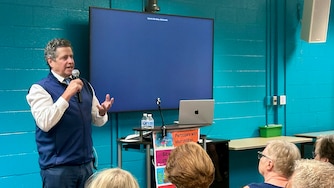
Around 80 Baltimore County residents gathered in the basement of Perry Hall Family Worship Center on Tuesday night, complaining to law enforcement and elected officials about unruly teenagers.
“When we, the citizens ... have somebody coming or circling our car, jumping up on it, threatening us, people are eventually going to start to make road bumps out of these kids,” Noël Schueler said.
Last weekend, Baltimore County Police arrested, and later charged, six teenagers with assault, trespassing and disorderly conduct after a “link-up” at White Marsh Mall attracted hundreds. A total of 17 officers were called to the scene to disperse them.
Across the Baltimore region, warm weather has long coincided with large gatherings of teenagers — in the Inner Harbor, Fells Point, at malls in Columbia, Towson and White Marsh. What happens next has become a perennial political issue. The disruptive behavior of a few leads to consequences for young people as a whole, in the form of law enforcement actions, curfews or reductions in public transportation. It also raises questions about who’s responsible and where teens should go as spaces get closed to them.
Past incidents have led to the dissemination of racist flyers and prompted a politician to describe “roving mobs of Black youth.”
Adults and elected leaders say the gatherings pose safety risks to teens and could lead to gun violence, theft and destruction of property. Meanwhile, young people say they’ve been left out of the conversation entirely.
Dozens of adults at the Perry Hall meeting had plenty to say as police, Baltimore County State’s Attorney Scott Shellenberger and Councilman David Marks fielded questions, critiques and complaints.
“You were talking about the Hickey School before ... is it still up and running?” one attendee asked Shellenberger, referring to the juvenile detention center facing sexual abuse allegations from 69 men.
“Can they do, like, a boot camp?” he added.
After about 90 minutes, the adults adjourned for the night. No teens spoke.

Curfews past and present
Getting kicked out of The Mall in Columbia didn’t feel fair to Dhruv Dobariya.
The 16-year-old was just hanging out with friends when a conflict broke out somewhere inside the Howard County shopping center. Then all the teens got kicked out, Dobariya said.
“Everyone feels they’re being blamed for the actions of a few,” he said.
Young people have long flocked to shopping malls, carnivals and Baltimore’s Inner Harbor when the days grow longer and schools let out for spring and summer breaks. Though the tradition is perhaps familiar to prior generations, the rise of social media has made it easier for word to spread and crowd sizes to swell by hundreds.
Meanwhile, the public spaces where young people can gather have shrunk, with many of the region’s malls and the Maryland State Fair enacting curfews and parental supervision policies.
Both White Marsh Mall and a nearby shopping center, The Avenue, have policies for unaccompanied minors. Since June 2024, The Avenue has required teens under the age of 17 to be chaperoned by a parent or adult 21 years or older at all times. At the mall, teens under 17 years old must be supervised by an adult after 5 p.m. on Fridays and Saturdays.

The issue came to a head in Baltimore City in 2023, amid a wave of gun violence in which high school-age teens were shot in record numbers. Leaders resurrected a citywide curfew for minors that year after large crowds gathered in the Inner Harbor, a fight broke out and two boys were injured in a shooting.
On Wednesday evening in Perry Hall, Baltimore County Police Capt. Jason Lentz explained that one teen reported being shot at after the White Marsh meetup on Saturday, although the department could not substantiate the incident.
“There was one juvenile that was pepper-sprayed and then was arrested,” he said. “The strong-arm robbery and the assault that occurred that resulted in the child being taken to the hospital are still both open investigations.”
Where are kids supposed to go?
The recurring debate over teen gatherings stigmatizes young people as dangerous, particularly those who are Black, said Dayvon Love, director of public policy for the grassroots think tank Leaders of a Beautiful Struggle.
“It’s easier to pitch them as a problem,” Love said. “What people won’t say out loud is, ‘I feel safer if a law enforcement officer is in a position to punish someone.’”
Although there are legitimate safety concerns about unsupervised young people in public spaces, Love said, ramping up law enforcement and passing curfews are not good-faith solutions.

Col. Chris Kelly, Baltimore County Police’s operations bureau chief, told The Banner that teenage gatherings have happened across malls, roller skating rinks and arcades forever.
“I think it’s important to highlight if there are several hundred children, there’s only been a few arrests,” he said. “We don’t want to paint with a broad brush that all the children, all these kids, are nefarious actors. They’re just doing what kids do.”
But the colonel stressed that if, and when, teenagers cross the line and disturb the public or private businesses, they have to be held accountable.
Love suggested law enforcement could accomplish that without punitive measures for teens or their parents.

He pointed to evidence-based alternatives such as Baltimore’s community-based violence intervention program, which uses intervention specialists to mediate conflicts and prevent them from escalating into violence.
Baltimore’s dirt bike culture offers another example, Love said. The organization B-360 provides programming that shifts young riders out of traffic and into safe spaces where they learn STEM skills by caring for their bikes.
Who is responsible?
Rosedale resident Sheila McGee believes that the parents of these teens need to be held accountable for their children’s behavior.
“If parents are repeatedly picking up their kids ... and the parents were like, ‘Oh well, we talked about it, they just didn’t listen to me.’ I’m sorry, but the second and third time ... the parent needs to have consequences,” she said during Tuesday’s meeting.
Shellenberger said that Maryland’s juvenile justice system limits his ability to prosecute teens. The state’s attorney, who is running for reelection this year, encouraged residents to contact their state delegates and push for legislation to make it easier to hold parents responsible for their kids’ actions.
“The problem with the juvenile justice system is, there’s a wall, OK?” he said. “And that wall is the Department of Juvenile Services.”
Shellenberger explained that when officers charge teens under 18, those cases are referred to the state, where intake officers speak with the child and their guardian, and potentially adjust charges.
“We need to put more money in the juvenile system, and something like a boot camp at the Hickey School would be great,” he said, referring back to the juvenile detention center, whose former housing supervisor was charged with sexual abuse last week.
Love reiterated that cycling teens in and out of the criminal justice system rarely addresses the root causes of misbehavior, and encouraged Baltimore County to implement programs like B-360.
“That’s the kind of presence that is actually about their safety,” he said.



Comments
Welcome to The Banner's subscriber-only commenting community. Please review our community guidelines.