
Will Mester could hardly wait to get to his job as a cook at Woodberry Kitchen.
This was around 2013, two years before its founder, Spike Gjerde, won the James Beard Award for Best Chef: Mid-Atlantic. Even so, among Baltimore’s food people, Woodberry Kitchen was the only place worth working, Mester recalled.
Woodberry wasn’t so much a farm-to-table restaurant aiming for sustainability as it was its own food ecosystem — it had a canning department, a butchery department, and relationships with local farmers that went above and beyond anything Mester had seen before. After reporting early for his shift to pick out his choice of produce, Mester would leave the restaurant after service to talk about food with his co-workers. “Cook and then go talk about cooking,” he said.
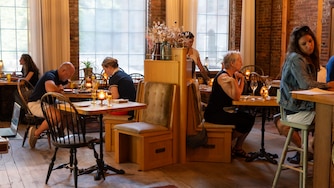
Now the restaurant is set to close in April, when its lease on its Clipper Mill location expires. But Woodberry Kitchen’s influence on Baltimore’s dining scene over its two decades in business, during which it closed and reopened as an event space with an intimate tavern attached, is hard to overstate.
At its height, Woodberry Kitchen embodied the virtues and vices of the restaurant world in the midst of a culinary revolution. It not only brought the farm-to-table movement to Maryland but it took it to new extremes, committing to local food to the extent that it long banned citrus and olive oil while encouraging farmers to rediscover lost heirloom crops. Over 20 years, it helped launch the careers of some of the city’s most promising young chefs. But that came at a cost. Some staff members felt undervalued and overworked. The environment was all-consuming.
“We showed people that you could make a restaurant or a place and you didn’t have to comply with the accepted thinking,” Gjerde said. But he acknowledged that not everyone shared his passion. “Not everyone came out of the door [going] 100 miles an hour.”
Read More

To Mester, intense pressure was just part of life working in a “proper kitchen” like Woodberry. “You have to be able to absorb pressure. And if you can’t do that, then you just can’t do this work,” he said. The restaurant nurtured other rising food stars in Baltimore, people like Mester, who would go on to open his own highly acclaimed spots, Le Comptoir du Vin and The Wren. And he’s far from alone: Dylan Salmon of Dylan’s Oyster Cellar, Russell Trimmer of Motzi Bread and George Marsh of Heritage Smokehouse all worked at Woodberry for a time, too.
“Woodberry Kitchen was building something larger than itself,” said farmer Denzel Mitchell, who has worked with the restaurant since soon after it opened. He was just starting out as an urban farmer in Baltimore when he heard Gjerde was looking to put fish peppers on the menu at Woodberry. A variety of chili, fish peppers were grown by Black farmers in the region through the 1800s but disappeared by the 1950s. Gjerde wanted to bring them back.
“No one knew anything else about the fish pepper at that time, outside of Spike asking about it,” said Mitchell, who decided to start cultivating the crop. The pepper became the signature ingredient in Woodberry’s Snake Oil hot sauce, and Mitchell and Gjerde became good friends. Mitchell, now executive director of the Farm Alliance of Baltimore, thrived as a farmer and said his career wouldn’t have happened without Woodberry.
At least one important artwork never would have existed without Woodberry Kitchen. Mitchell was eating dinner at the restaurant — farmers got a 50% discount — when he first met the artist Amy Sherald, who was then a server there but went on to fame after painting Michelle Obama’s portrait. Her portrait of Mitchell, “A God Blessed Land (Empire of Dirt),” was part of Sherald’s show at the Baltimore Museum of Art last year.
But there were less savory aspects to the eatery and its sister restaurants, which included Artifact Coffee and the now-closed Parts & Labor. The high-pressure environment could feel “toxic,” recalled Kit Zirschky, who worked at Parts & Labor from around 2013 to 2015. Employees were encouraged to live and breathe the company’s commitment to local food, he said. “They really wanted you to drink the Kool-Aid.”
Yet employees felt overworked and underpaid, Zirschky said. “They knew that people were very stressed out and felt undervalued,” he said. He compared gestures to boost morale to a husband picking out chocolates for his wife after a fight — superficial at best. Staff members might work a 13-hour day before a holiday, only to be rewarded with a nice glass of wine, he said. “And it’s like, ‘Well, I can’t be mad at you now,’” Zirschky said.
Responding to Zirschky’s characterizations, Gjerde said Wednesday that Parts & Labor had different management than Woodberry Kitchen and he had “never compelled an employee to eat or think a certain way.” The restaurateur also pointed to the many longtime workers at his businesses “who clearly don’t share that perspective” of being undercompensated.
For years after it opened, Woodberry Kitchen and its sister restaurants paid workers by their shift only. In 2015, the restaurant faced a lawsuit from employees who alleged they weren’t paid for overtime hours they worked and wouldn’t be paid at all if they worked fewer than 10 hours a day. The suit was eventually settled, and the restaurant moved to an hourly pay system.
“We thought we were in compliance” with the law, Gjerde said. When the issue was brought to his attention, he added, “We did everything in our power to correct that and make it right.” After the pandemic, the restaurant instituted a 23% service charge to pay all staff an equal rate, though it’s since been reduced to a 20% charge.
I asked Gjerde if he had any regrets about how the restaurant operated over its 20-year history. He quoted Frank Sinatra’s “My Way.” “Regrets? I have a few,” he said, admitting that the atmosphere at times “was not as supportive as it should have been.”
For his part, Gjerde will continue to feed Baltimore through his newly formed restaurant group, Ecco Project, which now runs three eateries in the city and has an Italian market in the works.
Still, the closure of Woodberry stings. “I’m feeling the incipient hole,” Gjerde said Monday, days after announcing the closure. “I really believe there will only be one Woodberry Kitchen.”



Comments
Welcome to The Banner's subscriber-only commenting community. Please review our community guidelines.