
The server rolled up to our table with plates of calamari and wings before chirping: “Gotta go!”
Robot waiters don’t do small talk.
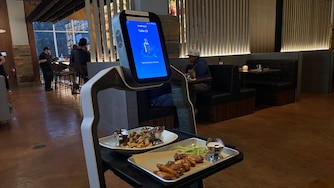
The future is here, or at least it was for date night with my husband at ViVa Ristorante, a casual Italian-American eatery located inside Elkridge’s Howard Square mixed-use development. ViVa uses a fleet of OrionStar autonomous mobile robots — each resembling a cafeteria tray tower with an iPad for a face — that glide silently around patrons and bar stools to deliver orders to each booth.
“It’ll be cool, but it’ll be soulless,” my sister predicted when I told her of our plan to dine with the machines.
The words echoed in my head as we entered and spotted a giant screen, not a human, behind the host station. I was relieved when, upon seating ourselves, a live waitress appeared to make sure we understood how ViVa worked.
Customers use their smart phones to place orders via a QR code posted at each table. The robots then deliver drinks, appetizers and entrees within minutes. For other needs, each table features a call button to summon a staffer.
As soon as the waitress finished her spiel, a robot arrived with our bread and water. Another whizzed by to drop off a tiny plate of olive oil and balsamic vinegar.
ViVa isn’t the only Maryland business embracing autonomous technology.
Robots are preparing food at the Chinese restaurant Mahjong just a few blocks from Johns Hopkins University. Waymo is busy preparing its self-driving cars for future taxi service, though humans are behind the wheel as the company maps out the city on its software. Takeout orders are being ferried around Towson University’s campus by 14 delivery robots. Giant Food Stores deployed googly-eyed robots to patrol for spills throughout its aisles.
Online retailers price robots like the ones at ViVa starting at $6,500, touting how businesses can use them to significantly reduce labor costs. Their availability comes at a time when some Maryland restaurants struggle to get customers in the door. Drinking habits also have changed since the pandemic, with diners ordering fewer alcoholic beverages than before.
Mobile robots serve patrons at ViVa Ristorante. (Lillian Reed/The Banner)
ViVa owner Gino Palma, who also operates Facci Ristorante locations in Baltimore, Turf Valley and Maple Lawn, did not respond to requests for comment. Palma told the Baltimore Business Journal that the bots provide stability amid industrywide problems like employee shortages and inconsistent work ethics.
Shortly after ViVa opened in late December, some Howard County residents took to social media to declare they wouldn’t eat at a joint that had removed humanity from the dining experience. To be sure, the robots easily outnumbered the lone waitress working ViVa’s dining room Friday night. Bartenders still prepared the drinks, however, and bussers briskly carried dirty dishes back to the kitchen and wiped down tables.
Putting aside any concerns about automation’s impact on jobs, we couldn’t help but whip out our phones to record each time a robot approached our table. In a way, these goofy runners provided both dinner and a show. I felt like I was in Japan or an episode of “The Jetsons.”
While the robots performed their jobs well, there were a few hiccups. We struggled to pry a stemmed glass out of a stabilizing tray and ended up spilling it on our non-sentient server. My husband watched one staffer attempt to reset a robot that had inexplicably halted in the middle of the floor, before giving up and dragging it away.
We hit the call button just once when our entrees arrived to ask for more water and a spare fork. I spotted another table use the button to ask for a to-go container.
The most spirited debate over the robots came at the meal’s end. We opened the tab on our phones and stared blankly at the bill, which noted that 100% of the tip went to staff.
“How should we calculate the tip?” I wondered aloud.
Robots don’t have bills to pay or kids to feed. We had hardly interacted with the human staffers, but they nonetheless prepared our drinks, bused our tables and were reasonably attentive.
A 20% tip on our bill would have amounted to about $30, which seemed a little steep given the automation of it all. I suggested 10% instead, but my husband pushed for more. We settled on a flat $20.
“These are the things the robots will remember when they take over,” he said as we headed for the door.



Comments
Welcome to The Banner's subscriber-only commenting community. Please review our community guidelines.