
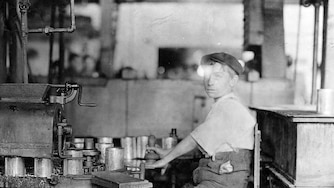
From 1908 to 1924, Lewis Hine’s camera documented child labor in Maryland and across the United States.
He took people into dark coal mines illuminated by little more than a dusty headlamp; onto mounds of oyster shells where boys who should have been in kindergarten took turns holding a newborn so their siblings could work; and through thickets of berries in what is now suburban Baltimore, where whole families lived in shacks and earned only tokens to spend at the company store.
The photos, which Hine took for the National Child Labor Committee, eventually prompted changes in America’s child labor laws, although they are still a work in progress. In 1938, Congress passed the Fair Labor Standards Act, establishing both a minimum wage and setting a minimum age of 14 for non-agricultural employment.
The University of Maryland, Baltimore County is the caretaker of Hine’s collection – 5,400 photographs, many with notations of what he saw at child labor camps. The university’s Special Collections team has assembled a searing exhibit of his work, specifically focused on Maryland and Baltimore labor camps, that will be at the Albin O. Kuhn Library until Dec. 3.
“Lewis Hine in Maryland” is the first comprehensive exhibit of his work in decades, said Beth Saunders, head of special collections. A grant from the National Endowment of the Humanities in 2022 made it possible. Those funds allowed archivists to digitize the notations and remove the photographs from the envelopes where they’d been stored. Adhesive strips on the back had begun to deteriorate and cause the photos to stick together.
UMBC is mounting the exhibition as the Trump administration attempts to weaken child labor protections. Just last month, the administration proposed relaxing the labor rules for 14- and 15-year-olds.
Read More
Hine’s work, Saunders said, came when the United States was swelling with poor immigrants and industries had an insatiable need for workers. But it was also a moment when Americans, particularly Gilded Age wives and mothers, began to advocate for kids to be kids.
“People start to think differently about childhood. That it’s not that children are just little adults, but that there are developmental stages to childhood, and that that’s something that we need to foster through education and even play,” Saunders said.
Also at work was a Progressive Era ethos that immigrants could rise above their station and contribute to society.
“It was this idea that you’re not born a king or born a peasant. That these are all changeable. That through social reform, through government, we could actually improve things,” she said. “And those progressive ideals are what start to fuel meaningful legislation in the 20th century.”
Hine is known for his newsboy images, including one at the Metropolitan Museum of Art showing a sleeping child wearing the snap-top flat caps on city steps after an early-morning shift selling daily newspapers. At the UMBC exhibit, though, the photographs show child hawkers’ heights in relation to a stack of newspapers they were selling. This is not “Newsies,” the Broadway musical featuring spinning grown men singing about solidarity before the Newsboys Strike of 1899 in New York City. Hine’s newsboys are tired, tiny, and scared.

“I always think of these as working documents,” said Sarah Fouts, a UMBC ethnographer. “It’s almost overwhelming, what’s here in these spaces. I mean, these are little kids.”
Among the most heartbreaking photos are those from Bottomley berry farms in Pasadena, not far from Thurgood Marshall Baltimore-Washington International Airport. Families would come to pick strawberries, lured by the promise of good wages and places where the family could live together. The accommodations, though, were little more than paper shacks, the work grueling, and the pay barely enough to cover expenses until the family had to move to the next place.

Hine also showed children engaging in adult vices like craps games and smoking. Elizabeth Patton, a UMBC communications studies professor, said these photos were particularly effective in mobilizing the Gilded Age matriarchs to fight child labor and keep low-income mothers at home or in domestic jobs like housekeeping. In so doing, she said, it solidified their importance in child-rearing and keeping house.
The National Child Labor Committee exhibited Hine’s work and collected donations to continue advocating for the laws to change. Success came in fits and starts. Congress established the Children’s Bureau in 1912 to safeguard the rights of young workers. In 1912, it passed the Keating-Owen Child Labor Act, which limited hours for child workers and blocked the interstate sale of goods that child labor produced. But the Supreme Court declared it unconstitutional.
Hine, who came from a working-class background in Wisconsin and found his way to the University of Chicago and later New York City, taught himself photography. The era’s style tended to be “pictorialist.” Photographers used soft light and brush strokes to mimic paintings. Hine, in contrast, employed what’s known as “straight photography,” playing with focus and lenses but not altering with brush strokes.

Though journalistic in style, Hine had a point of view, Saunders said; he was trying to change laws. Watching college students interact with the images, it’s clear how successful he was. The photos shock, provoke tears, prolong conversation.
The exhibit juxtaposes Hine’s work with that of New York artist Lisa Oppenheim. She enlarges his images and bifurcates them so the viewer can see how the repetitive work permanently curved the spines of adolescent textile workers who spent long days hunched over.
Of his own work, Hine said: “Perhaps you are weary of child labor pictures. Well, so are the rest of us, but we propose to make you and the whole country so sickened tired of the whole business that when the time for action comes, child-labor pictures will be records of the past.”




Comments
Welcome to The Banner's subscriber-only commenting community. Please review our community guidelines.