
On the last full day of his life, George Stone played baseball, went to the movie theater and then tucked into a dinner prepared by his mother, Hattie Stone.
Stone, who had grown up playing among the headstones of Havre de Grace’s Angel Hill Cemetery, had buried three close relatives by the time she served George his final dinner on June 3, 1929.
First, her mother-in-law, Emma Stone, had died in January 1924 after suffering nausea and convulsions. Then her elder son, Edgar Stone, had died at age 17 in June 1927, following months of treatment for seizures.
Next, her husband, Edward Stone, a Pennsylvania Railroad worker, fell into convulsions and died on a train after eating a hearty breakfast in January 1928.
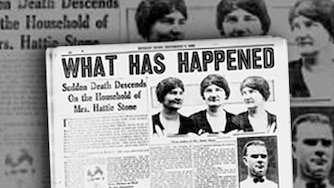
So when George, a Havre de Grace High School student, died suddenly, according to contemporaneous newspaper accounts, the local coroner cast a suspicious eye on his mother.
Little is known about Hattie Stone’s life before the string of mysterious deaths, said Amy Rosenkrans, a Havre de Grace historian who has given talks on Stone and will give a presentation on Angel Hill Cemetery on Wednesday.
Read More
Raised by her grandparents, the cemetery caretakers, Hattie Blackburn married Edward Stone in 1910. She worked as a nurse and midwife, taught Sunday school and cleaned and cooked for boarders in the family home.
While the deaths of her mother-in-law, husband and elder son did not appear to draw scrutiny, doctors became suspicious when young George first took ill in September 1928, nine months before his death.
Vomiting, convulsing and complaining of a bitter taste in his mouth, George was taken from school to the hospital, where a doctor sent the contents of his stomach to a lab for analysis, but no poison was found, according to a 1929 Evening Sun article.
When George suffered similar symptoms the following June, a doctor came to the house with medicine, according to The Evening Sun. When a physician stopped by the following morning, George’s condition had worsened; he died en route to the hospital.
This time, chemists did find evidence of toxins in George’s system: strychnine, a bitter-tasting rodenticide. They declared that the boy had been poisoned.
Police headed to Stone’s home with a warrant for her arrest and found her lying in bed, saying she was “too ill” to be taken to jail, according to The Evening Sun.
“Although she had drawn the bedclothes up over her person, the officers said they could easily observe that she was fully clothed,” the newspaper reported.
Protesting her innocence — and accusing doctors of poisoning George — Stone was taken to the Bel Air jail to await trial. The case became “an entire media circus,” said Rosenkrans. “Most of the newspaper articles I’ve found were from out of town.”
As Stone sat in the Bel Air jail that summer, her lawyer brought silk sheets, and sympathizers brought chocolates, Rosenkrans said. Even a group of schoolchildren, “report cards in hand,” came to visit her, The Baltimore Sun reported.
“First they gazed awkwardly at the woman accused of murdering her son,” The Sun reported. “Then Mrs. Stone asked in friendly fashion how they fared with their studies.”
Stone’s trial in September drew throngs of media to Havre de Grace. Reporters filled hotels and local residents set up an open-air bazaar along Main Street, selling “inexpensive jewelry and other trinkets,” The Evening Sun reported.
The scene in the courtroom “was pure Jerry Springer,” Rosenkrans said.
Prosecutors alleged that Stone had killed her husband to collect his life insurance and her son for his portion of her husband’s inheritance.
“The woman loved the pleasures of life more than her son,” said Harford County State’s Attorney W. Worthington Hopkins, who accused Stone of throwing “rum parties” and having multiple lovers.
“How many boyfriends do you have?” he asked Stone, according to The Evening Sun.
“I have quite a few, haven’t I?” she responded.
Stone portrayed herself as a loving and indulgent mother. George, she said, had an interest in chemistry and a tendency to play with dangerous substances.
Jurors didn’t buy it. They found Stone guilty of second-degree murder; she was sentenced to 18 years in prison. She was never charged for the deaths of her other relatives. Tests for poison were inconclusive when their bodies were exhumed.
Newspapers reported that Stone unsuccessfully attempted to receive parole three times, but then the record grew silent, Rosenkrans said. Stone doesn’t appear in the 1950 census, and there is no record of her death. “We don’t know what happened to her,” she said.
As for the other family members — Emma, Edgar, Edward and George Stone — their bones rest in Angel Hill Cemetery, among the same gravestones where young Hattie Stone once played.




Comments
Welcome to The Banner's subscriber-only commenting community. Please review our community guidelines.