
Pull open a heavy Hampden door and step back in time. It’s 1932 and you are in a secret speakeasy, where the performers are as illicit as the booze they’re slamming back.
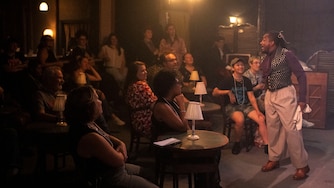
Miss Mad Haddie shimmers across the stage, tall feathered headdress swaying upon her bearded face. A bartender slides a cocktail to a lanky person in a seashell pink robe. The owner, jaunty in top hat and tails, twirls her cane.
Then someone calls, “Mary Had a Little Lamb.” Everyone freezes. Are the police about to raid?
“The Pansy Hour,” an immersive theater experience from Submersive Productions, which opens Friday at the theater company’s Hampden headquarters, allows audience members to explore a Prohibition-era drag bar. The play is based on clubs that opened — and quickly shut down — during the late 1920s and early ’30s, in Baltimore and other cities.
Visitors chat with performers, wander through rooms, open drawers of intriguing objects, drink mocktails and get a sense of the unfettered creativity and joyous — but fear-tinged — freedom of an underground Prohibition queer club.
“There was this brief period in the wild ’20s where queer culture became mainstream,” said Josh Aterovis, a core member of the play’s creative team. “Female impersonators — which is what they were called then — were everywhere.”
Read More
Drag bars known as “pansy clubs” sprung up in larger cities. In Baltimore, they appeared near Pennsylvania Avenue, the heart of the famed Black arts district, where Billie Holiday and Cab Calloway routinely performed. Other clubs opened in Mount Vernon and downtown before police shut them down.
Pansy balls, the forerunners to the pageants featured in “Paris Is Burning” and “RuPaul’s Drag Race,” were an important part of post-World War I queer culture. While most newspapers of the day described drag shows with a mix of horror and revulsion — if they covered them at all — Baltimore’s AFRO-American reported on pansy culture with open-minded curiosity. Its articles, preserved in the AFRO Archives, provide a rare historical account of these clubs.
“It’s an incredible record and legacy,” said local queer historian Ben Egerman, who mined the AFRO Archives to research his zine on the pansy craze. “The AFRO was more interested and less judgmental than any white newspapers.”
Aterovis, who joined the Submersive team soon after its founding 11 years ago, had long dreamed of creating a queer show along with his good friend drag performer Betty O’Hellno. Aterovis has previously produced a burlesque company, TimelessTease, and was fascinated by backstage drama.


After President Donald Trump was elected a second time and his administration began whittling away at the rights of queer people, Aterovis felt even more keenly the need to create a play about finding joy in the midst of oppression.
“I had this moment where I realized it all happened before,” he said. “It’s all happening again. It’s cyclical.”
Submersive’s co-artistic directors, Ursula Marcum and Glenn Ricci, were enthusiastic about the vision. They founded the company in 2015, after traveling to immersive theater productions in New York, Philadelphia and Pittsburgh. Although actors have been staging interactive performances since antiquity, modern immersive theater emerged in the 1960s.

Past Submersive shows include “H.T. Darling’s Incredible Musaeum Presents,” which filled The Peale museum with cases of exhibits of imagined creatures; “MASS/RABBLE,” a solemn dance about refugees performed in the War Memorial Building; and 2023’s “The Boundary,” a meditation on mortality and the first production the team staged in its Hampden headquarters.
For each play, audience members are invited to interact with performers and the scenery, respectfully. (Observers can just watch too.) The rare guest who tries to steal the show is ushered along by Subversive handlers. But most visitors are filled with courteous curiosity.
“The audience is the last character in our show,” Marcum said. Submersive shows usually sell out, and about half of the tickets for the six-week run of “The Pansy Hour” have been sold.
Vicky Graham, a production team member who plays bar owner Big Papa in “The Pansy Hour,” said working on the play made her feel connected to LGBTQ+ artists who struggled to live their truths in the past.

“We have so much in common with what we call our queer ancestors,” Graham said.
As Submersive’s team began sketching a vision for a pansy club-inspired play last autumn, they saw that Egerman, the historian, was giving a talk about the topic. Egerman shared his research and met with actors to discuss what their characters’ lives might have been like.
The Submersive team made their club integrated, like the pansy bars of New York, Philadelphia and other northern cities. In reality, the pansy clubs in Baltimore were segregated.
Baltimore was home to one of the pansy craze’s most famous Black performers, Joe Smothers, who headlined Pennsylvania Avenue clubs and inspired a character in “The Pansy Hour.” Two songs in the play, “Hot Nuts” and “Underneath the Harlem Moon,” were performed on Pennsylvania Avenue, Egerman said.
A famous white Baltimore pansy, Karyl Norman, a celebrated Vaudeville performer, also provided inspiration, Aterovis said.

The core team devised key characters and plot points, then cast actors in late spring who worked together to further refine the personalities and storylines.
Despite these rough guidelines, “The Pansy Hour” is a little different each night. There’s a rotating cast throughout the 18 performances. Many lines are improvised or spurred by conversations with guests. And if you’re lucky — and willing — an actor could pull you into some smaller scenes in a dressing room or office.
With the bawdy songs, the silk dressing gowns and the twirling beads, Aterovis said, he hopes audiences will come away from “The Pansy Hour” feeling renewed in the struggle for queer rights.
“The hard times we’re experiencing right now are not permanent,” Aterovis said. “Queer people will persevere. The community will get us through these hard times.”


Comments
Welcome to The Banner's subscriber-only commenting community. Please review our community guidelines.