
The two women locked eyes across the West Baltimore grocery store parking lot.
“I’m Traci’s mom,” said Tammy Bombardier, raising her hand in a shy wave.
Bonnie Marquez swept her up in a hug, then put her hands on the other woman’s shoulders. “I can tell you from experience, I’m not going to know exactly where your daughter is, but I am going to know by the time I leave Baltimore if she’s alive and if she’s been seen.”
Tammy, 56, was searching for her adult daughter, who had been missing for weeks. The mother felt something must be terribly wrong — she and Traci spoke most days.
First, Tammy turned to the Baltimore Police, who passed her from officer to officer and then stopped returning her calls. Then she went online and found Bonnie, who years earlier had created a Facebook group called Missing in Baltimore City to crowdsource leads when her own daughter went missing.
Bonnie’s social media presence has helped bridge the disconnect between the lack of police resources available for finding people who are suffering from addiction, and the sense of crisis that their loved ones feel.
“I quickly learned that no one cares about just another missing addict,” Bonnie wrote online after her daughter Alisha went missing in early August 2021.
Bonnie, who lives in Carroll County and is now 52, rarely ventured into Baltimore — its noise, its crowds, its reputation as dangerous kept her away. But when tips from her new Facebook group poured in, she spent days on the city’s street corners, handing out her number and repeating the same plea: I’m not a cop. I’m not judging. Just tell her to call her mom.

Each year, more than 3,000 people are reported missing in Baltimore. Yet the city’s missing persons unit — just two detectives and a supervisor — prioritizes only 400 of the most critical cases. Typically those cases involve young children or adults who are cognitively impaired or suicidal.
This leaves hundreds of cases with scarce police attention, and those involving addiction often slip to the bottom of the pile in a city already struggling to address its deepening opioid crisis.
Breaking Down Baltimore's Missing Stats
Baltimore Police handle more than 3,000 to 4,000 missing persons cases annually, averaging about 13 reports each day. While most individuals are found within hours, the volume is typical for a city of Baltimore’s size, according to a police spokesperson. In comparison, New York City sees over 13,000 missing persons cases each year, a figure tracked by the NYC Office of the Medical Examiner.
Started out of her own desperation, Bonnie’s Facebook group quickly accumulated requests from other parents with missing adult children.
Missing in Baltimore City now counts almost 39,000 members from across the country, with dozens of new missing-persons posts each week. Both online and on the ground, Bonnie goes searching for them — helping some find their way into rehab, connecting others with resources to escape domestic violence, and, in some cases, assisting families in identifying their loved one found in the morgue.
“This is my therapy,” Bonnie says. “It’s a good feeling to know I was part of that, part of their story.”
Bonnie activates for Tammy
Tammy’s story with Missing in Baltimore City began July 18, four days after her daughter Traci went missing.
“I’ve called the police but since they are homeless [they] said there is nothing I can do,” Tammy wrote in a post.
July 21. “Another day has come and gone, still no word.”
July 22. “Please someone has to know where she is!”
Tammy’s posts drew hundreds of likes, comments and scattered leads about where Traci might be. Some said she’d been seen in Brooklyn Park, others across town near Carrollton Ridge.
That weekend, Tammy made the five-hour drive from her rural town in upstate New York to Baltimore. Nothing. When Tammy mentioned in the Facebook group that she was planning another trip, Bonnie direct-messaged her, offering to organize a search party.
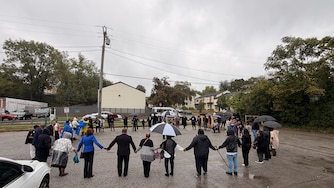
The search began at 11 a.m., timed for when, as Bonnie put it, “the new dope drops.” Several comments from the Facebook group had placed Traci near Pennsylvania Triangle Park, and Bonnie decided they would canvass the surrounding area with posters.
Other volunteers in the search party included a local advocate for missing people, those in recovery and recovery home workers — people who understood the stakes.

It clearly was not a professional job. Tape was forgotten. Not enough flyers were printed. The plan was to divide into two groups, but instead, they moved as a single cluster through the streets. Still, there was a sort of order, born of Bonnie’s experience. She laid out her rules as the party neared the park:
“Be alert.” No going into alleyways. Always tell another group member where you’re headed.
“You have to read people.” Don’t approach them first. Hold the poster up. Make eye contact. “If they make it known you’re not wanted, you leave.”
And no paying for information, especially in these parts, where addiction and drugs run deep. “I’m not going to be the last person to hand someone $20.”
To Bonnie, the key to finding Traci was in the photos on the missing poster. She placed four side by side, allowing the images to chart the progression of Traci’s addiction — her face growing increasingly hollow, her body thinning, and premature wrinkles etching deeper into her 32-year-old skin.
The posters seemed to have an almost magnetic pull. A letter carrier pulled over and took some to pass out along her route. The security guard at a nearby Dollar General asked for one, mentioning he might have seen Traci in the store weeks earlier. Two men washing cars near a boxing gym thought they’d spotted her at Penn North recently.
Upon hearing Penn North, Bonnie decided to take the search party there, recalling several Facebook leads also pointing to the area.
Addiction’s many crises
Over the last a decade, Tammy had grown used to her daughter’s addiction and all that came with it — the phone calls for money, the stealing, the broken promises. But even in her lowest moments, Tammy said, Traci always kept in regular contact, including after she moved to Baltimore two years earlier.
That’s why days without hearing from her had set off an alarm. Then the messages from acquaintances in Baltimore started coming in. One person claimed to have seen a black car abduct Traci. Another said they found her socks in a grassy field. Panic set in.
“There’s too many stories,” Tammy said. “But they’re all just scenarios that could happen.”
She’s right. Research shows that women struggling with addiction and homelessness are at high risk for violent crimes, including sex trafficking.
Bonnie has begun working more closely with local anti-sex-trafficking groups, hoping to bring some of the victims home. Ever since she launched the Facebook group, one pattern has stood out to her: Most of the missing are young women battling addiction. Oftentimes, they’re Black.

Outside a recovery center, the posters again drew people in, with several claiming to have seen Traci recently, though only in passing.
“If you see her, just say call your mom. That’s it,” Bonnie told a woman sitting on steps next to the center.
“I don’t forget faces. I’ve seen her, but I haven’t seen her in a minute,” the woman replied. “I’ll watch.”
“Thank you,” Bonnie told her. “Helping to look gives me something to do. She’s suffering. My daughter is suffering too.”
The Facebook group is the first thing Bonnie checks in the morning and the last thing she looks at before bed, monitoring it about every 30 minutes in between.
Just as with her real-world searches, she runs the group with steadfast rules: Make a disparaging comment, and you’re blocked. Try to crowdfund money, blocked. Post with the hopes of getting someone arrested, blocked again.
“The stigma of addiction stops here. If you’re here to mock an addict, don’t even click that join button because we don’t want you here,” reads the group’s “about” page.
As the search party for Traci combed through Penn North, Bonnie stopped in at the neighborhood’s library branch.
“You’re doing a good thing,” the woman told Bonnie as she took a handful of posters.
At the building entrance, Tammy held out posters to two women who were walking in. “This is my daughter.” she says while handing them a poster. “Two weeks, no word.”
“I’m so sorry,” one woman said. “We’ll keep an eye out.”
Bonnie soon concluded that Traci likely only came to Penn North to buy drugs, nothing more. They weren’t going to find her there.
Before calling it a day, there was one last place Bonnie wanted to check: Wilkins Avenue. That’s where she had found her daughter.

The cycle of lost and found
Almost three years ago, as Bonnie remembers it, she got a call from a dealer whom she had met while searching for Alisha. He said he’d found her on the ground, beaten.
Bonnie made the drive to Baltimore, but Alisha refused to go to the hospital. She took her daughter home to Carroll County, but a few weeks later, Alisha returned to Baltimore, and to drugs.
“We talk about addiction a lot, but we don’t talk about how it affects the families and what stages they go through,” Bonnie said. For Bonnie, Alisha’s addiction has left her in a continuous loop of fear, desperation, anger and hope — a cycle that only intensified when she went missing.
“The worst thing I have ever gone through was not knowing if my child was dead or alive,” she said.
“That’s what Tammy’s going through now.”
Bonnie, Tammy, and a group of volunteers stood outside a convenience store on Wilkins Avenue, posters in hand. A woman with a close-shaved head and loose dress slowed as she passed.
“Why you want the information?” she asked.
“No, we just want to know that she’s safe,” Tammy said.
The woman paused, took one of the posters, then nodded. “Well, I can tell you she’s alive,” she said.
She said she’d seen Traci three days earlier after a Narcotics Anonymous meeting when the church across the street was handing out peaches. She specifically remembered her because, after the peaches were all gone, Traci gave her a soda to help with withdrawal cravings.
Tammy exhaled deeply, her first glimmer of hope in weeks. Her daughter was alive, she now believed. She just had to keep searching Baltimore until she found her.
It was almost 5 p.m. With rush hour approaching, the search party disbanded, shifting their efforts back online.
A photo appeared in the Missing in Baltimore City group an hour later. It showed a thin young woman with red hair. “Spotted on Edmondson Ave and Allendale just now,” someone commented.
Bonnie messaged Tammy soon after, “Go get her.”
Tammy jumped out of her truck at the intersection and approached a woman holding a cardboard sign.
”Traci, it’s mama,” Tammy said.
The next day, Tammy drove Traci home to New York. Traci told her she had disappeared to escape an abusive partner, fearing for her safety. At first, she seemed open to rehab, but days later, she left.
Like Bonnie, Tammy found her daughter. Like Bonnie, she fears losing her again and again, to addiction and to everything that comes with it.
The mothers stay in contact, regularly messaging on Facebook. Soon, Tammy said, she’d be back in Baltimore to join Bonnie’s next search party — this time for another mother, another missing child.



Comments
Welcome to The Banner's subscriber-only commenting community. Please review our community guidelines.