
Domestic violence incidents in Prince George’s County have increased 14% so far this year even as overall violent crime has fallen 8%, according to county police data.
Police recorded 1,185 domestic violence incidents through Nov. 17, compared with 1,044 during the same period last year.
State’s Attorney Tara Jackson said police investigated 10 domestic violence-related homicides as of Nov. 18. About 50% of domestic violence-related homicides investigated from 2025 to 2026 involved a firearm, according to Jackson’s office.
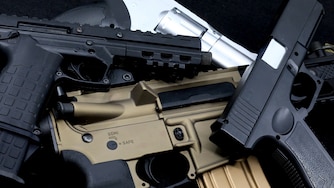
The increase comes as a new statewide assessment found that Maryland lacks consistent procedures to enforce courts’ orders for abusers to surrender their firearms. The report from the Battered Women’s Justice Project and Community Legal Services, released in September, also found that 75% of domestic violence homicides in Maryland in 2022 and 2023 involved a firearm.
A string of killings this summer in Prince George’s County underscores the issue, including the deaths of Kayla Richardson, Dakota Keys and Shawanda Alston.
Alston, 38, was shot in the head in August inside her Bowie home while holding her 2-month-old child. Her boyfriend, Kimball Hinton Jr., is charged with first-degree murder. Six children, ranging in age from two months to 16 years, were inside the home.
Read More
Hinton was prohibited from possessing a firearm because of previous convictions, including assault and possession of a stolen firearm, according to charging documents.
He told detectives that he and Alston had been arguing about their inability to afford school supplies when he shot her.
Who is most at risk?
Black women are disproportionately victims of domestic violence homicide in Maryland, according to data from the Maryland Network Against Domestic Violence.
“They are the majority of folks who are experiencing this, and of course, they are not the majority of the population at all,” said Jennifer Pollitt Hill, MNADV’s executive director.
Black women accounted for 41% of Maryland’s intimate partner homicide victims in 2025, according to MNADV’s data, compared with 32% who were white women and 12% who were Hispanic women. Black women represent approximately 16% of the state’s population.
Women made up 89% of intimate partner homicide victims in Maryland, according to MNADV’s data.
Prince George’s County crime statistics don’t distinguish domestic or intimate partner violence homicides from the county’s total killings, which isn’t uncommon.
“If someone is murdered, they’re treating it as a murder,” Hill said. “They are not necessarily connecting it back to some sort of intimate partner relationship.”
In an effort to produce more complete data, MNADV tracks intimate partner violence-related homicides in Maryland by gathering data from law enforcement agencies, news articles, domestic violence service providers and community fatality review teams.
The network defines intimate partner violence as violence between current or former intimate partners, a narrower category than domestic violence, which law enforcement agencies often use to include forms of family violence.
MNADV recorded 46 deaths connected to intimate partner violence statewide in 2025; the total includes 34 victims, 11 abusive partners and one child bystander.
Prince George’s County accounted for 10 intimate partner-related deaths last year, according to the network’s data — tied with Baltimore County for the top spot.
According to the network’s data, the county has had the highest number of intimate partner violence-related deaths from 2021 to 2025 compared to all other counties, with 48 (this number includes victim deaths, abusive partner deaths and bystanders). Baltimore County had the second highest over the same period with 36.
Firearms are the most common method used in domestic violence-related murders, and Hill said in MNADV is seeing a growing trend of murder-suicides over the past couple of years.
“We don’t really know what to attribute that to,” Hill said. “The only known way to combat that is to get firearms out of the hands of people who have abusive histories or abusive tendencies, even for their own safety.”
One proposal at the state level includes the Family and Law Enforcement Protection Act sponsored by Del. J. Sandy Bartlett. The bill would make firearm surrender mandatory earlier in the process of applying for a protective order. The bill would also require weapons to be turned over within 24 hours of service, and a law enforcement agency would check compliance within three business days and take steps to recover any firearms not surrendered.
At a Jan. 29 hearing, Bartlett said protective orders needed “meaningful enforcement protections, and not just a mere piece of paper.” The House passed HB 83, 89-32, in March. It was referred to the Senate Judicial Proceedings Committee but did not advance.
Compliance and solutions
Of the state’s 10,523 final protective orders last year, 98% directed respondents to surrender firearms, according to the Battered Women’s Justice Project and Community Legal Services’ report. But the requirement doesn’t guarantee they gave up their weapons.
There are no clear deadlines and no reliable tracking system, the report says. And the process can vary based on location and judge.
Under Maryland law, judges have discretion to order a person to surrender their firearm as part of a temporary protective order, which occurs early in the case. If a judge grants a final protective order, firearm surrender is mandatory.
But the statewide assessment found that firearm recovery is often most effective during the temporary stage, when law enforcement serves the order in person and can collect weapons. After a final order, follow-up and compliance verification tend to weaken. In some cases, final orders are served in court or by mail.
“The law as it is written puts the onus on the respondent to turn in their firearms. ... So we don’t really know what’s happening unless that survivor is saying that they believe that the respondent is in violation of that order,” said Monica Player, director of BWJP’s National Center on Protection Orders.
Jackson, the state’s attorney, said “in most instances” Prince George’s County judges order firearm surrender in final protective orders. But without a deadline, it’s difficult to determine whether the subject of an order surrendered their guns.
“There does seem to be a vacuum in terms of compliance,” Jackson said.
Jen Pauliukonis, executive director of Maryland Department of Health’s Center for Firearm Violence Prevention and Intervention, said improvements in Maryland are complicated by differences in state laws and a lack of a national firearm registry.
Maryland maintains records of regulated firearms, including handguns purchased in the state. But Pauliukonis said there might not be records of long guns, firearms purchased out of state, weapons acquired illegally or those built as untraceable ghost guns.
Player, of the Battered Women’s Justice Project, said the group’s assessment is serving as a foundation for a statewide effort to put some of its recommendations into practice.
The organization has launched the Maryland DVPO Firearm Surrender Community of Practice with funding from the Maryland Department of Health’s Center for Firearm Violence Prevention and Intervention.
The group brings together courts, law enforcement, prosecutors, advocates, clerks and attorneys from across Maryland to work through the challenges identified in the assessment and develop practical solutions. Prince George’s County is among the jurisdictions participating.
Have a tip for our Prince George’s County reporters? Tell us here.



Comments
Welcome to The Banner's subscriber-only commenting community. Please review our community guidelines.