
Northern Virginians couldn’t have imagined the mess that would ensue when they flushed their toilets over a month ago: one of the largest sewage spills in American history and a bitter fight between the U.S. president and Maryland’s governor.
Since the Potomac Interceptor ruptured Jan. 19 in Cabin John, Maryland, west of D.C., officials estimate at least 243 million gallons of raw sewage has poured into the Potomac River as they struggle to reach and repair the massive wastewater line.
Weeks into the job, the spill drew the ire of President Donald Trump, who blamed Gov. Wes Moore on social media for the disaster, calling it “a Radical Left caused Environmental Hazard.”
Moore fired back to point out the federal government’s jurisdiction over the disaster.
“I know this is breaking news to everyone, but the president is not telling the truth,” Moore told reporters this week.
As attention shifts from containing an ecological catastrophe to seeking accountability, the political dispute over this spill has raised a bigger question: When America’s outdated wastewater infrastructure fails, who bears the blame?
Read More
In the case of the Potomac Interceptor, the question ensnares at least four different governments. DC Water, the utility that serves the nation’s capital and surrounding suburbs, owns and operates the line and the treatment plant under oversight by the U.S. Environmental Protection Agency. Collecting sewage in Virginia, the interceptor travels under the river into Maryland, where it ruptured on National Park Service land.
As a result of the break, millions of gallons of raw excrement have now emptied into the Potomac, known as “The Nation’s River,” which — to the chagrin of some Virginians — belongs to Maryland.
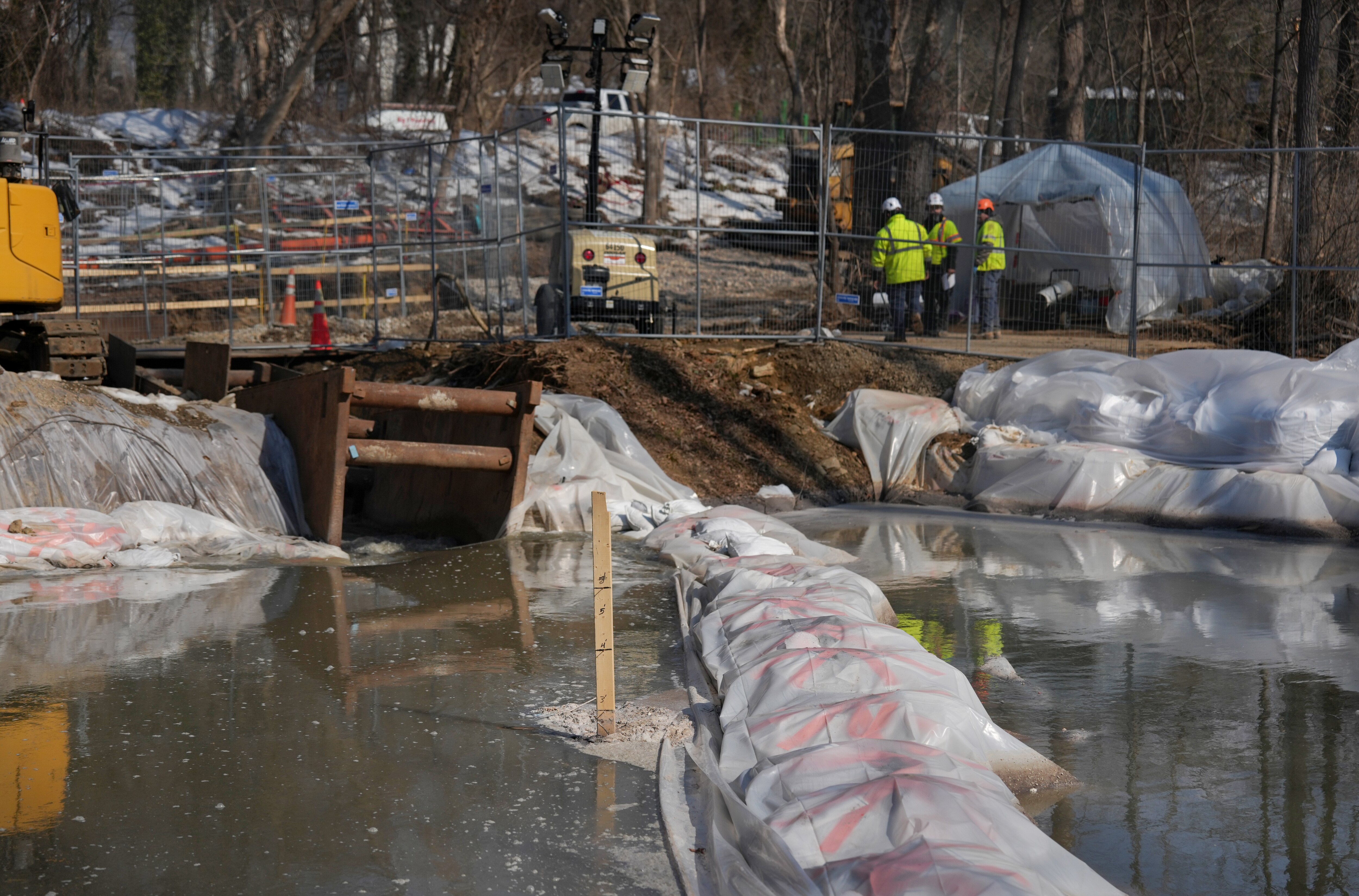
While tensions between the White House and Maryland’s governor’s mansion have grown hotter, DC Water diverted the sewage flow into the parallel Chesapeake and Ohio Canal to bypass the broken section. A trail of used toilet paper laced with dangerous bacteria now plasters the National Park land.
Behind the scenes, state and federal officials have looked for a path forward. Even as Trump’s chief spokesperson dismissed Moore as “incapable” Wednesday, representatives from Maryland, Virginia and D.C. met with administration officials at the White House about the debacle.
Broken pipe and a historic spill
Vulnerabilities in the Potomac Interceptor, which originates near Dulles International Airport in Virginia and runs to the Blue Plains treatment plant near Maryland’s National Harbor, collecting other sewage along the way, didn’t surprise utility officials.
The 72-inch pipe was completed in 1963 to serve a growing suburban population, and DC Water last inspected it in 2021. At the time, engineers determined the section was in “fair” condition, DC Water spokesperson Sherri Lewis said. The utility allocated $625 million to rehabilitate the Potomac Interceptor and expected to start work this summer on the section that is now ruptured.


Utility officials have not explained how this break occurred, but fixing it was delayed after boulders once used to bury the pipeline fell inside of the ruptured section. DC Water expects these emergency repairs could take six weeks and cost $20 million, while rehabilitating that pipe section to run until early next year.
On Thursday afternoon, the stench of sewage wafted along the C&O Canal, a pre-Civil War channel popular with walkers, runners and cyclists. DC Water crews worked around the site, including one team using an excavator to lift a boulder from the broken pipe.
Most of the escaped waste flowed into the Potomac in the days immediately after the pipe eruption. Within five days, DC Water had diverted flows from the interceptor into the canal, though additional sewage has escaped — most recently 600,000 gallons on Super Bowl Sunday.
Dean Naujoks, the Potomac riverkeeper and the river’s watchdog, is grateful for the canal diversion, which he said allowed DC Water to dodge “one of literally the worst environmental disasters ever.”
Still, Naujoks believes the spill may be tens of millions of gallons over DC Water’s 243-million-gallon estimate. The resulting nitrogen pollution, he added, is similar to a year’s worth of effluent from a sewage treatment plant.

While E. coli concentrations have abated downstream, testing by the Potomac Riverkeepers showed high levels of the bacteria at the spill site this week. University of Maryland researchers, meanwhile, found pathogens there that can lead to staph infections in people who have contact with the polluted water.
As Moore has pointed out in recent days, the Maryland Department of the Environment responded quickly, arriving on the scene a day after the rupture, and worked alongside Trump’s Environmental Protection Agency.
Naujoks, though, said he’s had no luck getting through to federal environmental regulators.
“We need EPA to step up and do its job,” he said.
A bitter political fight
DC Water operates its sewage system under an EPA permit, and its board is largely appointed by the D.C. mayor, Muriel Bowser, but that hasn’t stopped Trump from blaming Moore for the spill.
The president said Monday on his Truth Social media platform that he planned to dispatch the Federal Emergency Management Agency, since he could not allow “incompetent Local ‘Leadership’ to turn the River in the Heart of Washington into a Disaster Zone.”
Moore, already at odds with Trump over his canceled invitation to a White House dinner for governors, has fired back since, at one point trolling the president in a post that marked in red the federally owned land along the Potomac.
“The White House wants to get involved even though we were doing their job for the past month,” Moore told CNN Wednesday. “So if the president wants me to ask nicely — here’s my nice ask of the president: Mr. President, please do your job.”


The federal government flagged concerns with the Potomac Interceptor several years ago.
The National Parks Service identified pipe corrosion as early as 2022, according to an inventory of park projects reported by the outlet NOTUS. If unaddressed, a project description states, “deterioration could result in the release of raw sewage to the environment.”
But the Trump administration has maintained that it will help only if called upon by local leaders.
The EPA, meanwhile, declined an invitation to brief Maryland lawmakers on the spill last week.
The EPA, in a response to Del. Linda Foley, a Montgomery County Democrat, said its role has been “limited to specific support activities,” which the agency planned to summarize on a webpage with links to information from MDE and DC Water.
EPA spokeswoman Brigit Hirsch said in an email Thursday that there’s “a complex regulatory framework” surrounding this incident and called Maryland leaders’ assertions about federal jurisdiction “completely false” and confusing to state residents.

State leaders should want to remediate public health hazards quickly, Hirsch said.
“That is clearly not the case here,” she continued, “so the federal government ... is stepping up to fill that void.”
Who will pay?
On Wednesday evening, a month after raw sewage first flowed into the Potomac, Bowser declared a public emergency and requested total reimbursement from the federal government to cover costs that could fall to DC Water ratepayers.
Whether the president intends to offer that assistance isn’t clear. In a Truth Social post Thursday night, he praised Bowser for her request and goaded Moore. On disaster payment, though, he was cryptic.
“If they can’t do the job, all they have to do is call, be polite and respectful, and the Federal Government will handle it, and bill them for services rendered,” he wrote, adding that he intends to do this “from the DC standpoint.”
Spokespeople for the White House and FEMA did not answer questions on Friday.

Moore spokesperson Rhyan Lake said Thursday that the governor had no plans to seek emergency relief himself, since responsibility for repair and cleanup “does not fall to Maryland.”
Evan Isaacson, an attorney with the Chesapeake Legal Alliance, hopes this political tiff results in more federal funding for aging water systems. DC Water’s sewage infrastructure needs are underfunded by $1.9 billion, according to a 2022 EPA report to Congress.
DC Water struggles with overflows of mixed waste and stormwater — over 650 million gallons in a typical year.
“The fact is, this is happening all the time in ways that people don’t understand,” Isaacson said.
With most of this spill contained, Naujoks has turned his attention from crisis response to accountability for the disaster.
The riverkeeper worries about lasting harms for the Potomac’s blue catfish fishery, for communities whose economies depend on the river and for public trust in a beloved waterway — problems he believes DC Water should pay to address.
“To me, they’re a polluter that caused one of the worst problems this river’s ever seen,” he said. “They need to be held accountable.”





Comments
Welcome to The Banner's subscriber-only commenting community. Please review our community guidelines.