
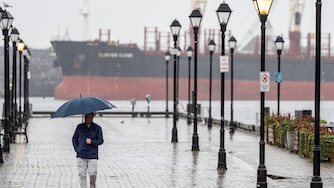
Maryland health experts are urging residents to stay indoors Friday as wildfire smoke from Canada pushes air quality to dangerous levels, warning that even healthy people could experience breathing problems and other effects.
The Maryland Department of the Environment issued Code Purple air quality alerts, one of the agency’s highest warnings, which signals air quality is “very unhealthy” for everyone. Parts of Southern Maryland and the Eastern Shore are under Code Red, which is a level below.
“At-risk populations should stay indoors and keep your windows closed to keep yourself safe,” Maryland Gov. Wes Moore said in a statement Friday on the wildfire smoke. “Please make sure to check in on your family, neighbors and loved ones.”
As of Friday morning, monitoring sites showed Air Quality Index, or AQI, levels over 200 across much of the state, with some areas topping 250. The Air Quality Index converts pollutant levels into a single number. The lower the number, the better. Anything over 200 is considered “very unhealthy.”
The smoke could persist into Saturday, but chances of rain may mitigate the air quality issues, forecasters said. The triple-digit heat ends Friday, but highs in the low 90s combined with smoky skies will continue to pose health risks.
Dr. Panagis Galiatsatos, a pulmonologist at Johns Hopkins Medicine, said the best way to protect yourself is by limiting time spent outside. Officials in cities including New York and Philadelphia are recommending residents wear masks and cancel outdoor events. But Galiatsatos said masks will not protect against the “very refined” particles that have traveled from Canada.
Read More
“When you breathe them in, they will get deep into your lungs and maybe even into your bloodstream,” Galiatsatos said.
The last time Canadian wildfire smoke blanketed Maryland, in the summer of 2023, the University of Maryland Medical System saw a 20% increase in heart- and lung-related medical issues compared with the same period in previous years, according to University of Maryland, Baltimore research. The six-day stretch of poor air quality also cost the health system an estimated $2.4 million.
State officials say this week’s smoke is expected to contain lower concentrations of fine particulate matter than the 2023 event, though it could linger longer because of weather conditions, said Joel Dreessen, a meteorologist with the Maryland Department of the Environment.
People with lung and heart disease are at the highest risk, Galiatsatos said, and the effects of breathing in the small particulate matter can show up days later.
He recommends that all people stay inside during the middle of the day, when the temperatures and sun exposure are high. It is especially important for the most sensitive groups: children, older people, pregnant people and those with underlying conditions such as asthma, chronic obstructive pulmonary disease and other lung conditions.
If you have to get in your car Friday, he said to switch your vehicle’s ventilation so it reuses air within the car instead of pulling it from outside. Also, keep the windows and doors in your home closed.
Galiatsatos said you should seek medical help if you are experiencing chest pains or feeling breathless. If other symptoms persist after the air quality event, call your primary care physician.
To protect your eyes, the American Society of Ophthalmic Trauma recommends wearing wraparound glasses or goggles if you have to go outdoors. If your eyes become dry, itchy or begin to burn, the group said, it is best to flush them with cool water or saline solution and avoid rubbing them.
The heavy wildfire smoke has darkened skies from the Great Lakes to parts of the East Coast, reducing visibility and prompting health warnings. All of Michigan and much of Minnesota were under a hazardous air quality alert. In the Chicago area, air quality ranged from very unhealthy to hazardous.
National Weather Service meteorologist Jake Petr said even if winds from the northwest clear skies as expected later this week, the smoky air could keep returning to some parts of the U.S. until the fires are out. That could take months, until it snows in Canada and northern Minnesota, officials said.
Banner reporter Clara Longo de Freitas and the Associated Press contributed to this report.
This story has been updated.
Correction: This story was updated to correct that research on 2023 wildfire smoke was done by an associate professor with the University of Maryland, Baltimore.



Comments
Welcome to The Banner's subscriber-only commenting community. Please review our community guidelines.