
After flying from Cameroon to Virginia in August, Monique Ngock was exhausted. Soon, she’d complete her final fitness tests and start playing for the Washington Spirit of the National Women’s Soccer League. First, she needed rest.
When she woke up, her phone read 7 a.m. The Spirit’s director of player experience, Katia Rabinowitch, was supposed to arrive at 7:30 to pick her up for the exams. So Ngock rushed to get ready and ran downstairs to meet her.
Only there was one problem: It was pitch black outside. She texted Rabinowitch, asking her whereabouts. Rabinowitch was home. It was 2 a.m. Ngock had looked at the wrong clock.
“She just laughed and told me, ‘Go back to sleep,’” Ngock said. “It was very difficult at first.”
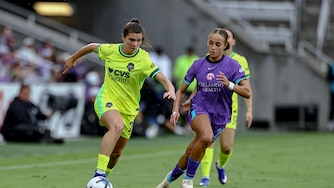
NWSL teams have seven international roster spots to sign players who are not U.S. citizens or green card holders. The Spirit have 14 international players, excluding players on loan, tied for third most in the NWSL, thanks to their ability to work creatively around the league’s system (they traded for an extra spot and have six players on green cards).
For international players like Ngock who earn the opportunity to play in the NWSL, life in the United States can be an adjustment.
Read More
So the Spirit — the No. 3 seed in the NWSL playoffs, set to play Portland on Sunday afternoon — refined their process for scouting international players and ensuring a smooth transition on and off the pitch.
“Everyone feels part of the group,” Italian forward Sofia Cantore said. “We’re really good with each other. We spend a lot of time [together], the long travels that we do. There’s a very good environment and good vibes.”
Looking abroad
Colombian midfielder Leicy Santos signed with the Spirit in 2024. One of the primary reasons: the crowds at NWSL games she watched on TV.
“‘Oh my god, this is crazy,’” Santos remembered thinking. “Women’s soccer here in the United States, they have good support. I think that’s one of the main reasons for why we come.”
Cantore added: “Yeah, they invested a lot in women’s soccer, and now it’s better than the other countries.”
In recent years, the number of international players in the NWSL has grown. James Hocken, the Spirit’s sporting director, points to a few reasons.
Since 2020, the NWSL has expanded from nine teams to 16, creating a higher demand for high-quality players. The domestic player pool, though, isn’t growing at the same rate. Teams have been forced to look elsewhere.
The NWSL also implemented two rule changes in 2024 that have had a direct impact on the number of international players.
The league abolished the draft in 2024, meaning top domestic players have freedom to sign anywhere. That drives up their price.
The number of roster spots available for international players increased from five to seven that year, too. International roster spots are also tradeable assets; teams can trade spots for the current league season plus up to three future seasons.
The Spirit have seven international players taking up seven standard international spots, one filling an international spot acquired by trade and six on green cards.
Under Haley Carter, the Spirit’s president of soccer operations, and Hocken, members of the Spirit’s staff help players from outside the United States receive their green cards, which clears an international roster spot and allows the team to pursue more foreign players.
To acquire that talent, they’ve leaned heavily on data to scout and identify players in markets that are often overlooked. They also take chances on players others might not.
“Some [clubs] want more accomplished national-team-experience players,” Hocken said. “For us, we’re willing to take a little bit more risk on some of the younger players that we think can really develop into it.”
The team uses two companies — Stats Perform and SkillCorner — to gather data on international players. And, for countries where there isn’t data, it often does manual scouting. The Spirit’s 14 international players hail from 12 countries.
Hocken used Cantore, whom the team signed from Juventus FC in 2025, as an example. Cantore was the first Italian to play in the NWSL, which brought a risk. There was an external perception that the Italian league wasn’t as competitive as the NWSL. Cantore said soccer is more physical in the U.S. than in Italy.
“I’m a player who runs a lot. … In Italy, I’m a fast player. Here, I’m not fast,” Cantore said, jokingly. “It’s very different, and this was something that I was like, ‘I don’t know if I will fit in this league or not.’”
But the data on Cantore gave the team confidence that she’d transition well. She has scored 10 goals over two seasons, including six in 2026.
The Spirit have five players from African countries; no other NWSL team has more than three.
Of course, the data can’t tell a team everything. There are risks to mitigate. A player might not acclimate to life in the States or the speed, intensity and physicality of the NWSL game. Not to mention, the diversity of cultures brings language barriers and different playing styles.
But Hocken and his staff feel they have a sense of what leads to success. And they believe the unique playing styles from various cultures create a better on-field product after early growing pains.
“It also provides the opportunity for players to learn from each other, not just from the football side but from a cultural side as well. It’s just a cool place to be,” Hocken said.
A smooth transition
Ngock’s transition was particularly unusual. In August, she helped Cameroon win the Women’s Africa Cup of Nations. The following week, she met with the president of Cameroon and was on talk shows. All the while, she was preparing to leave for the States.
Rabinowitch and player care specialist Riley Poduje didn’t want to overwhelm Ngock, but getting a player to the United States is a complicated dance once the ink dries on the contract.
Fortunately, with experience and connections built over time, the Spirit have made that process smoother.
Rabinowitch typically gets in contact with the player’s agent to talk through the basics, such as how many bags to bring and how to pack for the weather. Before the players come to the United States, the team’s immigration lawyers set up an appointment for their work visas.
For Rabinowitch, the transition is broken into the first and second waves. The first, which typically takes place within a week, starts with getting a player situated into team housing, which is fully furnished.
At the team facility, the most important priorities are an appointment with team doctors to get the player on the field, as well as team meetings. Away from the pitch, players need to get a Social Security number and bank account to get paid.
The second wave includes pressing but less immediate needs: getting an American phone number or a Virginia driver’s license or planning ways to get to Audi Field, the Spirit’s home in Washington.
“At the end of the day, I don’t want to be running around like a chicken with my head cut off, but I don’t want them to ever feel like they’re stressed,” Rabinowitch said.
Aside from the obvious barriers such as language, there’s also culture shock.
Rabinowitch laughed recalling the first time Cantore saw an in-unit washer and dryer stacked one on top of the other in her apartment. In Italy, there’s typically only one machine. Cantore raved about how her apartment has a trash chute a few doors down from her apartment, as opposed to her having to walk outside.
A few weeks ago, Ngock went to a community service event at a local high school and saw a yellow school bus. She’d only seen them on the big screen and said she felt like she was “in a movie.”
Rabinowitch finds the biggest adjustment for most players is food. The team orders specific grains to accommodate players’ palates.
Ngock transferred the same week as Mélissa Bethi of Algeria, giving her an immediate buddy. She’s slowly adjusting to the time change to make time to call family and friends.
On the pitch, there have been adjustments, too. Practices, according to Ngock, have been at a much higher intensity than she’s used to. Even though she knows English, communicating on the field with less time to think has been a challenge.
But Ngock is up for it. She came here for the diversity of the league, the chance to compete at the highest level and to represent Cameroon. She knows her country is full of tough and talented players. She wants to show it.
“The adjustment in the change of environment and all this stuff, that’s the part that is going to be difficult,” Ngock said. “But I trust myself. I know that I will make it.”



Comments
Welcome to The Banner's subscriber-only commenting community. Please review our community guidelines.